

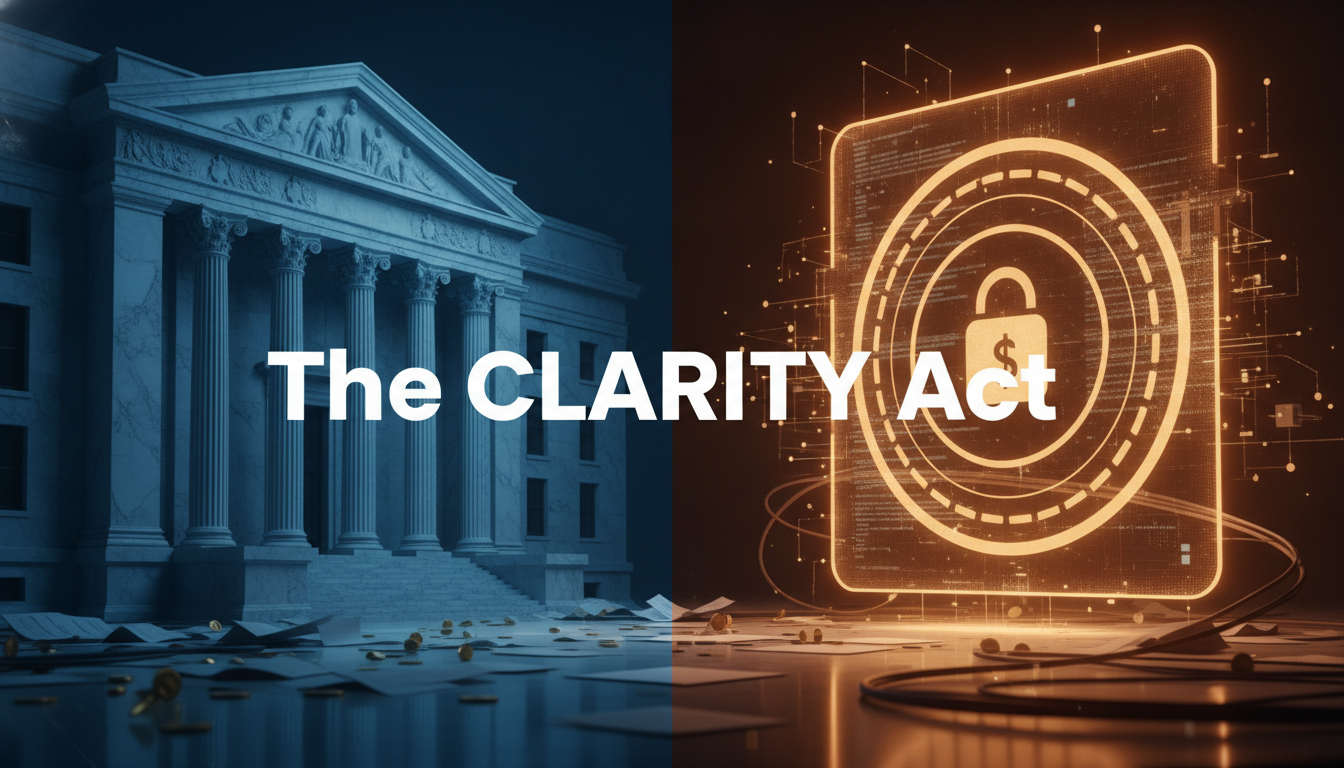
The CLARITY Act has sparked a massive regulatory battle. Small community banks have launched a six-figure ad campaign against it. The fight for crypto regulation has shifted from Wall Street to rural America. This ad buy aims to block the bill. It targets everyday American households in the Midwest.
What Community Banks Really Care About

The Independent Community Bankers of America (ICBA) represents about 4,000 small banks. They are leading this charge. Their primary concern is stablecoin rewards. As passed in the Senate, the bill allows platforms to reward users for transactions, payments, and transfers.
According to banks, these rewards act like interest. Consumers will follow the yield and hold digital dollars on crypto platforms. They will leave traditional savings accounts behind.
The ICBA predicts a stark outcome. They expect a $1.3 trillion drop in bank deposits. This would deprive local businesses of $850 billion in loans.
How the CLARITY Act Could Reshape Main Street Banking
ICBA President Rebeca Romero Rainey spoke bluntly about the stakes. Community banks make over 60% of small business loans. They also make almost 80% of agricultural loans. They are the primary economic drivers in rural counties.
Many community banks are turning to a professional Stablecoin Development Company to understand the technical architecture behind these competing assets. Traditional lenders argue that while blockchain and White Label Blockchain Solutions can enhance efficiency, allowing unregulated platforms to pay interest-like rewards creates an unfair playing field. This shift is closely tied to the rise of decentralization and the Top Advantage Of Web 3 0 technologies, which allow users to bypass traditional intermediaries.
The Frontlines: A Louisiana Banker’s Perspective
Troy Richards serves at Guaranty Bank and Trust in Northeast Louisiana. The bank has $450 million in assets. He has worked with farming communities for more than 40 years.
Richards has already noticed the impact. This year, $40,000 left customer accounts and flowed directly into crypto.
‘It is going to likely be the largest disruptor of community banking that we have ever witnessed,’ Richards warned. He believes this outflow will accelerate if stablecoin rewards are permitted.
The threat is not just financial. Richards notes that crypto issuers do not live in these neighborhoods. They cannot counsel a farmer across a desk. They do not back local little league teams, buy local high school yearbook ads, or pay local taxes.
Adapting to the Yield Revolution
Traditional banks must find ways to compete. As users look for yield, many are exploring options like The Future Of White Label Staking or yield-bearing digital assets. This has forced many banks to study the technology from a Crypto Coin Development Company to prepare for the inevitable shift. Some progressive institutions are even researching Staking Pool Development to retain yield-seeking depositors.
The Crypto Counterargument: Defending Outdated Models?
Crypto advocates offer a different view. They argue banks are protecting outdated business models, not their clients.
Cody Carbone, CEO of the Digital Chamber, spoke bluntly about the campaign. ‘The ICBA’s campaign is not about protecting Main Street,’ Carbone stated. ‘It’s to protect a model that nobody wants anymore.’
The crypto industry also argues that stablecoin reserves remain at banks, so deposits will not disappear.
Community banks remain skeptical. They reply that reserves will flow to Wall Street giants like JP Morgan and Citigroup. A nine-branch lender in rural Louisiana will not benefit.
Technological Disruption of Legacy Finance
The decentralized finance space continues to grow rapidly. Crypto firms emphasize that a modern Defi Development Company can foster financial inclusion, which cannot be matched by old systems. These systems are built by Top Blockchain Development Companies that aim to automate trust. To participate securely, users often seek advice from a Guide To Crypto Wallet Development Company to store their digital assets safely.
The Political Outlook for the CLARITY Act
The ICBA campaign is highly strategic. It is a calculated political move.
To pass the Senate, Republicans need 60 votes. This means at least eight Democrats must cross over.
Democrats remain hesitant. They point to the Trump family’s crypto holdings as a potential conflict of interest.
Now, rural Republicans have another reason for caution. They must consider the lobbying of community banks.
The Senate Banking Committee cleared the bill in May. However, it has not hit the floor yet. The August recess is approaching quickly, aligning with the midterm campaign season. The ICBA is banking on rural voters to influence Washington.
Troy Richards believes the community will make its voice heard. ‘The crypto industry has been fairly successful in communicating their message well,’ he said. ‘It’s our turn now.’
Shifting Regulatory Dynamics
This regulatory tug-of-war highlights the shifting landscape of Blockchain In Finance Tradeweb Leads. It shows how traditional frameworks are being challenged. Some suggest that stablecoins could eventually be regulated like digital dollars under projects similar to Metas Stablecoin Facebook Whatsapp. According to The Guardian’s recent coverage, local banks are ramping up grassroots pressure.
Crypto Market Watch: Hot Trends in 2026
The debate surrounding the bill comes during high market activity. Several notable shifts are happening across the blockchain space.
1. Bitcoin Miners Increase Exchange Inflows
Bitcoin miners recently added 19,560 BTC to Binance. This is the largest miner inflow to the exchange since February. It also marks the fourth-largest overall miner outflow to exchanges.
Last month, two massive whale deposits hit Binance. First, 23,000 BTC arrived in early June. Then, another 19,560 BTC followed this week. This occurred while Bitcoin traded in the low-$60,000s.
CryptoQuant analyst Amr Taha analyzed the trend. He noted that large transfers signal key on-chain activity. This is not business as usual. Almost all inflows went to Binance. Very little flowed to Coinbase or Kraken.
BTC.com was the most active depositor. Yet, it represents only 0.46% of the hashrate. Larger pools like Antpool and F2Pool continue to hold reserves.
This major selling pressure comes right as Bitcoin Reaches Lowest Price Support Since February. However, analyst Wiener concluded that spot pressure is coming from miner flows, not retail panic.
2. Meta Explores Prediction Market Integrations
Mark Zuckerberg has tasked Meta executives with a new goal. They must explore partnerships with Polymarket and Kalshi.
Meta is currently testing its own app called ‘Arena’ internally. The app uses a points system instead of real money. Meta aims to reach 100 million monthly active users aged 18-34. They plan to eventually integrate it into Facebook and Messenger.
In 2026 alone, combined volume on Polymarket and Kalshi reached $130 billion. DraftKings shares fell over 2% on the news. Flutter shares also slid nearly 2%. Both have since recovered.
Meta’s previous financial attempt, the Libra stablecoin, failed under regulatory pressure. Arena remains unreleased, and no rollout date is set.
As social networks explore these token models, some analysts point to guides such as the Ai Token Development Cost Guide to understand the massive costs of managing decentralized protocols.
3. Tokenized Equities Hit Record Volumes
Tokenized stocks just experienced their largest single day in history. Solana handled a staggering 97.8% of the volume.
Spot decentralized exchanges saw $565 million in tokenized equity volume on June 24. Solana settled $553.3 million of that total. BNB Chain settled $7 million, Base settled $5.2 million, and Ethereum handled $94,000.
The surge followed two major catalysts. First was SpaceX’s June 12 initial public offering. Second was a tokenized Micron token that launched just ahead of its earnings report on June 24.
The total tokenized equity market cap sits at $1.49 billion. Ten stocks make up nearly 60% of all assets.
This massive shift towards digital equities shows that an Asset Tokenization Development Company is no longer a concept for the distant future. It mirrors recent market events where big players are offering innovative products; for example, Binance Offers Us Stocks Plans Tokenized Shares to bridge the gap between traditional equity and Web3.