

Intel hasn’t sold stock since the Richard Nixon administration. Allow that incredible milestone to register for a moment. Intel has been a publicly traded company for over 55 years. During that time, it became a cornerstone of modern computing.
The chipmaker navigated the personal computer boom of the 1990s. It survived the wild internet bubble of 2000. It watched the entire rise-and-fall of Silicon Valley. Yet, it never once returned to the equity market for funding.
Why Intel Hasn’t Sold Stock in Over Five Decades
That historic 55-year streak ended on Monday. Intel announced a massive underwritten public offering of $15 billion in new common stock. This represents its first secondary share sale since its 1971 initial public offering. According to Morningstar’s coverage of the announcement, the core driver behind this monumental capital raise is a single word: AI.
To put this into perspective, raising capital at this scale is rare for legacy tech giants. It is reminiscent of other landmark market actions, such as the historic Trump Media Technology Raise 2 5billion that shook public markets. For Intel, this is not a move of desperation. It is a strategic effort to capitalize on a skyrocketing stock price and a booming AI sector.
Dilution Math meets Market Conviction: The Stock Price Tug-of-War
When the news broke, Wall Street’s immediate reaction was predictable. Shares fell over 3% premarket as investors calculated the obvious dilution. With a 3% dilution to existing holders, some immediate downward pressure was expected. However, the stock showed remarkable resilience, grinding back to finish up 1.8% at $101.65.
This rapid recovery illustrates the dual narrative surrounding Intel in 2026. On one hand, there is genuine skepticism about its turnaround. On the other hand, there is massive conviction. The stock has tripled this year alone. Even after a sharp 28% decline in July, it remains up about 170% since January. The fact that Intel hasn’t sold stock since 1971 adds an extra layer of historical significance to this market reaction.
This dynamic demonstrates how rapidly the technology sector is evolving. Entrepreneurs studying How To Build Ai Automation Agency 2025 know that securing robust infrastructure is the foundation of future growth. Intel is betting that public markets will fund that infrastructure.
What is Actually Funding the AI Compute War?
Intel is raising cash because its core data center business is delivering spectacular numbers. Last quarter, Intel’s data center segment posted a year-on-year revenue surge of 59%, reaching $6.3 billion. This division now accounts for a staggering 39% of everything Intel sells. Total company revenue rose by 25%, marking its fastest growth rate in almost 15 years.
CEO Lip-Bu Tan bluntly stated on the earnings call that AI is driving extraordinary demand for compute. This demand benefits Intel even if it does not win the direct accelerator war against Nvidia. Every time a hyperscaler purchases a cluster of GPUs, they also buy hundreds of thousands of high-performance CPUs to feed them. This is where Intel’s general processors shine.
To harness this scale, software creators must adapt. Working with an experienced Ai Development Company In San Francisco or a reliable Ai Development Company In Columbus ensures that software architectures can handle such massive hardware capabilities. This global demand is why localized centers are flourishing. Businesses are consulting with an Ai Development Company In Germany, an Ai Development Company In England, or an Ai Development Company In Montreal to deploy enterprise-grade AI models worldwide.
Where the Billions are Going: Building the 18A Foundry Node
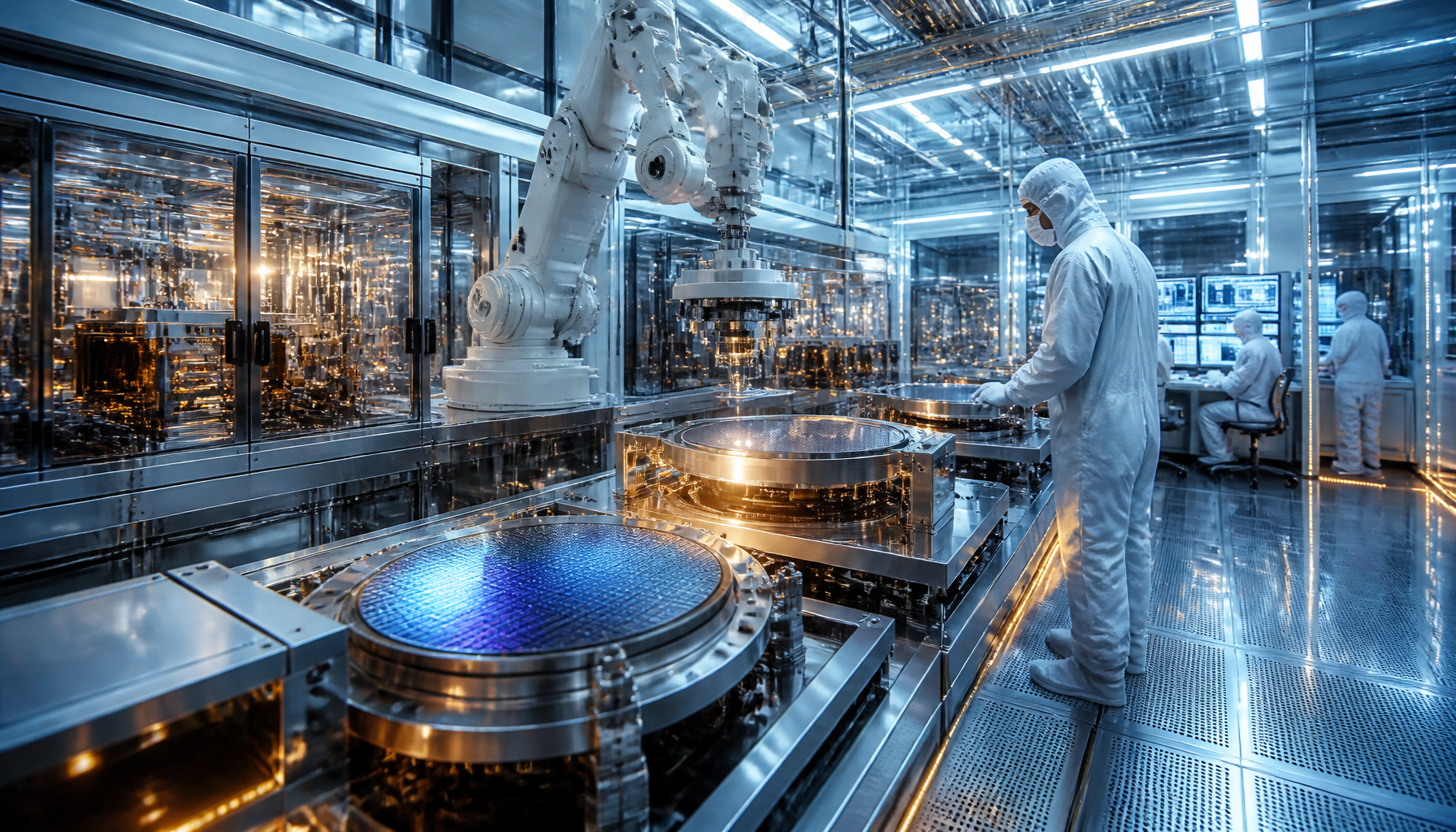
Officially, the proceeds are earmarked for general corporate purposes. Unofficially, this is foundry and fab money. Intel recently bagged a major cloud provider to build on its advanced 18A manufacturing node. The node has reached an impressive 85% yield, up significantly from its starting point of 65%.
To fund these state-of-the-art facilities, Intel needs substantial capital. Elite financial institutions are backing the deal. JPMorgan, Goldman Sachs, Morgan Stanley, and Citigroup are running the books. Underwriters also hold a 30-day option to acquire up to $2.25 billion more in common stock if demand remains hot.
This physical infrastructure is highly capital-intensive. It contrasts sharply with software design. When companies partner with an Ai Development Company In Florida, an Ai Development Company In Texas, or an Ai Development Company In Boardman, they focus on algorithms. However, Intel is building the physical foundation that makes those algorithms run.
The Unsolved Question: Buying Customers, Not Clean Rooms
While $15 billion buys clean rooms and cutting-edge equipment, it does not buy customers. Intel still needs a major external chipmaker to commit massive volumes to its factories instead of relying solely on TSMC. Until that happens, this stock sale remains an expensive vote of confidence in an unproven foundry turnaround. Historically, Intel hasn’t sold stock because its internal cash generation was sufficient, but the AI era has forced a major shift in strategy.
The US government currently owns approximately 10% of Intel due to last year’s historic CHIPS Act agreement. Now, Wall Street is agreeing to take on a larger ownership stake as well. Whether this multi-billion-dollar bet pays off remains an open question. However, Intel’s belief in its own roadmap is clear.
Macro Market Trends: Bitcoin and Stablecoin Evolution
While the semiconductor sector is reorganizing, digital asset markets are undergoing their own major transformations. Institutional traders are taking a larger hand in setting Bitcoin’s price. In the first half of 2026, institutions accounted for a record 72% of Wintermute’s spot OTC Bitcoin trading, up from 59% year-on-year.
This institutional shift alters trading dynamics. Institutions tend to exit positions near local tops rather than holding indefinitely, compressing traditional altcoin waves. BlackRock’s Robert Mitchnick noted an increasing decoupling of Bitcoin from traditional equities. Consequently, Bitcoin’s realized volatility has plunged from 70% to 45%.
This shift matches the rise of Real World Asset Tokenization as a dominant theme in modern finance. To navigate these complex global markets, staying informed is vital. Just as modern learners find tools to Learn Any Language For Free Online, finance professionals must master the shifting mechanics of web3.
Simultaneously, crypto card spending has reached an impressive $759 million per month, a 2.5x increase year-on-year. Stablecoins now dominate this volume, with USDC representing 58% and USDT taking 26%. This is a massive shift from early-2024, when the euro-backed EURe held a dominant 88% share before collapsing to just 2%.
In July alone, nearly 9 million purchases occurred with an average transaction size of $86. Most of this micro-transaction activity has migrated to high-speed networks like Optimism, Solana, and Base. While designers explore the Most Populer Photoshop Alternatives You Must Try It to create beautiful user interfaces, blockchain developers are building high-speed payment systems to support this massive consumer adoption.
Open-Source AI and Global Listings
In other tech news, Meta has released an open-weight AI model named Muse Glimmer. CEO Mark Zuckerberg released an accompanying manifesto, stating that the primary risk of AI is centralization rather than rogue machines. He argued that a single company or government controlling AI technology represents the ultimate danger.
Furthermore, defense technology firm Lyntris has filed for a $528 million US IPO, targeting a valuation of $2.53 billion. Formed from two Trive Capital companies, the Virginia-based military sensor and antenna maker is going public during a highly active period for defense sector listings.
Conclusion: A High-Stakes Gamble on the Future
Intel’s decision to break its 55-year streak and issue new stock is one of the most significant corporate events of 2026. It underscores the immense capital required to compete in the modern AI and semiconductor landscape. While some investors remain cautious about dilution, others see this as the definitive step toward reclaiming hardware supremacy.
Watching this corporate drama unfold is as thrilling as any blockbuster movie for you. The outcome of Intel’s $15 billion wager will shape the tech industry for decades to come.