


How to build AI-powered smart contracts has become one of the most exciting topics in blockchain and artificial intelligence. AI-powered smart contracts merge blockchain’s decentralized security with AI’s data-processing and decision-making capabilities, creating automated systems that can think, evaluate, and execute beyond traditional code-based transactions. This guide will help you understand the entire process—from fundamentals and technologies to practical examples and future trends—so you can confidently start building your own AI-integrated smart contracts.
Understanding AI-Powered Smart Contracts
AI-powered smart contracts combine two powerful technologies: artificial intelligence and blockchain. A traditional smart contract is a self-executing digital agreement with preset rules implemented on a blockchain. Once conditions are met, the contract executes automatically without third-party intervention. By integrating AI, these contracts can analyze inputs, learn patterns, and execute adaptive logic instead of static, predefined conditions. Essentially, AI allows smart contracts to make data-driven decisions dynamically.
Core Concepts Behind AI-Powered Smart Contracts
To build AI-powered smart contracts, developers must understand key underlying technologies. First, blockchain provides immutability and transparency, ensuring that once a contract is written, it cannot be changed without consensus. Second, AI brings reasoning, pattern recognition, and predictive capabilities. The integration often involves machine learning algorithms linked with blockchain oracles that fetch real-world data. Together, they enable contracts to perform intelligent actions, like adjusting payments based on AI-predicted outcomes.
How AI-Powered Smart Contracts Work
These smart contracts operate by embedding AI logic either off-chain or on-chain. Off-chain AI models analyze external data—such as market trends, weather forecasts, or credit risk—then send results back to the smart contract via blockchain oracles. The on-chain component then verifies AI output and executes an action accordingly. Some architectures even use decentralized AI processing to reduce centralization risks. For technical implementations, tools like Chainlink, Fetch.ai, and SingularityNET offer integration frameworks.
Technical Architecture of AI-Powered Smart Contracts
The architecture typically includes the blockchain layer, AI model, oracle system, and user interface. The blockchain handles contract logic and storage. AI models run on separate environments optimized for computation like Python-based ML frameworks. The oracle acts as a communication bridge between blockchain and external data sources. Developers can deploy AI decisions securely by signing model results cryptographically before passing them to the blockchain.
Example Setup and Code Snippet for AI-Powered Smart Contracts
Let’s explore a simplified Ethereum-based implementation of an AI-powered smart contract:
1. Build an AI model in Python to predict, for instance, loan default probabilities.
2. Deploy an oracle to push prediction results to an Ethereum smart contract.
3. The Solidity contract receives a score input and automatically triggers predefined actions like approving or rejecting a loan.
4. Include safeguards for false predictions by integrating feedback mechanisms to retrain models periodically.
Example Solidity Pseudocode:
function processResult(uint riskScore) public {
if(riskScore < 40) approveLoan();
else rejectLoan();
}
Benefits of AI-Powered Smart Contracts
The key advantages include automation, adaptability, and intelligence. Traditional smart contracts follow static if/then conditions, while AI-empowered versions adapt using historical data and predictions. Benefits include real-time decision-making, cost reduction, improved trust, and enhanced functionality in predictive scenarios. Businesses can use adaptive contracts for insurance payouts or yield-optimizing DeFi strategies automatically adjusted using AI forecasts.
Challenges and Limitations of AI-Powered Smart Contracts
Despite significant benefits, there are challenges. AI models can introduce opacity because neural networks function as “black boxes.” Verifying an AI decision on a transparent blockchain environment is complex. Moreover, computing heavy AI operations directly on-chain is expensive. Security is another concern since inaccurate AI outputs could trigger incorrect results. Regulatory compliance and data privacy rules require additional consideration when integrating AI with blockchain.
Real-World Use Cases of AI-Powered Smart Contracts
Many industries are already experimenting with AI-integrated smart contracts:
- DeFi: AI algorithms automatically rebalance portfolios and adjust interest rates on decentralised lending platforms.
- Insurance: AI assesses claims through image and damage recognition, and smart contracts release payments instantly.
- Supply Chain: Predictive AI ensures timely delivery and smart contracts trigger supplier payments after quality verification.
- Gaming: AI assesses player behavior and uses contracts to distribute rewards fairly.
- Healthcare: AI evaluation of patient data triggers smart contracts for data exchange and billing securely.
Comparing AI-Powered Smart Contracts with Traditional Smart Contracts
| Feature | Traditional Smart Contracts | AI-Powered Smart Contracts |
|---|---|---|
| Logic Type | Static | Dynamic, learning-based |
| Data Source | On-chain | On-chain and off-chain |
| Execution | Rule-based | Prediction-based |
| Adaptability | Limited | High |
Latest Trends in AI-Powered Smart Contracts
Major trends include application in decentralized autonomous organizations (DAOs), AI-enhanced DeFi, and NFTs that evolve with user behavior. AI oracles, privacy-preserving learning, and federated AI training on blockchain nodes are also rising. Additionally, layer-2 scaling solutions and modular blockchain architectures are making on-chain AI more efficient. Analysts predict that AI-enabled smart contracts will play a central role in Web3 economies.
Building Steps for AI-Powered Smart Contracts
Developing these contracts involves a systematic journey:
- Step 1: Define the contract’s objective.
- Step 2: Prepare AI datasets and train the ML model.
- Step 3: Choose blockchain architecture such as Ethereum, Hyperledger Fabric, or Binance Smart Chain.
- Step 4: Integrate an oracle service.
- Step 5: Test and validate model accuracy.
- Step 6: Deploy and continuously optimize performance.
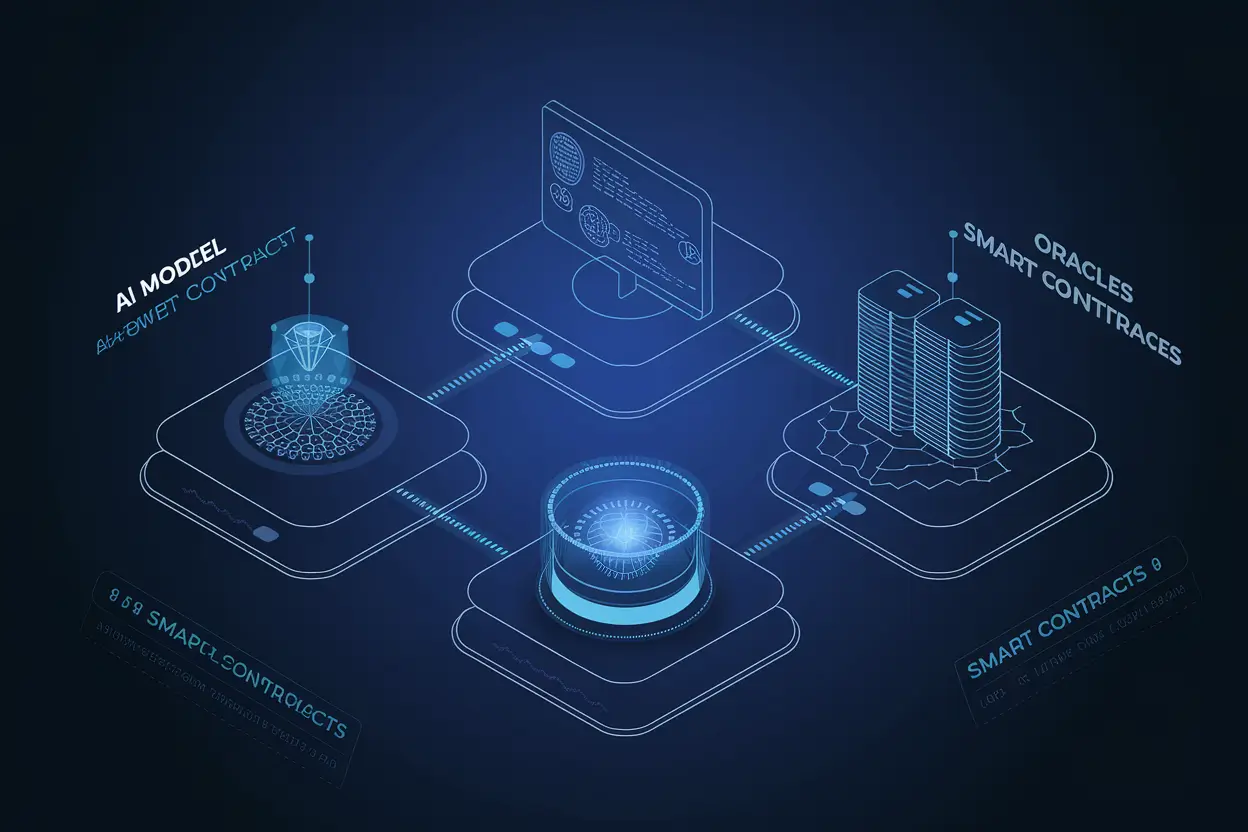
For illustration, imagine a graphical diagram showing workflow from AI model output feeding into an oracle, interacting with blockchain smart contract execution, and completing the automation loop that triggers an event such as a financial transaction or supply chain payment verification.
Security and Compliance in AI-Powered Smart Contracts
Security measures are crucial. Developers must validate oracles, ensure robust cryptographic authentication, protect model integrity, and mitigate bias in AI training data. Using testnets prevents expensive mainnet failures. Data compliance laws such as GDPR need attention, focusing on how AI uses user data for decision making. Transparent reporting of AI model performance builds confidence among users.
Technical Tools and Frameworks to Build AI-Powered Smart Contracts
Tools such as Ethereum, Solidity, Chainlink, TensorFlow, and IPFS form the primary toolkit. Developers can store model weights on IPFS for decentralized access while executing AI inference results via Chainlink oracles. Platforms like Fetch.ai, Ocean Protocol, and SingularityNET simplify decentralized AI processes. Programming languages such as Python and Solidity are typically paired with web3.js for blockchain interaction.
Best Practices for Deploying AI-Powered Smart Contracts
Follow standard deployment practices: extensive audits, modular architecture, off-chain AI computation, ethical AI usage, transparent AI reports, and active monitoring. Continuous learning loops allow contracts to evolve. Define clear fallback logic in case AI data becomes unavailable. Version control ensures traceability of contract updates.
Common Mistakes and How to Avoid Them
Common pitfalls include overreliance on AI without sufficient verification, exposing oracle vulnerabilities, and neglecting contract optimization. To avoid these, always test with simulated datasets and build redundant oracle networks. Another issue is excessive gas consumption due to bloated logic. Separate complex AI from on-chain execution to minimize costs.
Future Outlook of AI-Powered Smart Contracts
The future for AI-powered smart contracts looks promising. As AI models become smaller and more efficient, direct on-chain inference may soon become reality. Web3 will evolve into data-driven ecosystems where intelligent contracts handle negotiation and decision-making autonomously. Cross-chain interoperability will allow AI models trained on one network to interact seamlessly across ecosystems, creating a true cognitive layer for the decentralized internet.
Use Case: AI-Powered Insurance Smart Contract Example
Imagine an AI-driven agricultural insurance policy. Satellite AI systems predict drought conditions, and when the model detects high probability, it reports this prediction through an oracle. The smart contract then automatically releases partial payments to farmers before the drought occurs, increasing liquidity and preventing financial hardship. This predictive automation demonstrates the practicality of AI integrations in real-world environments.
Key Differences Between AI-Powered Smart Contracts and Automated Scripts
Automated scripts perform predefined repetitive actions without understanding context. AI-powered smart contracts, however, analyze data patterns and adjust outcomes accordingly. While both automate processes, AI-powered contracts represent a paradigm shift from automation to autonomous cognition. This distinction will become more evident as decentralized machine learning grows more mature.
Performance Optimization for AI-Powered Smart Contracts
Optimizing performance involves using lightweight AI models, off-chain computation, and data caching to minimize gas fees. Compressing AI outputs before blockchain transmission reduces load. Some innovations even use zk-SNARKs or zero-knowledge proofs to verify AI results privately without revealing data, maintaining both security and efficiency.
Investment and Business Opportunities in AI-Powered Smart Contracts
Enterprises and developers can capitalize on AI-powered smart contracts in sectors like finance, healthcare, logistics, and gaming. Startups are exploring decentralized AI data marketplaces where smart contracts automate model licensing and profit-sharing. Enterprises looking for data-driven automation can invest early to secure competitive advantage in Web3 innovation cycles.
Frequently Asked Questions About AI-Powered Smart Contracts
What are AI-powered smart contracts?
They are blockchain-based contracts enhanced by artificial intelligence to make adaptive, data-driven decisions.
Do AI-powered smart contracts require coding knowledge?
Yes. Basic blockchain coding with Solidity and AI development using Python or similar languages is essential.
Can I run AI on the blockchain directly?
Full AI computation on-chain is expensive; most systems run it off-chain and send results to smart contracts.
What industries benefit most from AI-powered smart contracts?
Finance, insurance, healthcare, and supply chain industries benefit due to automation and predictive analytics capabilities.
Are AI-powered smart contracts secure?
Yes, if built responsibly with verified oracles, transparent AI models, and robust auditing. However, model biases and oracle attacks can be risks.
Conclusion on AI-Powered Smart Contracts
In conclusion, how to build AI-powered smart contracts involves uniting blockchain’s decentralized trust with AI’s cognitive power to create adaptable, automated agreements. As the Web3 landscape evolves, these intelligent contracts will shift from simple conditional automation to fully autonomous economic decision-makers. Businesses that invest in learning and adopting this hybrid technology today will lead in the intelligent blockchain era of tomorrow.