

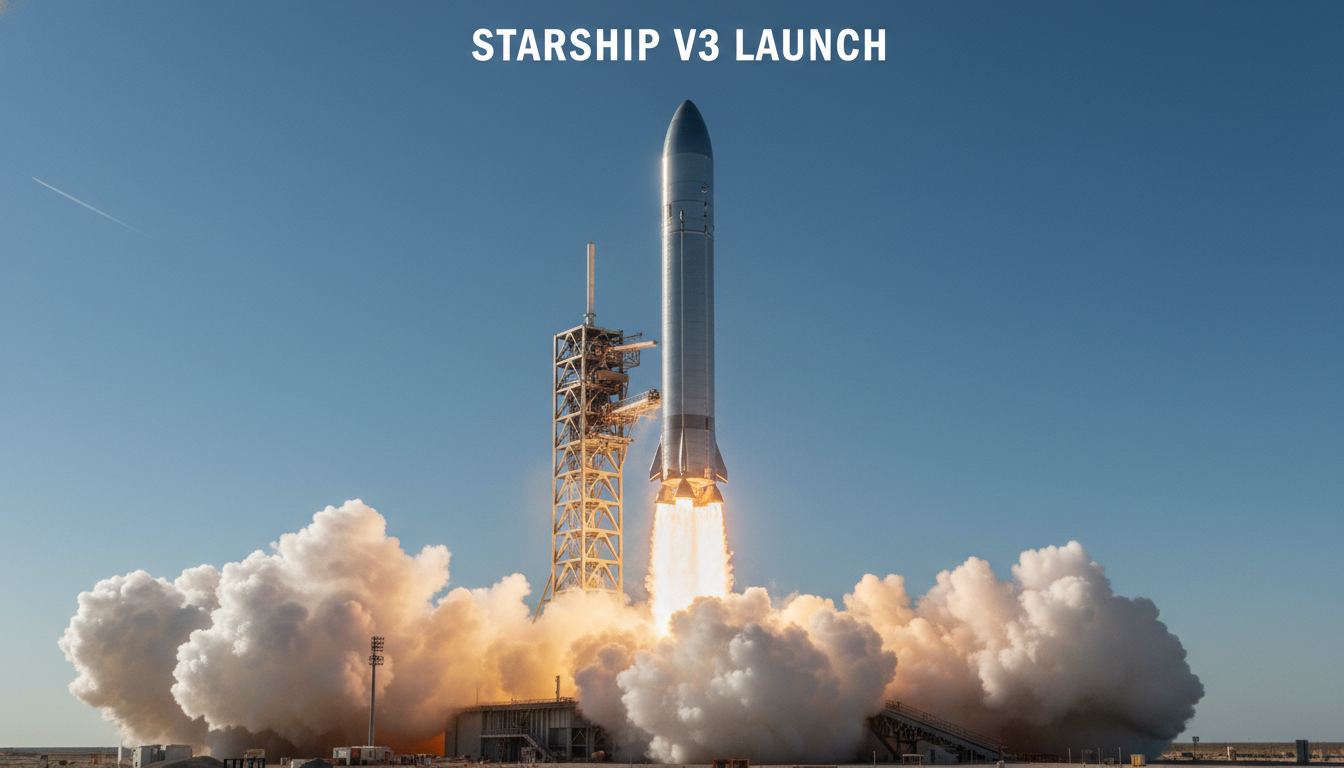
The historic SpaceX Starship V3 launch marked a monumental milestone in aerospace history on Friday, May 22, 2026. This spectacular test flight sent the company’s largest and most powerful rocket yet soaring into space. It blasted off from Starbase in southern Texas, carrying 20 mock Starlink satellites. The launch occurred just two days after CEO Elon Musk announced plans to take the company public. This was the 12th test flight of the massive rocket. Ultimately, Musk wants to use this vehicle to ferry humans to Mars.
Why was the SpaceX Starship V3 launch such a massive deal? NASA is counting on this upgraded mega-rocket to land astronauts on the moon. The space agency is investing billions of dollars to secure dependable lunar landers for the Artemis program. With private industry racing toward the cosmos, this test represents a giant leap forward.
Analyzing the Milestones of the SpaceX Starship V3 Launch
The previous generation of space-skimming Starships flew in October. For Flight 12, SpaceX debuted its third-generation spacecraft, known as Version 3 (V3). The behemoth soared from a brand-new, state-of-the-art launch pad at Starbase. Last-minute ground pad issues had thwarted a launch attempt on Thursday evening. However, engineers quickly solved the issues to clear the vehicle for Friday’s flight.
This latest model is larger than older Starship lines by several feet, standing 407 feet tall. The extra height allows it to pack significantly more fuel and engine thrust. The success of the SpaceX Starship V3 launch lies in its structural upgrades. The booster sports fewer but larger and stronger grid fins. These fins steer the giant booster back to Earth following liftoff. Additionally, it features a more robust fuel transfer line to feed the 33 main engines. This fuel line is incredibly massive, matching the size of a Falcon 9 booster.
This retro-looking stainless steel spacecraft also includes more camera coverage, upgraded computers, and stronger navigation units. It even features docking cones for future rendezvous in space and moon landings. Despite the upgrades, this specific trial run did not focus on recovering hardware. Instead, the Gulf of Mexico marked the final destination for the booster, while the Indian Ocean served as the target for the spacecraft.
Launch and Ascent: Testing the Raptor 3 Engines
During the SpaceX Starship V3 launch, the booster ignited its 33 upgraded Raptor 3 engines. The rocket generated a staggering 18 million pounds of thrust as it cleared the tower. One of the booster engines shut down quickly during ascent. However, the vehicle utilized its built-in engine-out capability to continue safely. This design redundancy is crucial for crewed missions in the future.
The hot-staging maneuver occurred successfully high above the Texas coastline. The Starship upper stage ignited its engines to continue its journey to space. The Super Heavy booster then performed a flip maneuver to begin its boostback burn. Unfortunately, not all planned engines reignited correctly. The booster came in too hot and broke apart over the Gulf of Mexico. It was not attempting a tower catch on this flight, but the landing failure provided valuable telemetry.
Meanwhile, the Starship spacecraft, designated Ship 39, continued climbing. It lost one of its vacuum engines during ascent, yet again demonstrating resilient engine-out capability. According to the official SpaceX Flight 12 update, the ship successfully reached its target suborbital trajectory.
In-Space Milestones and Re-entry
A critical phase of the SpaceX Starship V3 launch was the payload deployment. While coasting in space, Starship successfully released 20 mock Starlink satellites. It also deployed two modified operational satellites. These operational satellites carried cameras pointed back at the ship. They scanned the heat shield and sent real-time images down to flight operators.
Starship then began its atmospheric re-entry over the Indian Ocean. The ship endured extreme temperatures that tested its thermal protection systems. The upgraded V3 heat shield performed exceptionally well during descent. The ship used its four flaps to guide itself toward the target zone.
In the final minutes of flight, the spacecraft performed a landing flip. It fired its landing engines to execute a pinpoint soft landing in the Indian Ocean. Upon touching the water, the spacecraft tipped over and erupted in a spectacular fireball. This ending was expected, and Elon Musk described the flight as “epic”.
How Modern Software Engineering Mirrors Aerospace Scaling

While the SpaceX Starship V3 launch represents the pinnacle of space hardware, it also inspires software innovation. Developing advanced space systems requires incredible precision. In many ways, building robust rockets parallels how developers scale complex software platforms. For instance, just as a top Mobile App Development Company works to optimize mobile experiences, SpaceX writes custom algorithms for real-time telemetry. Integrating features like Ai In Mobile Apps can vastly improve user experience on Earth, much like automated systems guide a spacecraft during descent.
To keep launchpads running, engineers use Custom Workflow Automation to direct launch protocols. Just as safety systems protect a rocket, modern enterprises apply Model Governance Safety Layers to control digital operations. Furthermore, the integration of Predictive Maintenance Alerts allows engineers to identify hardware issues before liftoff.
On the business side, SpaceX’s impending public listing reflects the growing tech economy. Developers building decentralized applications often contact a Bep20 Token Development Company or a Smart Contract Development Company to create secure ecosystems. For advanced algorithms, a reputable Generative Ai Consulting Company or a specialist in Deep Learning Consulting can offer crucial guidance. Additionally, knowing How To Build A Decentralized Application is vital for developers wanting to innovate.
Managing the supply chains for rocket parts is equally complex. It requires robust systems like Ai In Supply Chain Management to streamline deliveries. Complex logistics depend on Ai Powered Decision Flows to keep materials moving. Finally, after a long shift of monitoring rocket flights, team members might stream all movies about space exploration while incorporating 10 Foods Into Your Diet For Good Heart Health to manage stressful deadlines.
The Road to the Moon and Mars
In conclusion, the SpaceX Starship V3 launch has brought humanity closer to sustainable interplanetary travel. NASA is paying SpaceX billions to develop a lunar lander variant of Starship. This vehicle is central to the Artemis program, which aims to return humans to the lunar surface. At the same time, Jeff Bezos’ Blue Origin is scrambling to develop its own competitive lander. This intense space race is driving unprecedented innovation in both public and private sectors. As V3 tests continue, the dream of establishing a human presence on the moon and Mars is rapidly becoming a reality.