

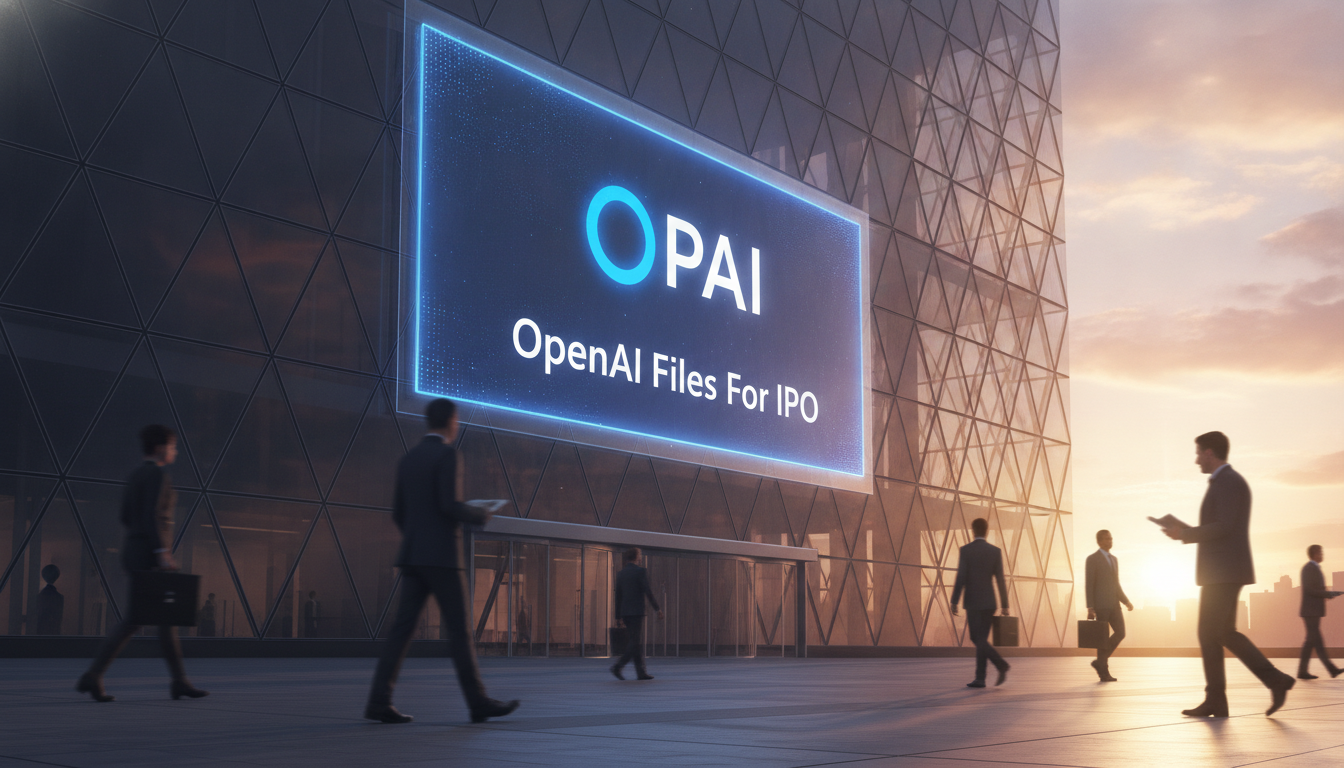
The tech landscape is shifting rapidly as OpenAI files for IPO with the U.S. Securities and Exchange Commission (SEC). This landmark confidential S-1 submission arrived on Monday. It comes just one week after its chief rival, Anthropic, made a similar move. The race to dominate public markets is officially underway.
OpenAI announced its filing in a direct, transparent blog post. The company explained that it expects leaks anyway. Therefore, it decided to share the news early. However, the exact timing of this initial public offering remains highly flexible.
Meanwhile, CEO Sam Altman published a bold, co-authored vision. He outlined how artificial general intelligence (AGI) should benefit everyone. This dual announcement highlights a fascinating tension. OpenAI must balance profit-seeking goals against public safety.
Decoding the S-1: What Happens When OpenAI Files for IPO?
A confidential S-1 filing allows a company to start the registration process quietly. The SEC reviews the draft documents privately. This lets OpenAI fix regulatory issues before showing its financial secrets to the public.
When OpenAI files for IPO, it triggers immense market excitement. Underwriters like Goldman Sachs and Morgan Stanley are already guiding the startup. The eventual public filing will reveal actual revenues, losses, and margin structures for the very first time.
Historically, private tech valuations are based on speculative potential. For instance, OpenAI was valued at $852 billion in its last funding round. Once the public prospectus drops, retail investors can finally evaluate its true financial health.
To prepare for this major transition, many corporations are auditing their digital stacks. They are turning to advanced tools like ai for legal compliance automation. These systems help manage complex financial and regulatory requirements safely.
According to CBS News, going public will let OpenAI inject massive capital into its infrastructure. This is critical as the cost of training frontier models continues to skyrocket.
The Trillion-Dollar Race: OpenAI vs. Anthropic
The timing of these filings is no coincidence. Anthropic filed its own confidential IPO paperwork just one week earlier. Anthropic’s last private round valued the creator of Claude at a massive $965 billion.
Both companies are targeting valuations close to or exceeding one trillion dollars. This historic clash will define the market value of frontier artificial intelligence. It represents the ultimate test of investor enthusiasm for generative software.
This rapid shift is forcing global business leaders to rethink their technical infrastructure. Many ask how do blockchain and ai work together to secure modern financial data. Combining these technologies can help protect proprietary models from unauthorized leaks.
Furthermore, local development centers are expanding. Organizations frequently hire an ai development company in umm al quwain to build decentralized tools. These local experts specialize in integrating secure databases with conversational intelligence.
Meanwhile, international trends show that this boom is not limited to Silicon Valley. For example, the ernie bot ai innovation revolution in China proved that global competition is fierce. Both OpenAI and Anthropic must scale quickly to maintain their technological advantages.
Why OpenAI Files for IPO: Private Tradeoffs and Massive Costs
Despite submitting the S-1, OpenAI is not rushing to the stock exchange. The company stated that it might wait quite a while. They admitted that “there are things we want to do that are likely easier as a private company.”
Why would a company delay its listing? Remaining private allows a startup to take extreme risks without public shareholder backlash. For instance, massive capital expenditures on chips and energy are easier to hide from quarterly earnings reports.
To reduce these astronomical costs, OpenAI needs smarter hosting models. Setting up a scalable model as a service maas setup can help deliver API services efficiently. This reduces the friction of hosting massive neural networks on-premise.
At the same time, companies must focus on continuous model training and optimization. Fine-tuning models ensures that expensive GPU resources are never wasted. Efficiency is now a critical metric for public-market survival.
As OpenAI files for IPO, financial analysts are closely watching its cost structure. Using specialized ai for finance and forecasting tools will help investors model these future expenditures. The race to profitability requires extreme computational efficiency.
Sam Altman’s Phase Three Plan: AI for Everyone
Alongside the IPO news, Sam Altman and Chief Scientist Jakub Pachocki shared their strategic blueprint. They announced that OpenAI is entering its third developmental phase. This chapter focuses on abundance, accessibility, and safety.
The first phase of the startup was dedicated to fundamental research. The second phase, which started with ChatGPT in 2022, was about real-world user adoption. Now, the third phase aims to scale these solutions globally.
The co-authored plan outlines three primary milestones. First, OpenAI wants its systems to assist in building the next generation of models by 2028. This means creating an automated AI researcher.
Second, the company aims to accelerate scientific progress and economic growth. The goal is to turn frontier capabilities into affordable tools. These tools must be easy enough for every person and organization to use.
Third, they plan to give everyone on Earth a personal AGI. This empowers individuals to use the technology however they choose. However, powerful systems must remain safe and subject to human control.
To support this vision, companies are adopting custom ai assistant development services. These assistants can automate customer relations and complex backend operations. It represents a shift from raw research to practical utility.
Additionally, modern developers are embedding ai in mobile apps to make these models accessible to everyone. This widespread integration ensures that advanced reasoning is always just a tap away.
Scaling Enterprise Solutions Safely

As OpenAI transitions, the demand for enterprise-grade integration is skyrocketing. Companies can no longer rely on simple web interfaces. They require robust, custom setups to stay competitive.
Many businesses now turn to a generative ai consulting company to map out their technical roadmaps. These consultants help design secure data pipelines. They ensure that internal company secrets never leak to public APIs.
Once the strategy is clear, deploying generative ai integration services becomes the next step. This process connects legacy databases with state-of-the-art reasoning engines. It turns complex databases into active business assets.
If your business is located in the UK, finding local support is easy. You can work directly with an ai development company in manchester to build custom internal tools. Local expertise ensures that regional data protection rules are strictly followed.
These tailored systems often include specific capabilities like text to speech ai solutions. This tech helps brands communicate with customers in a more natural, human-like voice. It bridges the gap between digital interfaces and human emotion.
Securing your digital environment is critical during this period of high growth. Understanding 10 tips keep your android device secure on personal hardware is essential for overall safety.
Formulating a Sustainable AI Strategy
When OpenAI files for IPO, it reminds every business leader of the speed of technical evolution. To survive, you must establish a clear roadmap. Relying on default models is no longer enough.
As OpenAI files for IPO, the industry awaits a massive shakeup. The exact moment OpenAI files for IPO will go down in history. These repeated indicators show that commercialization is the new priority.
A comprehensive ai consulting strategy is essential for long-term survival. This strategy helps you decide whether to build proprietary models or rent open-source options. It balances initial capital costs against ongoing operational fees.
By automating workflows, you can cut overhead significantly. Leveraging tailored ai automation services allows teams to focus on high-value creative tasks. This transition is exactly what Sam Altman’s vision describes.
Ultimately, the news that OpenAI files for IPO is more than a financial event. It is a sign that artificial intelligence has matured. It is moving from a novel laboratory experiment to the very foundation of the global economy.