

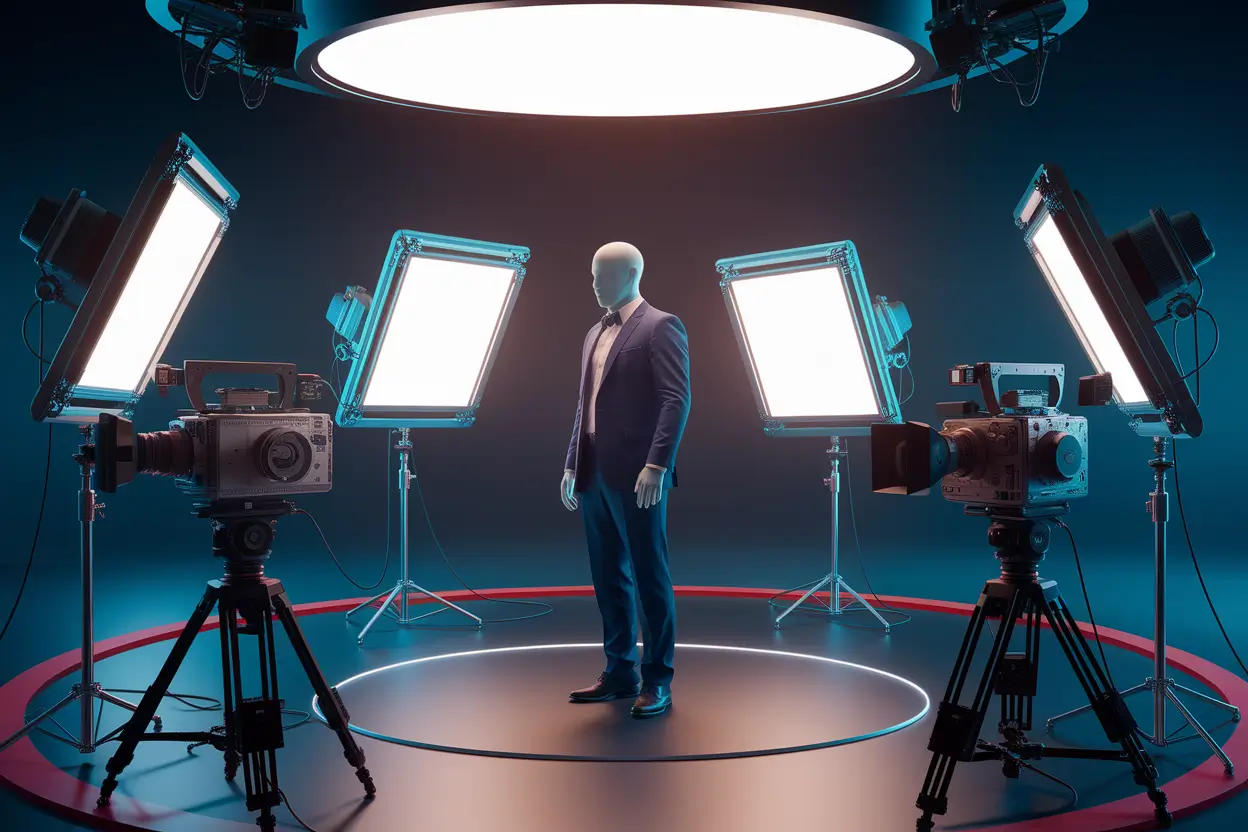
How AI is Creating Digital Actors in Movies is becoming one of the most revolutionary topics in modern filmmaking. Artificial intelligence (AI) is transforming how movies are made, from visual effects to screenplay generation. But one of its most impressive achievements is the rise of digital actors — realistic, artificial performers created and controlled by machine learning algorithms. These AI-based digital humans can act, speak, and even evoke emotions like real people, offering filmmakers new frontiers in creativity and production efficiency.
As the entertainment industry evolves, digital actors powered by AI are reshaping the way films are produced and consumed. They combine deep learning, computer vision, motion capture, and generative modeling to create lifelike performances that can mimic or even resurrect real actors. This transformation raises fascinating technical, ethical, and artistic questions about the future of acting and storytelling.
What Are Digital Actors in Movies and How AI Enables Them
Digital actors are virtual human characters generated by artificial intelligence and advanced 3D modeling techniques. Unlike traditional CGI characters that depend heavily on manual animation, AI-driven digital actors can autonomously learn from human motion data and behavioral patterns. They are capable of performing complex emotions, gestures, and linguistic nuances derived from training data. AI models like Generative Adversarial Networks (GANs), diffusion models, and neural rendering play vital roles in creating these hyper-realistic visuals.
Core Technologies Behind How AI is Creating Digital Actors in Movies
The foundation of AI-created digital actors lies in machine learning and deep neural networks. Key components include:
- GANs (Generative Adversarial Networks) – Used for creating hyper-realistic faces, textures, and movements by training a generator and discriminator in competition.
- Neural Radiance Fields (NeRFs) – Produces high-fidelity 3D representations of faces and bodies from 2D images.
- Motion Capture and Pose Estimation – AI refines human motion data and can generate movement autonomously from training datasets.
- Speech Synthesis and Lip Syncing – Deep learning models create realistic synced dialogues using text-to-speech and audio-to-lip animation systems.
- Emotion Recognition Systems – AI interprets emotional context to make an actor’s expressions and delivery authentic.
How AI is Creating Digital Actors in Movies Step by Step
Creating a digital actor involves several critical stages:
- Data Collection: Gathering high-quality video and motion data of target human subjects.
- Model Training: Training AI models using this data for facial expression, movement, and voice imitation.
- Rendering and Animation: Using deep learning and rendering engines to combine visual and motion data.
- Emotion and Context Integration: Teaching the model to express emotions appropriate to the scene.
- On-screen Integration: Embedding the AI-generated actor into movie scenes seamlessly with correct lighting and shadowing.
Real-World Examples of How AI is Creating Digital Actors in Movies
Several blockbuster films have implemented digital humans successfully. In “Rogue One: A Star Wars Story,” the late Peter Cushing was re-created digitally using AI and CGI. Similar techniques were applied to recreate a younger version of actor Carrie Fisher for Princess Leia. In another milestone, the film “The Irishman” used AI to de-age Robert De Niro and Al Pacino. Moreover, deepfake technologies have allowed independent creators to produce short films featuring digital replicas of well-known celebrities.
Comparing Traditional CGI with How AI is Creating Digital Actors in Movies
| Aspect | Traditional CGI | AI-Driven Digital Actors |
|---|---|---|
| Creation Time | Long and labor-intensive | Faster generation through training |
| Realism | Highly detailed but limited in motion realism | Adaptive realism through machine learning |
| Cost | High production costs | Reduced cost after initial training |
| Flexibility | Requires manual revision | Dynamic adjustments possible |
Advantages of How AI is Creating Digital Actors in Movies
- Scalability – Once trained, digital actors can perform in multiple films without reshoots.
- Safety and Flexibility – Dangerous stunts can be handled by AI models rather than real actors.
- Cost Efficiency – Reduces the need for live shooting and location-based expenses.
- Character Longevity – Deceased actors can continue appearing in films ethically managed by estates.
- Creative Freedom – Directors can visualize characters beyond physical human limitations.
Challenges and Drawbacks of How AI is Creating Digital Actors in Movies
While technology offers revolutionary benefits, it comes with complex challenges. Ethical dilemmas about consent, digital identity, and copyright must be addressed. Additionally, model bias can lead to inaccurate cultural or emotional representations. Another issue is the uncanny valley – where near-human likenesses appear unsettling to audiences. Moreover, questions arise about replacing human actors and the potential loss of originality and improvisational value.
Ethical and Legal Considerations in How AI is Creating Digital Actors in Movies
Digital replication of actors raises intellectual property questions. Actors must provide explicit consent for their digital likeness use. Entertainment bodies are now drafting new contracts specifying digital rights. Filmmakers must also ensure AI models do not misuse celebrity images without licenses. Data privacy laws, deepfake regulations, and ethical filmmaking codes will play crucial roles in defining future practices.
Use Cases of How AI is Creating Digital Actors in Movies
- Recreating historical figures for biopics without distortions.
- Rejuvenating actors for flashback scenes.
- Fully generating AI celebrities for futuristic or animated films.
- Enhancing production speed for visual storytelling.
- AI stunt doubles that replicate dangerous movements precisely.
Technical Suggestions for Implementing How AI is Creating Digital Actors in Movies
Successful AI-driven digital actor creation requires a combination of high-end tools and algorithms. Developers should integrate open-source frameworks like TensorFlow and PyTorch for training generative models. For photorealistic rendering, engines such as Unreal Engine and Unity’s Metahuman Creator are essential. AI motion data can be captured using markerless motion capture systems like RADiCAL. Voice cloning and emotion analysis rely on Transformer-based models and speech synthesis APIs.
Example Code Snippet
Here’s a basic conceptual setup showing integration of a neural rendering model using Python libraries:
Example:
Import necessary modules, load pre-trained GAN model, and apply generated output for rendering faces in a film scene. While this is an abstract level description, the implementation follows the principles of deep learning pipelines for generative art and motion synthesis.
Trends in How AI is Creating Digital Actors in Movies
Current trends show rapid acceleration of AI production pipelines. Major studios are introducing AI casting and voice-assisted post-production tools. The concept of the “virtual production studio” allows directors to shoot films entirely with digital actors inside simulated environments. AI is also merging with AR and VR, letting audiences interact with virtual characters in immersive storytelling formats. AI synthetic media startups are being funded to produce lifelike virtual influencers alongside mainstream performers.
How AI is Creating Digital Actors in Movies Impacts Filmmakers and Actors
Filmmakers benefit from reduced production burdens and expanded creative control. Actors, however, face both opportunities and threats. They can extend their brand digitally, but there’s potential competition from virtual performers. Some actors are licensing their likenesses for AI replication, ensuring income from their digital personas even after retirement.
Case Study: AI Resurrection in Film Production
In 2019, an independent studio recreated actor James Dean digitally for a new film project. The move sparked both interest and criticism worldwide. Using AI motion synthesis and face mapping, they built a performance entirely driven by AI trained on historical footage. This marked a turning point in understanding the tradeoff between creative innovation and ethical filmmaking boundaries.
Future Outlook of How AI is Creating Digital Actors in Movies
The next decade will see digital humans integrated beyond cinema into advertising, education, and gaming. As rendering and deep learning systems evolve, digital actors will achieve parity with real performers in emotional depth and realism. AI models may soon use reinforcement learning to improvise live reactions, making purely digital performances indistinguishable from human acting. However, ongoing debates on regulation, human value preservation, and creative authenticity will continue to shape this emerging field.
Common Mistakes and Solutions in How AI is Creating Digital Actors in Movies
- Mistake: Relying purely on visual accuracy without emotional realism. Solution: Train models using emotional context datasets.
- Mistake: Poor data quality. Solution: Use high-resolution, diverse, and ethically-sourced data.
- Mistake: Ignoring legal consent issues. Solution: Implement contractual clauses for digital likeness rights.
FAQs About How AI is Creating Digital Actors in Movies
What software is used in creating AI digital actors?
Studios use AI-enhanced tools like Unreal Engine Metahumans, DeepFaceLab, and DeepMotion integrated with Python AI frameworks such as TensorFlow or PyTorch.
Can AI completely replace human actors?
Although AI can replicate appearance and voice, it still lacks spontaneous creativity and empathy, which remain uniquely human strengths.
What are the ethical challenges in this field?
Ethical issues include ownership rights, posthumous use of likeness, and audience deception concerns raised by AI-generated impersonations.
Will digital actors make production cheaper?
Yes, once trained, digital actors significantly lower long-term filming and editing costs by eliminating the need for multiple physical shoots.
How realistic are AI digital humans today?
Modern models like NeRF and GAN-based renderings provide near photorealistic results, with continuing improvements expected in the next few years.
Conclusion: The Evolution of How AI is Creating Digital Actors in Movies
AI is not only an innovation but a paradigm shift in cinematic storytelling. How AI is creating digital actors in movies highlights humanity’s ability to merge science with art to redefine creative boundaries. With balanced regulation, ethical practices, and continuing research, these digital performers can enrich motion pictures while preserving authenticity. The fusion of AI and filmmaking signals a promising evolution — where imagination truly meets intelligence.