

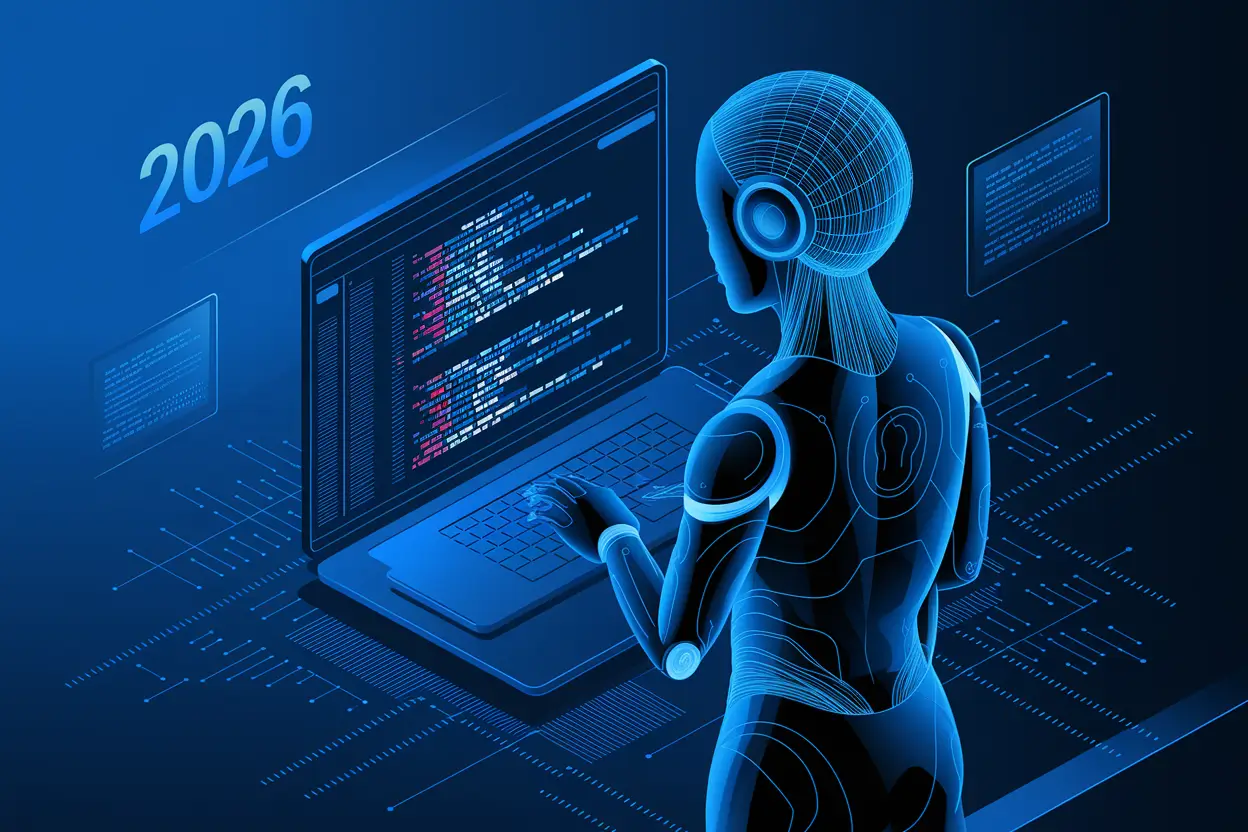
How AI is Revolutionizing Smart Contract Development in 2026 marks a turning point in how blockchain ecosystems operate. Artificial Intelligence (AI) is now transforming the entire process of coding, testing, auditing, and deploying smart contracts. Smart contracts are self-executing digital agreements that exist on a blockchain, automatically enforcing terms without human intervention. In 2026, advancements in natural language processing, machine learning, and predictive analytics have made AI indispensable for developers aiming to ensure reliability, efficiency, and security in blockchain applications.
AI-driven automation and intelligent auditing tools allow developers to write and verify contracts faster, reducing vulnerabilities and human errors. This article explores the technological synergy between AI and blockchain, covering its concepts, benefits, challenges, real-world applications, and future trends.
Understanding How AI is Revolutionizing Smart Contract Development in 2026
To understand how AI is revolutionizing smart contract development, it’s essential to begin with the fundamentals. Smart contracts are protocols written primarily in blockchain-specific languages like Solidity and Rust. They outline the logic for automated transactions and state changes triggered by certain conditions. AI enhances this process through code generation, predictive modeling, anomaly detection, and semantic analysis, making contract execution faster and safer. By leveraging training data from previous blockchain transactions and contract behaviors, machines can predict performance outcomes or highlight potential exploits before deployment.
Core Concepts Behind How AI is Revolutionizing Smart Contract Development
Several technical concepts drive this transformation. First is AI-assisted programming, where large language models suggest optimized or corrected code. Next is predictive contract behavior, allowing AI to forecast how a contract might interact with other blockchain systems. Another core concept is intelligent verification, where neural networks detect logic flaws, inefficiencies, or gas consumption anomalies. Finally, adaptive learning models build on historical blockchain data to fine-tune recommendations and security settings.
How AI Works Within Smart Contract Development Processes
AI integrates through the entire lifecycle of contract creation. It begins with generating contract code from plain language requests using NLP models. Then, machine learning algorithms validate syntax and check logic consistency. Automated auditing detects security vulnerabilities, such as reentrancy attacks or overflows, while reinforcement learning helps systems improve from prior audits. After deployment, AI continues monitoring real-time execution data, flagging suspicious activities or inefficiencies and recommending patches or optimizations.
Technical Mechanisms Behind How AI is Revolutionizing Smart Contract Development
At the technical level, AI interacts with blockchain development frameworks through APIs and training data pipelines. Models like GPT-based engines help translate business logic into executable Solidity code. Anomaly detection algorithms compare newly written contracts against massive historical datasets. Deep neural networks simulate multi-agent transactions on testnets. AI audit engines cross-check contract performance across various blockchain environments and blockchain interoperability layers. Through these mechanisms, developers gain thorough insights into contract reliability before actual deployment.
Key Advantages of How AI is Revolutionizing Smart Contract Development
- Speed and Efficiency: AI automates repetitive coding and testing tasks, significantly reducing time to market.
- Error Reduction: AI auditing tools catch common code flaws that manual reviews might miss.
- Predictive Security: Predictive analytics preempt vulnerabilities by simulating real exploit scenarios.
- Cost Reduction: Lower maintenance and fewer failed transactions reduce operational expenses.
- Improved Trust: Intelligent contract validation ensures fairness and accuracy in decentralized agreements.
Challenges and Limitations in How AI is Revolutionizing Smart Contract Development
Despite its promise, integrating AI with blockchain smart contracts faces key challenges. Data bias is one issue—AI models trained on limited datasets can make poor predictions. Explainability is another concern, as AI decisions within contract logic must be transparent for regulatory reasons. Computational costs also rise when running intensive AI models. Additionally, the immutable nature of blockchain means once AI-generated code is deployed, rectifying mistakes can be difficult without upgradeable contract designs.
Real-World Use Cases of How AI is Revolutionizing Smart Contract Development
Several industries now depend on this synergy. In decentralized finance (DeFi), AI-driven contracts manage loan approvals, automatic liquidation triggers, and insurance claims. In legal tech, AI converts natural language contracts into auditable, blockchain-ready smart contracts. Supply chain management uses AI bots to validate product authenticity and trigger payments upon delivery verification. Energy trading platforms employ AI to forecast demand and automate distributed ledger transactions. Gaming ecosystems leverage AI-based fairness verification in smart reward systems.
Case Studies Demonstrating How AI is Revolutionizing Smart Contract Development
In 2026, multiple blockchain enterprises showcase applied success. A financial consortium developed an AI auditing system that reduced coding vulnerabilities by 73%. Another startup automated NFT contract generation, cutting deployment time by 60%.
A global supply chain platform integrated AI to dynamically adjust contract fees based on real-time logistics data, saving millions annually. Such case studies indicate how deploying AI in contract logic saves effort and boosts accuracy.
Latest Trends in How AI is Revolutionizing Smart Contract Development
- Layer-2 Integration: AI components optimizing gas use across scaling solutions.
- Autonomous DAOs: Governance models where AI moderates voting results and fund allocation automatically.
- Explainable AI (XAI): Ensures transparency in how AI makes smart contract decisions.
- AI-driven Oracles: Feeding validated, consistent data to blockchain contracts.
- Generative Coding Platforms: Turning verbal input into secure, production-ready contract code.
Technical Suggestions for Implementing How AI is Revolutionizing Smart Contract Development
For projects adopting AI in blockchain development, clear architectural planning is essential. Start with integrating machine learning frameworks via APIs from TensorFlow, PyTorch, or ONNX within your blockchain environment. Establish a training pipeline using historical blockchain transaction data stored securely off-chain. Implement reinforcement learning models to improve over time. Use containerization (Docker, Kubernetes) for scalability. Maintain strong encryption for AI results storage and implement explainability dashboards for compliance review.
Practical Coding Setup Example in How AI is Revolutionizing Smart Contract Development
A basic architecture might involve a smart contract coded in Solidity connected to an AI auditing microservice. The microservice analyzes syntax with a model trained on previous code patterns and flags risks before deployment. It could use Python scripts with TensorFlow for analysis and Web3.js for blockchain communication. The AI continuously monitors deployed contract events to retrain itself, ensuring that each iteration makes code smarter and safer.
Comparing How AI is Revolutionizing Smart Contract Development With Traditional Approaches
| Feature | AI-Enhanced Smart Contracts | Traditional Smart Contracts |
|---|---|---|
| Development Speed | High (Automated generation) | Moderate (Manual coding) |
| Security | Predictive and adaptive | Reactive and static |
| Audit Process | AI-based continuous monitoring | Occasional manual reviews |
| Maintenance | Dynamic optimization | Manual updates |
Pros and Cons Analysis of How AI is Revolutionizing Smart Contract Development
Pros
- Greater automation in code generation reduces time and human errors.
- Adaptive systems continuously enhance accuracy.
- AI expands blockchain scalability and accessibility for non-developers.
Cons
- Potential AI model bias leading to inaccurate contract behavior.
- Computational costs require more infrastructure.
- Regulatory complexities surrounding autonomous systems.
Security Implications in How AI is Revolutionizing Smart Contract Development
AI strengthens blockchain security by identifying patterns of fraudulent activity and predicting attack surfaces before exploitation occurs. However, malicious use of AI could also automate more advanced exploits. Therefore, continuous human oversight combined with AI interpretability ensures safe operation. Encryption, verification protocols, and explainable algorithmic evaluations are necessary to balance innovation with protection.
Future Outlook of How AI is Revolutionizing Smart Contract Development in 2026 and Beyond
The coming years will likely see decentralized AI networks fueled by blockchain-based federated learning. By 2030, AI agents could autonomously create, negotiate, and enforce digital contracts across multiple blockchains. Hybrid governance models blending AI decisions with human arbitration will ensure fairness. Quantum-resistant AI algorithms will bolster security for next-generation contracts, protecting critical industries like finance, health, and logistics. As smart economies expand, AI will remain the cornerstone of innovation.
Best Practices When Embracing How AI is Revolutionizing Smart Contract Development
- Leverage explainable AI frameworks for transparency.
- Employ continuous data training to reduce prediction bias.
- Ensure human auditing of final outputs for compliance.
- Utilize modular architectures for easy scalability.
- Implement multi-layer defense strategies to detect anomalies.
Industry Adoption Rate in How AI is Revolutionizing Smart Contract Development
In 2026, AI-powered contract systems are prominent across fintech, real estate, healthcare, and gaming. Major enterprises are deploying AI-audited tokens and governance frameworks. Startups spearhead hybrid solutions enabling voice-to-contract generation. Estimates suggest that over 60% of enterprise smart contracts have at least one AI component embedded for efficiency, making it the new industry norm.
Common Mistakes and Solutions in How AI is Revolutionizing Smart Contract Development
- Mistake: Over-relying on AI without human review. Solution: Enforce dual validation layers.
- Mistake: Using insufficient training data. Solution: Expand dataset coverage.
- Mistake: Ignoring explainability. Solution: Integrate dashboards showing AI reasoning.
FAQ About How AI is Revolutionizing Smart Contract Development
What is the role of AI in smart contract auditing?
AI automatically scans thousands of lines of blockchain code to detect vulnerabilities and ensures compliance by analyzing historical exploit patterns.
Can AI write smart contracts from plain English?
Yes, in 2026, natural language processing models can interpret normal sentences into ready-to-deploy smart contract structures, bridging technical gaps.
How does AI ensure security in smart contracts?
Machine learning models simulate real-world attacks and analyze transaction logs, providing fixes before launch to prevent costly breaches.
Is AI integration expensive for blockchain developers?
Initial setup costs can be high, but operational savings and reduced failure rates quickly offset the investments within months of deployment.
What are the future trends in AI and smart contracts?
Expect growth in self-learning DAOs, cross-chain AI integration, automation of multi-contract ecosystems, and human-AI hybrid decision nodes.
Conclusion: The Impact of How AI is Revolutionizing Smart Contract Development
In summary, How AI is Revolutionizing Smart Contract Development in 2026 showcases one of the most revolutionary trends in blockchain technology. AI’s capabilities in automation, predictive security, and performance optimization are redefining how contracts are built and executed. While challenges remain, the combined force of AI and blockchain continues to propel industries toward trustless, efficient, and intelligent digital ecosystems prepared for the next technological leap.