
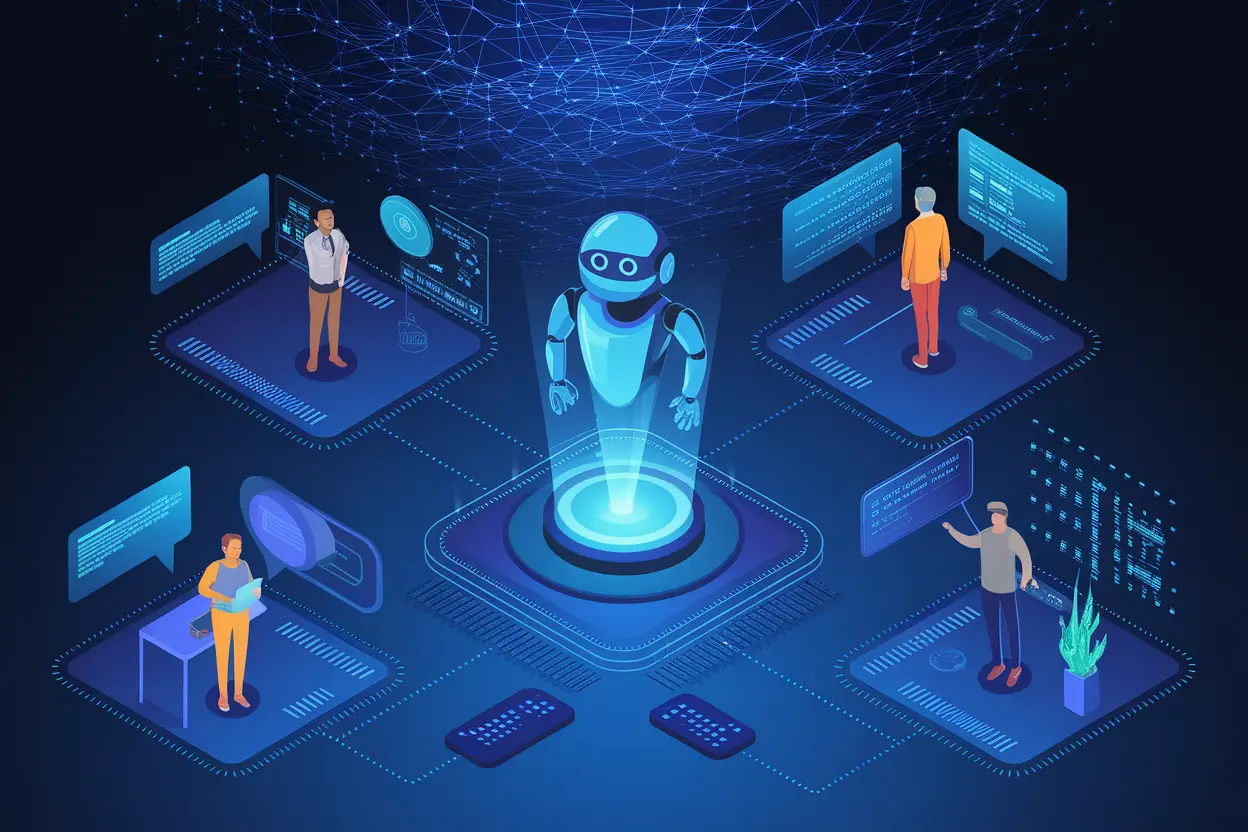
The Ultimate List of AI Chatbot Development Companies in 2026 represents a comprehensive overview of the top organizations that lead the development, deployment, and innovation in conversational AI technologies. As AI chatbots evolve, they are transforming how businesses communicate with users, manage operations, and improve customer experience. In 2026, the AI chatbot development landscape includes advanced NLP (Natural Language Processing), multimodal bots, and integrated generative AI solutions, marking a significant leap from previous years.
AI chatbot development companies focus on building intelligent virtual agents capable of understanding context, emotions, and complex interactions. These developers integrate large language models, voice recognition, and machine learning algorithms to deliver personalized and efficient communication experiences. This guide offers a detailed exploration of how these companies operate, their products, benefits, limitations, and projections for the future.
The Core Concept of AI Chatbot Development Companies in 2026
AI chatbot development companies build software that enables organizations to create bots capable of human-like conversations. In 2026, advanced companies utilize large language models (LLMs) such as GPT-5, Gemini, Claude, or LLaMA variants to enhance communication precision. They also employ multimodal inputs—text, voice, and image—to produce seamless and interactive responses. These companies focus on enterprise-grade chatbot platforms with layered data privacy, emotion detection, and real-time analytics.
How AI Chatbot Development Companies in 2026 Work
Modern AI chatbot development companies follow a unified model that combines data collection, intent training, natural language understanding (NLU), and feedback loops. The process begins with dataset preparation—thousands of conversational samples are tagged and used to train models. The next stage involves model fine-tuning, allowing the bot to adapt to industry-specific queries, terminologies, and user expectations. Many companies use reinforcement learning from human feedback (RLHF) to continuously improve their bots. APIs are provided for simple embedding into platforms like websites, WhatsApp, Telegram, and enterprise business systems like CRMs or ERP tools.

To illustrate, top companies often deploy advanced middleware that interfaces chatbots with cloud systems, making them capable of contextual learning. This approach allows systems to remember customer preferences, recommend products, or process transactions autonomously. Additionally, 2026-era AI chatbots are increasingly voice-based, offering cross-device consistency through mobile, web, and IoT platforms.
Key Technologies Used by AI Chatbot Development Companies in 2026
- Natural Language Processing (NLP): Enables understanding and context-based response generation.
- Machine Learning (ML): Supports adaptation and continuous improvement of models.
- Large Language Models (LLMs): Deliver complex logic and near-human responses.
- Cloud AI APIs: Simplify integration and scaling.
- Emotion AI: Identifies user emotions for empathetic interactions.
- Voice Synthesis & Recognition: Enables hybrid text-to-speech communication.
Top AI Chatbot Development Companies in 2026
1. OpenAI Enterprise Suite: Leading innovation in conversational AI and assistant design for corporate environments.
2. Google DeepMind Conversa: With cutting-edge multimodal chatbot frameworks integrated into Google Workspace ecosystem.
3. IBM WatsonX Chat Cloud: Enterprise-focused with hybrid cloud capabilities and exceptional integration options.
4. Microsoft Azure Copilot Framework: Blends generative AI with productivity tools and security compliance.
5. Anthropic Claude Enterprise Agents: Known for reliability, safety filters, and advanced reasoning capabilities.
6. Amazon Lex 3.0: Empowers e-commerce automation through improved ML-assisted chatbot design.
7. Rain Infotech: Specializing in building blockchain-integrated AI chatbots for fintech and healthcare sectors.
8. Plusmind Technologies: Offers custom multilingual and omni-platform chatbot solutions for businesses worldwide.
9. Cognigy.AI: Provides low-code conversational platforms designed for omnichannel deployment.
10. Kore.ai: Focused on enterprise-level automation and NLP-driven agent systems.
11. Yellow.ai: Bridges customer experience with generative AI via hybrid human-AI collaboration frameworks.
12. Tars AI Labs: Known for personalized marketing-driven chatbot designs and analytics integration.
Each of these companies fuels the global chatbot economy through expertise in domain adaptation, scalability, and continuous language enrichment.
Advantages of Partnering with AI Chatbot Development Companies in 2026
- Cost Efficiency: Reduces repetitive human tasks.
- 24/7 Customer Support: Continuous availability with multilingual coverage.
- Personalization: Data-driven customization of user experiences.
- Enhanced Conversion Rates: Bots guide users through automated yet human-like sales funnels.
- Integration: Easy deployment across applications and websites.
Challenges and Limitations of AI Chatbot Development Companies in 2026
Despite remarkable progress, AI chatbot development faces challenges like model bias, hallucinations, compliance restrictions, and contextual retention limits. Overtraining or inaccurate datasets can lead to inconsistent outputs. Moreover, managing privacy when handling personal data is an ongoing issue. Balancing automation with the human touch remains a key design consideration.
Use Cases of AI Chatbot Development Companies in 2026
- Healthcare: Patient triaging bots, treatment follow-up systems, and appointment scheduling.
- Finance: Conversational banking assistants and fraud detection communications.
- E-commerce: Customer guidance, order processing, and product recommendations.
- Education: Personalized tutoring, assessment feedback, and virtual classroom assistants.
- Travel: Real-time itinerary management and support.
Technical Suggestions for Implementing Chatbots in 2026
When designing an AI chatbot, development companies recommend the following technical steps:
- Choose the proper AI model—depending on language and tone requirements.
- Implement data governance protocols ensuring responsible usage.
- Integrate feedback loops for iterative learning.
- Use API encryption and tokenization for security.
- Establish scalability using serverless cloud infrastructure.
- Monitor performance through analytical dashboards and anomaly detection models.
Example Code Snippet for AI Chatbot Setup
Python Setup Example:
Define a Python-based chatbot leveraging a language model API:
import openai
response = openai.ChatCompletion.create(model=”gpt-4-turbo”, messages=[{“role”:”user”,”content”:”Hello”}])
print(response[“choices”][0][“message”][“content”])
This represents the simplified example of chatbot implementation logic.
Comparing AI Chatbot Development Companies in 2026 with Alternative Solutions
Traditional chatbot builders focus on decision-trees or rule-based scripts, whereas AI chatbot development companies leverage deep neural networks for contextual understanding. In table form below:
| Feature | Rule-Based Bots | AI Chatbots (2026) |
|---|---|---|
| Learning Ability | Static | Adaptive |
| Language Understanding | Keyword-Driven | Semantic Context Recognition |
| Integration | Limited | Omnichannel & API Friendly |
| Maintenance | Manual | Automated Continuous Learning |
| User Experience | Rigid | Human-like Natural |
Real-World Case Studies from AI Chatbot Development Companies in 2026
Rain Infotech partnered with a logistics company to design a blockchain-driven AI assistant. The bot tracked inventory and shipment records securely, improving transparency. Plusmind Technologies implemented a voice-intelligent chatbot for an educational institute that handled admission inquiries, saving 60% of the administrative work. These real-world scenarios demonstrate result-oriented implementations.
Trends Impacting AI Chatbot Development Companies in 2026
- Hyper-Personalization: Using predictive data analytics to anticipate user behavior.
- Multimodal Chatbots: Combining text, speech, and image input recognition.
- Autonomous Decision-Making: Self-learning agents capable of completing tasks independently.
- Edge-AI Integration: Implementing lightweight chatbots on personal devices.
- Sustainability: Reducing computational waste through optimized model training.
Key Performance Metrics for AI Chatbot Development Companies in 2026
Organizations evaluate development companies based on metrics like response accuracy, latency (response time), user satisfaction scores (CSAT), and task completion rates. Advanced analytics frameworks now provide live A/B testing environments to monitor chatbot performance in real time. ROI measurements also include cost per conversation and automation ratio (number of queries handled by bots vs humans).
Future Outlook of AI Chatbot Development Companies in 2026
The future of these companies involves increased collaboration between generative AI, robotics, and immersive technologies. Chatbots are expected to evolve into complete digital companions integrated with AR and VR. By 2030, we can expect enterprise-wide digital humans replacing traditional support channels. Continuous ethical AI regulation will also guide these transformations, ensuring fairness and transparency.
Common Mistakes to Avoid While Choosing AI Chatbot Development Companies in 2026
- Ignoring scalability during design phases.
- Neglecting multilingual or accessibility features.
- Failing to train on domain-specific datasets.
- Overreliance on free APIs without support guarantees.
- Skipping conversational flow testing.
How to Evaluate the Best AI Chatbot Development Companies in 2026
Consider technical stack expertise, case portfolios, client testimonials, and post-deployment support. Examine customization capabilities and compliance with regional data laws. The best partners aim not only to develop but also to innovate alongside your business.
FAQs on AI Chatbot Development Companies in 2026
What do AI chatbot development companies in 2026 specialize in?
They specialize in creating intelligent conversational systems using NLP, machine learning, and generative AI to automate communication tasks and improve engagement.
How much does it cost to develop a chatbot in 2026?
Development costs vary based on model size, platform, and integration complexity, typically ranging from $5,000 for basic versions to over $150,000 for enterprise bots.
What industries benefit the most from AI chatbot development?
Key industries include banking, healthcare, education, retail, logistics, and technology services, where chatbots streamline communication and enhance conversion.
Are chatbots in 2026 capable of real emotional understanding?
Yes, emotion AI integration allows advanced bots to infer tone and sentiment, responding empathetically and adjusting messaging accordingly.
What is the future of AI chatbot development companies?
Future lies in fully autonomous multimodal assistants capable of decision-making, predictive personalization, and ethical AI adherence.
Conclusion: The Role of AI Chatbot Development Companies in 2026
The Ultimate List of AI Chatbot Development Companies in 2026 demonstrates how the industry has surpassed traditional automation boundaries. These companies are building dynamic, secure, and human-like systems that will shape the future of customer engagement and business intelligence. Whether for startups or enterprises, aligning with these frontrunners ensures innovation, growth, and scalability in a rapidly evolving digital ecosystem.