


AI Agent Design Best Practices represent the key principles and methodologies used to create intelligent software agents that can think, learn, and act autonomously in digital environments. These practices ensure that AI agents are reliable, efficient, ethical, and capable of solving real-world problems effectively. In today’s world, AI agents are critical to automating business processes, improving user experience, and enhancing decision-making. Understanding the design best practices behind these agents helps organizations build scalable and trustworthy AI systems. This article explores, in depth, how AI agent design works, its core components, advantages and limitations, use cases, and emerging trends you can implement today.
Understanding AI Agent Design Best Practices
AI Agent Design Best Practices are the strategic methods and procedures followed while creating intelligent agents. These agents use machine learning, natural language processing, and data-driven reasoning to perform tasks that mimic human intelligence. A well-designed AI agent follows principles such as modularity, interpretability, goal orientation, and adaptability. The goal of these best practices is to ensure that AI systems can operate autonomously yet align with human intent. Designers need to focus on efficiency, explainability, and security while ensuring user trust. A solid AI agent design prevents biases and ensures ethical AI behavior in real-world applications.
Core Concepts of AI Agent Design Best Practices
AI Agent Design Best Practices focus on several key concepts including autonomy, reactivity, proactiveness, and social ability. Autonomy allows the agent to make decisions without human intervention. Reactivity ensures the agent responds to environmental changes in real-time. Proactiveness involves taking initiative rather than merely reacting, while social ability enables interaction with humans or other agents. Additional technical considerations include modular architecture, reinforcement learning, knowledge representation, and environmental modeling. Understanding these concepts ensures developers create AI systems capable of decision-making under uncertainty and constant change.
How AI Agent Design Best Practices Work
In practical terms, AI Agent Design Best Practices dictate how an AI agent processes information. The design typically starts with defining a task-specific environment, where agents sense, reason, and act. Agents receive input data, process it through rule-based or learning-based models, and execute actions to achieve predefined goals. Machine learning frameworks, such as supervised and reinforcement learning, enhance adaptive behavior, allowing the agent to learn from feedback loops. A well-defined reward function ensures optimal performance aligned with desired outcomes. The entire system is supported by continuous data collection, model evaluation, and algorithm optimization mechanisms.
Technical Architecture in AI Agent Design Best Practices
AI agents typically have a layered architecture comprising perception, decision-making, and action modules. The perception layer gathers and preprocesses data. The decision-making layer interprets this data through reasoning models or machine learning algorithms. The action layer then executes decisions in the real or digital environment. Developers implement this using technologies like TensorFlow, PyTorch, or spaCy for NLP agents. Code setup usually involves establishing agent-environment interactions, defining behavioral rules, and initializing learning systems. For example, a reinforcement-learning-based AI could be initiated with a Python script that defines state spaces, actions, and rewards to train the agent for goal achievement.
Here’s a brief illustrative structure:
- Input: Environment data or user context
- Processing: Algorithmic reasoning, ML predictions
- Output: Decisions, suggestions, or actions
- Feedback: Learning loop for continuous improvement
Advantages of Following AI Agent Design Best Practices
When adhered to carefully, AI Agent Design Best Practices produce numerous benefits. Efficiency increases as the system optimizes itself using continuous learning mechanisms. Robustness improves since agents learn from errors and adapt to changing conditions. Scalability is enhanced by modular architecture that allows new functionalities to integrate seamlessly. Ethical compliance and transparency ensure that decisions are traceable and explainable. Furthermore, defining clear performance metrics makes evaluation straightforward and ensures accountability in automated processes.
Drawbacks of Ignoring AI Agent Design Best Practices
Neglecting standardized design practices introduces high risks into AI development. Agents could become biased, unreliable, or even non-functional in real-world conditions. Poorly structured data management leads to inaccurate predictions. Without proper interpretability mechanisms, users lose trust in agent behavior. Additionally, agents built without scalability in mind fail to perform under complex data loads. Insufficient attention to privacy and ethical frameworks can also subject organizations to regulatory penalties.
Real-World Use Cases of AI Agent Design Best Practices
AI Agent Design Best Practices are used across various industries. In customer service, chatbots designed using modular frameworks and NLP best practices ensure natural communication and quick issue resolution. Financial institutions implement trading agents that analyze markets and execute trades autonomously while following compliance-focused algorithms. In healthcare, diagnostic agents combine perception and reasoning layers to assist doctors in identifying conditions. Autonomous vehicles employ multi-agent coordination systems to handle dynamic traffic conditions. E-commerce companies use recommendation agents to analyze preferences and improve conversion rates. These examples highlight how effective design translates into practical, scalable AI systems.
AI Agent Design Best Practices in Business Operations
Businesses that integrate AI Agent Design Best Practices achieve competitive advantages through data-driven automation. Sales, logistics, and supply chain systems benefit from intelligent agents that forecast demand, optimize routing, or personalize customer experience. Predictive agents analyze business metrics and suggest cost reductions or productivity improvements. Implementing strong security, reproducibility, and documentation frameworks ensures operational stability. Moreover, integrating human oversight allows agents to complement rather than replace workers, creating human-AI synergy that boosts productivity.
Code Implementation and Setup in AI Agent Design Best Practices
A standard setup example may include defining agents and environment classes using Python and reinforcement learning libraries.
Algorithm outline example:
- Initialize environment and define state-action spaces.
- Use policy gradients or Q-learning mechanisms.
- Establish reward functions aligned with goals.
- Train the agent through exploration vs. exploitation balance.
- Evaluate performance and deploy model into production pipeline.
This ensures that agents follow logical flow while learning effectively. Such implementations can be wrapped in MLOps pipelines to automate retraining and deployment.
Comparison: AI Agent Design Best Practices vs Traditional Automation
Traditional automation follows rule-based programming with limited adaptability. In contrast, AI agents designed under modern best practices exhibit self-learning and adaptive behaviors. While traditional systems fail when faced with unpredictable inputs, AI agents evolve continuously. Moreover, well-designed AI agents offer explainability, scalability, and ethical oversight unavailable in rigid mechanistic automation systems. This fundamental difference enables organizations to transition from static scripts to intelligent, autonomous ecosystems.
Latest Trends in AI Agent Design Best Practices
The most recent trend emphasizes multi-agent collaboration where multiple AI entities communicate and coordinate toward shared objectives. Researchers have introduced frameworks like generative AI integration, allowing reasoning beyond static datasets. Explainable AI (XAI) design principles ensure ethical compliance and interpretability. Low-code agent design platforms are emerging to democratize access for non-technical users. Furthermore, hybrid AI agents, merging symbolic reasoning and deep learning, combine the best of human logic and machine pattern recognition. As orchestration tools and APIs advance, deploying multi-agent ecosystems becomes seamless for enterprises.
Ethical Frameworks in AI Agent Design Best Practices
One of the most critical aspects of AI Agent Design Best Practices is the inclusion of ethics. Designers must consider fairness, accountability, and transparency principles. Bias mitigation, consent-driven data collection, and privacy-first handling are vital. Ethical algorithms prioritize societal well-being over efficiency alone. Implementing governance mechanisms ensures the AI remains auditable. Integrated fairness testing frameworks help identify discriminatory behaviors in models before deployment. A sustainable AI system respects both user rights and business integrity.
Common Mistakes to Avoid in AI Agent Design Best Practices
Several pitfalls exist when ignoring best practices. Developers often under-prioritize data quality, resulting in poor learning outcomes. Over-complex architecture can create performance bottlenecks. Another frequent error is improper evaluation metrics, causing misleading interpretations of success. Lack of cybersecurity safeguards leads to threats like data breaches or model manipulation. To prevent these issues, continuous testing, proper documentation, and human feedback loops must be established.
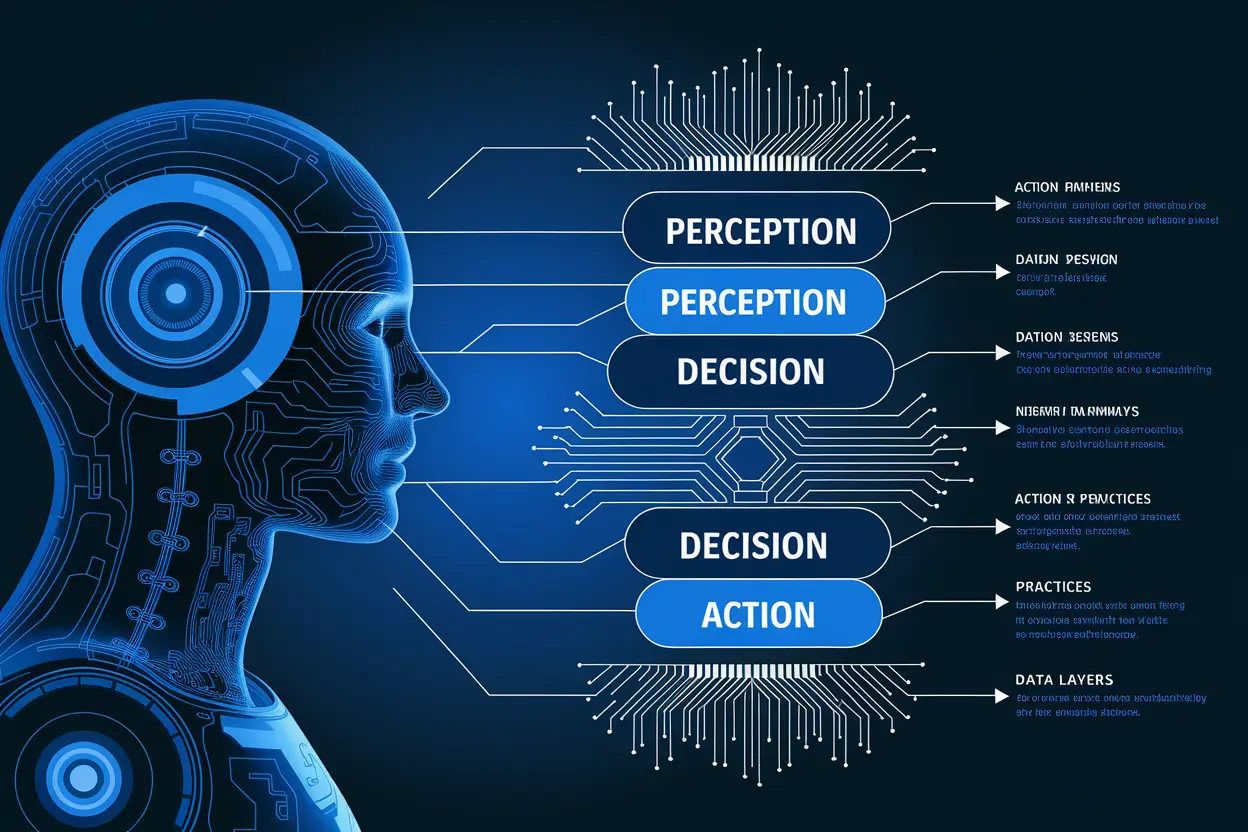
To visualize a well-designed AI agent system, consider a neural network diagram showcasing how perception feeds decision nodes that communicate via APIs to execute tasks autonomously in a real-world simulation environment.
Future Outlook of AI Agent Design Best Practices
The future of AI Agent Design Best Practices lies in autonomous adaptation, cross-domain intelligence, and democratically accessible AI systems. Agents will be capable of understanding context beyond predefined boundaries, integrating multi-modal learning inputs like text, vision, and sound. Federated learning and edge AI will ensure privacy-first intelligence, enabling agents to operate locally on user devices. As regulatory frameworks evolve, ethical AI design will transition from recommendation to mandatory compliance. In the next decade, agents will function as digital coworkers capable of understanding goals, emotions, and strategic priorities.
Step-by-Step Guide to Implement AI Agent Design Best Practices
1. Define objectives aligned with business value.
2. Select appropriate agent architecture (rule-based, learning-based, or hybrid).
3. Identify datasets and establish preprocessing pipelines.
4. Choose algorithms best suited to the problem domain.
5. Integrate feedback mechanisms and reward structures.
6. Evaluate systematically using robust performance metrics.
7. Ensure compliance with ethics and security standards.
8. Deploy iteratively and monitor results for continuous optimization.
Case Study: AI Agent Design Best Practices in Action
A financial firm adopted reinforcement learning AI agents to optimize stock trading strategies. By following AI Agent Design Best Practices—such as model retraining loops, bias checks, and real-time feedback integration—they achieved a 15% increase in portfolio efficiency and a 30% reduction in trading risk. The modular design allowed seamless scalability and compliance with regulatory requirements.
AI Agent Design Best Practices Comparison Table
| Design Focus | Best Practice | Impact |
|---|---|---|
| Architecture | Modular and scalable | Improved maintainability |
| Ethical Framework | Fairness and transparency | Builds trust |
| Learning Type | Reinforcement-based | Enhances adaptability |
| Evaluation | Continuous monitoring | Optimized performance |
FAQs About AI Agent Design Best Practices
What are AI Agent Design Best Practices?
They are guidelines ensuring AI agents are effective, ethical, and efficient, focusing on adaptability, transparency, and explainability.
Why are AI Agent Design Best Practices important?
They ensure trustworthy automation that aligns with business and ethical standards, minimizing bias and performance errors.
Can small businesses apply AI Agent Design Best Practices?
Yes, modular design allows small enterprises to adopt scaled-down implementations with proven frameworks and cloud-based tools.
What technologies support AI Agent Design Best Practices?
Frameworks like TensorFlow, PyTorch, and OpenAI Gym provide robust environments for creating and training intelligent agents.
What is the future of AI Agent Design Best Practices?
Future designs will embrace ethical AI, federated learning, and multi-agent ecosystems that interact in decentralized intelligent networks.
Conclusion: Implementing AI Agent Design Best Practices Today
In conclusion, adopting AI Agent Design Best Practices ensures intelligent systems are efficient, ethical, and scalable. By following structured frameworks—from defining objectives to deploying adaptive algorithms—organizations can achieve innovation safely and effectively. As AI continues to redefine industries, mastering these practices becomes essential for sustainable success. Implementing them today will position businesses to lead in tomorrow’s intelligent economy.