


AI Agents in Insurance are revolutionizing the traditional insurance industry by advancing well beyond basic chatbot capabilities. These intelligent systems not only respond to customer queries but autonomously handle complex tasks like claims processing, underwriting, and fraud detection. As digital transformation accelerates across industries, insurers embracing AI agents position themselves for enhanced performance, reduced costs, and superior customer satisfaction.
Understanding AI Agents in Insurance
AI agents in insurance are software entities powered by artificial intelligence that independently carry out processes typically handled by human agents. Unlike basic chatbots that follow scripted flows, AI agents use contextual understanding, real-time data, and machine learning to solve complex tasks. These agents help insurers improve customer service, streamline operations, manage risk better, and stay agile in dynamic market conditions.
How AI Agents in Insurance Work
AI agents function by fusing multiple technologies:
- Natural Language Processing (NLP): Enables agents to understand policy terms, customer queries, and documentation.
- Machine Learning (ML): Learns from historical data to improve decision-making and response accuracy.
- Data Integration: Pulls insights from multiple internal and external data sources to generate real-time resolutions.
- Security Frameworks: Ensures compliance and data privacy uphold industry standards.
Core Capabilities of AI Agents in Insurance
- Autonomy: Operate without manual input, following intelligent pathways for task resolution.
- Context Awareness: Understand user behavior, historical interactions, and policy complexity for personalized responses.
- Self-Learning: Continuously improve from each engagement using feedback loops and dataset expansions.
AI Agents in Insurance vs Traditional Chatbots
| Feature | AI Agents | Traditional Chatbots |
|---|---|---|
| Autonomy | Can handle end-to-end tasks | Limited to scripted replies |
| Learning Ability | Uses machine learning | No learning capability |
| Complexity Handling | Manages intricate processes | Handles only FAQs |
| Personalization | High, via contextual understanding | Minimal, based on pre-programmed logic |
Use Cases of AI Agents in Insurance
AI agents are transforming every facet of insurance:
- Claims Processing: From FNOL (first notice of loss) to settlement, AI agents enhance speed and accuracy.
- Policy Underwriting: Uses data analytics to assess risk and suggest policy criteria.
- Fraud Detection: Leverages pattern recognition to flag suspicious claims automatically.
- Customer Engagement: Offers 24/7 assistance across channels with personalized service.
Real-World Applications of AI Agents in Insurance
- ZestyAI: Uses AI to assess fire and climate risk through satellite imagery, enhancing underwriting decisions.
- FurtherAI: Streamlines workflows with AI-driven data extraction and claims automation.
- Hippo Insurance: Incorporates AI for proactive risk management and dynamic pricing for homeowners insurance.
Pros and Cons of AI Agents in Insurance
Pros
- Efficiency: Automates tasks, significantly reducing the turnaround time.
- Accuracy: Minimizes operational errors by using data-driven logic.
- Cost Efficiency: Reduces reliance on human labor and associated costs.
- Customer Satisfaction: Provides real-time, personalized service.
Cons
- High Setup Costs: Initial investments in technology and integration are significant.
- Complex Maintenance: Requires skilled teams for updates and optimization.
- Job Displacement: Possible downsizing of support staff roles.
- Data Privacy: Handling sensitive customer data requires high-security compliance.
Current Trends in AI Agents in Insurance
The landscape of AI agents is morphing rapidly with new trends:
- Agentic AI: A step beyond reactive machines, agentic AI facilitates self-driven intelligent operations.
- Large Language Models Integration: Boosts comprehension and interaction quality through advanced NLP.
- Zero-Trust Security: Ensures identity-verification and threat detection for AI applications.
Technical Suggestions to Implement AI Agents in Insurance
- Use Clean, Diverse Data: High-quality and varied datasets improve model training.
- Prepare Scalable Architecture: Cloud and server scaling ensure future-proof functionality.
- Regulatory Awareness: Ensure compliance with regional insurance data laws.
- Performance Monitoring: Use dashboards and KPIs to track AI agent efficiency.
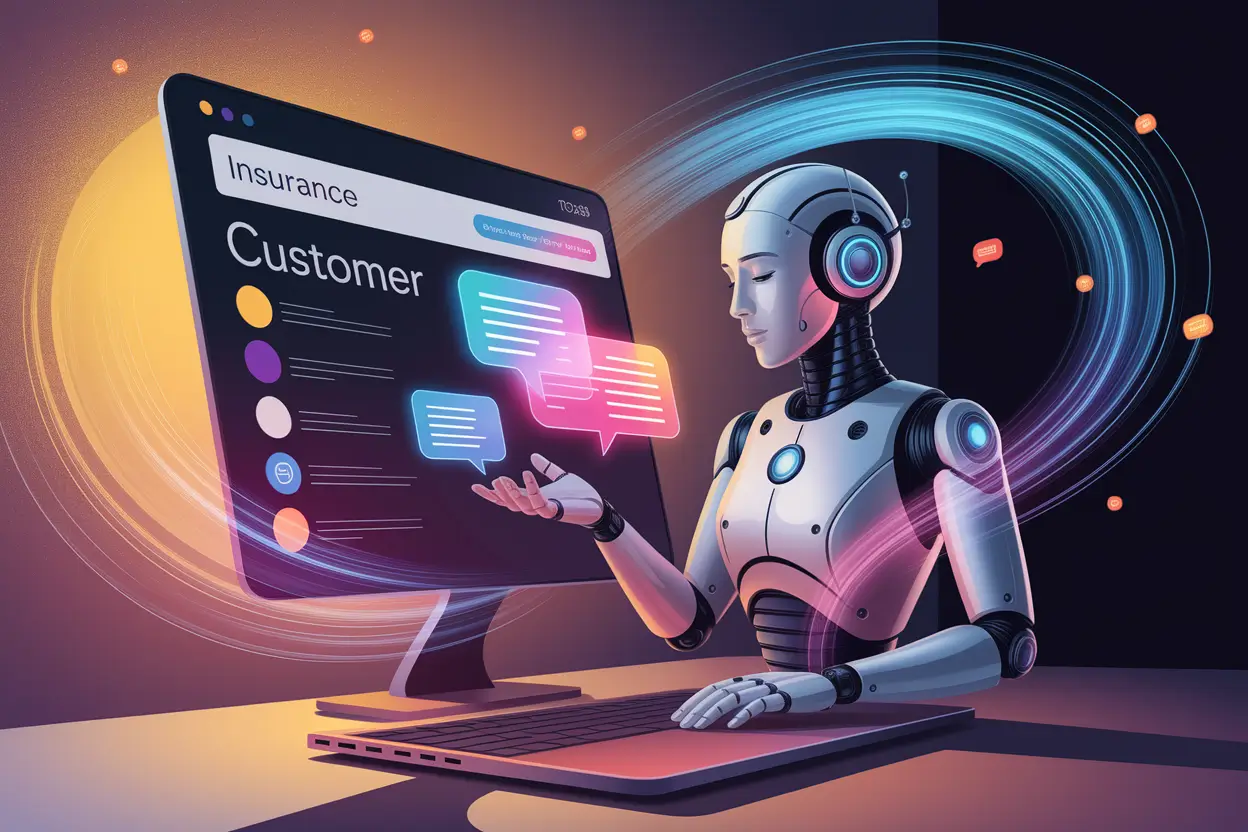
One effective way to achieve successful AI agent integration in insurance is by starting with customer service. This use case offers quick wins and insights into operational challenges, allowing teams to refine models before applying them to underwriting or claims. Gradual scaling ensures better accuracy and stakeholder trust throughout the transformation journey.
AI Agents in Insurance and Human Teams
AI agents are not replacing humans entirely but augmenting them. Human agents focus on nuanced negotiation, empathy-driven support, and exception handling. More time is freed up for complex case management while AI handles administration and routine queries.
Future Outlook of AI Agents in Insurance
The future holds promising developments:
- Ubiquitous Adoption: Most insurance firms will implement AI agents as standard practice.
- Blockchain Integration: Enhanced transparency and data traceability with AI-enabled smart claims.
- Ethical AI Focus: Enhanced emphasis on responsible AI use with bias audits and transparent decisions.
- IoT Synergy: Sensor-based alerts feed real-time data to AI models for proactive insurance services.
Common Mistakes in Deploying AI Agents in Insurance
- Insufficient Training Data: Leads to poor decision-making by the AI.
- Over-Automation: Trying to automate everything reduces service personalization.
- Neglecting Ethics: Not accounting for fairness and transparency damages brand trust.
Step-by-Step Guide to Deploy AI Agents in Insurance
- Assess internal data infrastructure readiness.
- Select high-impact use cases for initial deployment.
- Build and train initial AI models using real data.
- Pilot with a limited rollout to evaluate performance.
- Optimize and expand across functions.
FAQs About AI Agents in Insurance
What are AI agents used for in insurance?
They are used for automating claims, underwriting, fraud detection, and customer service.
How are AI agents different from chatbots?
AI agents can learn, reason, and act autonomously, while chatbots follow predefined scripts.
Are AI agents cost-effective?
Yes, AI agents reduce long-term costs by streamlining operations and minimizing errors.
Can AI agents replace human insurance agents?
Not entirely. They complement human agents by handling repetitive tasks and allowing humans to focus on complex issues.
How secure are AI agents?
AI agents are built with advanced encryption and data handling practices to ensure compliance and security.
Conclusion: The Role of AI Agents in Insurance Evolution
AI agents in insurance signify a massive leap from traditional systems. They are transforming not only customer service but also the very structure of operations through automation, intelligence, and adaptability. As their adoption grows, insurers must responsibly scale these tools to ensure fair, efficient, and secure service for the modern customer.