


OpenAI says AI browsers may always be vulnerable to prompt attacks – a statement that highlights one of the biggest challenges in the ongoing development of AI-powered browsing technology. As artificial intelligence and large language models (LLMs) become more integrated into web browsers, concerns around prompt-based attacks have become increasingly serious. OpenAI’s acknowledgment serves as both a caution and a guide for developers and cybersecurity experts navigating this emerging domain.
AI browsers are designed to use intelligent agents or LLMs to interpret user commands, summarize content, execute tasks, and automate browsing functions. These systems fundamentally change how users interact with the internet. However, they also introduce new vulnerabilities arising from the LLM’s linguistic and contextual interpretation abilities. Prompt attacks exploit these capabilities by manipulating the model’s understanding of instructions, leading to unintended outputs, data leaks, or compromise of user security.
Understanding what OpenAI says AI browsers may always be vulnerable to prompt attacks means
OpenAI’s message implies that, despite advancements in model alignment, safety layers, and guardrails, AI browsers will inherently remain susceptible to prompt-based manipulation. A prompt attack in this context refers to any crafted input—written in natural language or embedded in content—that causes an AI model to behave in unexpected ways. This differs from traditional cybersecurity threats, as the vulnerability lies not in code exploits but in linguistic ambiguity and model reasoning.
These vulnerabilities often stem from the model’s probabilistic understanding of text. Since LLMs are designed to predict the next word or pattern in a given sequence, clever attackers can exploit these predictive biases. Even if developers apply filters and safety mechanisms, models can still misinterpret cleverly disguised instructions.
How OpenAI says AI browsers may always be vulnerable to prompt attacks works
A typical prompt attack begins when an attacker plants hidden or deceptive instructions within web content or links. When an AI browser encounters this content, it processes the embedded instructions as legitimate prompts. The model’s internal logic, prioritizing task execution, may follow these instructions blindly. For example, a malicious script could include hidden text that tells the browser to reveal sensitive data, or it could inject misleading information into AI-generated summaries.
Indirect prompt injection is one of the most common forms. This occurs when an attacker embeds prompts inside documents, emails, or websites the AI model later reads. Because LLMs cannot fully distinguish between instruction and data without context, they can execute malicious prompts unintentionally.
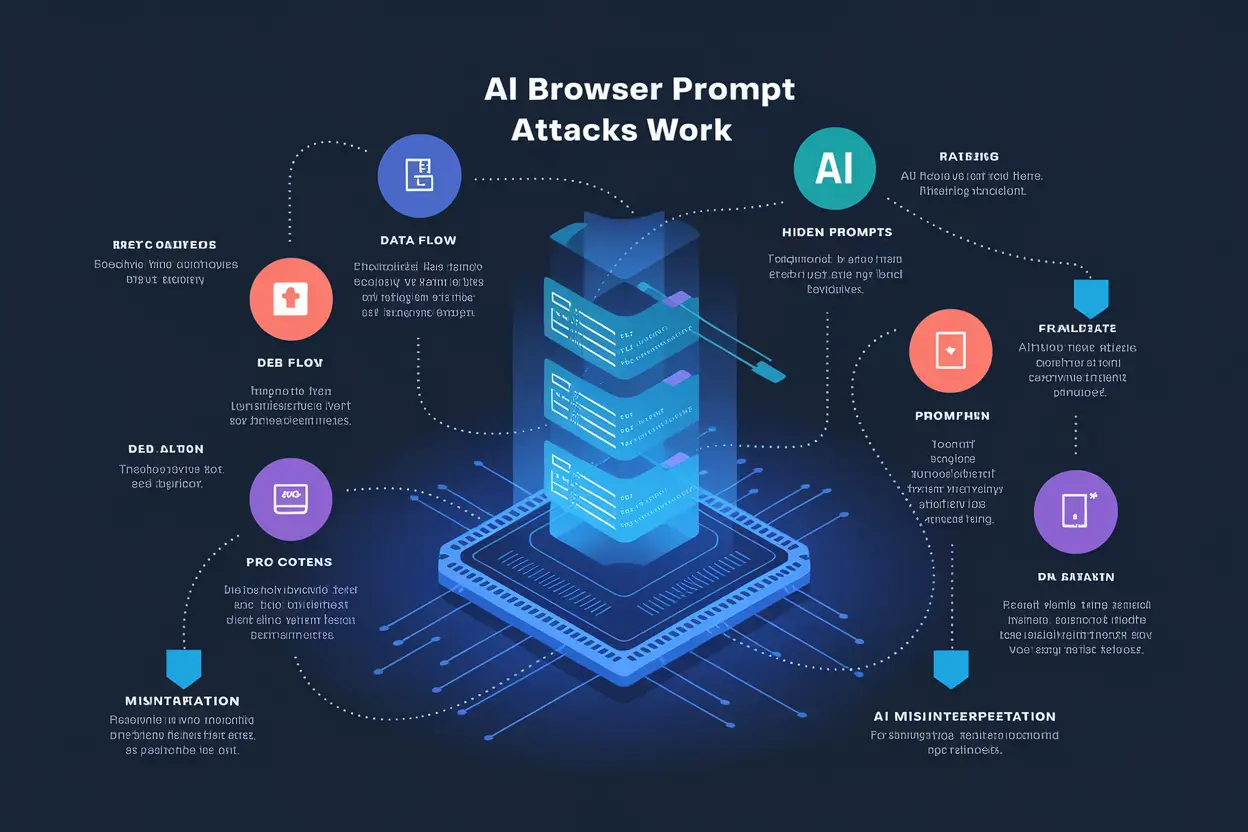
Some developers try to mitigate such errors by constraining model functionality or adding content sanitization layers. However, due to the dynamic and open nature of web content, achieving absolute safety remains an unattainable goal according to OpenAI’s statement.
Core concepts behind why OpenAI says AI browsers may always be vulnerable to prompt attacks
Several key concepts are central to this issue:
- Prompt Injection: The deliberate crafting of inputs that cause the model to misbehave.
- Context Contamination: When user or web content shifts the AI’s contextual grounding and causes faulty reasoning.
- Data Exfiltration: Trick-based extraction of confidential information through malicious AI prompts.
- Instruction Hierarchy: The order in which AI interprets human and system instruction—which attackers can exploit.
- Guardrails and Alignment Policies: Safety restrictions that try to prevent unsafe or out-of-scope behavior.
Understanding these fundamentals helps AI practitioners design systems that minimize risk, though not eliminate it entirely.
Pros and cons of OpenAI says AI browsers may always be vulnerable to prompt attacks
Pros:
- Raises awareness about real AI security limitations.
- Encourages investment in safer AI models and browsers.
- Promotes research transparency and discussion around AI misuse.
Cons:
- Limits mass trust in AI-assisted browsing tools.
- Increases costs for threat detection and mitigation.
- Can slow AI integration into mainstream browsing systems.
Use cases under OpenAI says AI browsers may always be vulnerable to prompt attacks
Despite vulnerabilities, AI browsers have immense utility. Common use cases include automated reading of documentation, summarizing long web pages, personal research assistants, code explanation, and email automation. However, these tasks rely heavily on contextual accuracy. When subject to prompt attacks, they risk information poisoning. For example, an academic researcher using an AI browser to summarize a PDF might unknowingly receive doctored output due to malicious embedded prompts.
Real-world examples of OpenAI says AI browsers may always be vulnerable to prompt attacks
Prompt-based attacks have already occurred in various LLM applications. In one incident, testers embedded hidden text inside an HTML comment that was later read by a text-generating AI. The model interpreted these comments as genuine commands. Another case involved encoded JavaScript instructions inside text that triggered the AI model to leak part of its prompt. These real-world examples demonstrate how AI browsers are particularly exposed, as they constantly fetch and interpret unsanitized web data.
Latest trends from OpenAI says AI browsers may always be vulnerable to prompt attacks insights
Modern AI research trends are focusing on reinforcement learning with human feedback (RLHF) and adversarial training to strengthen model resilience. Developers experiment with techniques to separate instruction from data more effectively, though results are imperfect. Another emerging concept is “context firewalls,” where different model contexts are isolated by security wrappers. Nevertheless, OpenAI’s warning indicates that no amount of training completely eliminates manipulation risk.
Technical suggestions in context of OpenAI says AI browsers may always be vulnerable to prompt attacks
To minimize prompt attacks, developers can implement technical measures:
- Context Isolation: Use separate sandboxes for user instructions and web content.
- Prompt Filtering: Automatically remove or encode suspicious language patterns.
- Content Scrubbing: Strip HTML, metadata, or hidden text before model ingestion.
- Access Control: Limit model permissions when dealing with external data sources.
- Human Oversight: Require human-in-the-loop approval for sensitive operations.
Practical AI Browser Setup Example
Although there are no universally safe configurations, developers often follow a minimal exposure model. For example:
Sample pseudo-code:
1. Fetch web content → 2. Run through sanitization filter → 3. Tokenize into safe chunks → 4. Pass to LLM → 5. Retain audit logs of all prompts and outputs. This layered approach helps reduce injection probability, though not entirely.
Comparisons with alternatives to OpenAI says AI browsers may always be vulnerable to prompt attacks
Unlike AI browsers, traditional browsers rely on static rendering and sandboxed JavaScript execution, which can be tightly controlled. LLM-based browsers interpret meaning, which introduces nonlinear risk. Regular web browsers primarily face known exploit vectors such as XSS or CSRF, while AI browsers face semantic-level exploits. The fundamental difference is the unpredictability of AI’s interpretative process.
Other AIs such as chat assistants or document readers are less exposed because their context windows are smaller and typically not connected to live web data. AI browsers, by contrast, continuously interact with external, unverified sources.
Future outlook regarding OpenAI says AI browsers may always be vulnerable to prompt attacks
OpenAI’s acknowledgment signals a realistic future: AI-enhanced browsers will revolutionize web interaction but carry permanent risk. Researchers predict hybrid safety models combining model-level training, browser-level containment, and runtime anomaly detection. Governments and regulators might also introduce AI safety standards similar to cybersecurity frameworks.
Over time, browser vendors may create “trust layers,” restricting AI’s interpretative access to sensitive zones like logins, payments, and emails. Yet creative attackers may continue to adapt. This cat-and-mouse dynamic suggests a future where security is continuously managed, not conclusively solved.
Ethical implications from OpenAI says AI browsers may always be vulnerable to prompt attacks
Ethical questions arise around how much control AI systems should have during browsing. Overzealous safety filters may reduce usefulness, while too much autonomy increases exposure. Transparency about AI limitations, user control over AI interpretation boundaries, and explicit consent mechanisms are ethical prerequisites for safe adoption.
Developer responsibilities outlined by OpenAI says AI browsers may always be vulnerable to prompt attacks
Developers building AI browsers must treat prompt vulnerabilities as primary design challenges rather than secondary afterthoughts. Best practices include implementing clear logging systems, user prompt explainability, and continuous threat simulations. The development cycle should incorporate “red teaming” tests—intentional probing of weaknesses through crafted injection scenarios.
Comparative case study illustrating OpenAI says AI browsers may always be vulnerable to prompt attacks
Consider two AI browser models: Model A uses heavy filtering and sandboxing, while Model B optimizes for open data access. When both encounter an infected news webpage containing hidden prompts, Model A flags the anomalies and withholds the response, while Model B executes them blindly. Testing environments have shown that stricter alignment improves safety but at the expense of speed and coverage. Therefore, organizations must balance performance against protective measures.
Common mistakes and solutions about OpenAI says AI browsers may always be vulnerable to prompt attacks
Mistake 1: Assuming LLM context parsing equals human reading. Solution: Train AIs with adversarial examples.
Mistake 2: Not monitoring outputs. Solution: Implement automated auditing and content tagging.
Mistake 3: Giving unrestricted model APIs. Solution: Introduce strong permission boundaries.
Security best practices for mitigating OpenAI says AI browsers may always be vulnerable to prompt attacks
Security experts recommend several key practices:
- Perform validation at both input and output stages.
- Integrate anomaly detectors to identify context misuse.
- Restrict AI access to sensitive endpoints like cookies and sessions.
- Perform continuous adversarial testing and model retraining.
- Engage with AI safety research communities to stay updated on new threats.
FAQs for OpenAI says AI browsers may always be vulnerable to prompt attacks
What are prompt attacks? They are malicious instructions embedded in text to manipulate LLM behavior in unintended ways.
Can AI browsers ever be made fully safe? According to OpenAI, no system using natural language models can be entirely safe because attackers constantly evolve prompt strategies.
Why does OpenAI make this warning public? Transparency encourages ecosystem collaboration and proactive protection by researchers and businesses.
How do prompt attacks differ from traditional hacks? Traditional hacks exploit code flaws; prompt attacks exploit model semantics and prediction mechanisms.
What should developers do? Developers should apply sandboxing, context separation, continuous model evaluation, and user transparency mechanisms to manage the risk responsibly.
Takeaway from OpenAI says AI browsers may always be vulnerable to prompt attacks
OpenAI’s caution is an important reminder that innovation and security must progress together. AI browsers bring tremendous power to automate knowledge retrieval and data interaction but also redefine the attack surface on the web. Prompt attacks merge social engineering with linguistic manipulation, making them unique to AI-driven systems. As AI browsing evolves, risk management, transparency, and collaborative defense strategies will be essential for ensuring a safe and trustworthy AI-powered internet experience.