
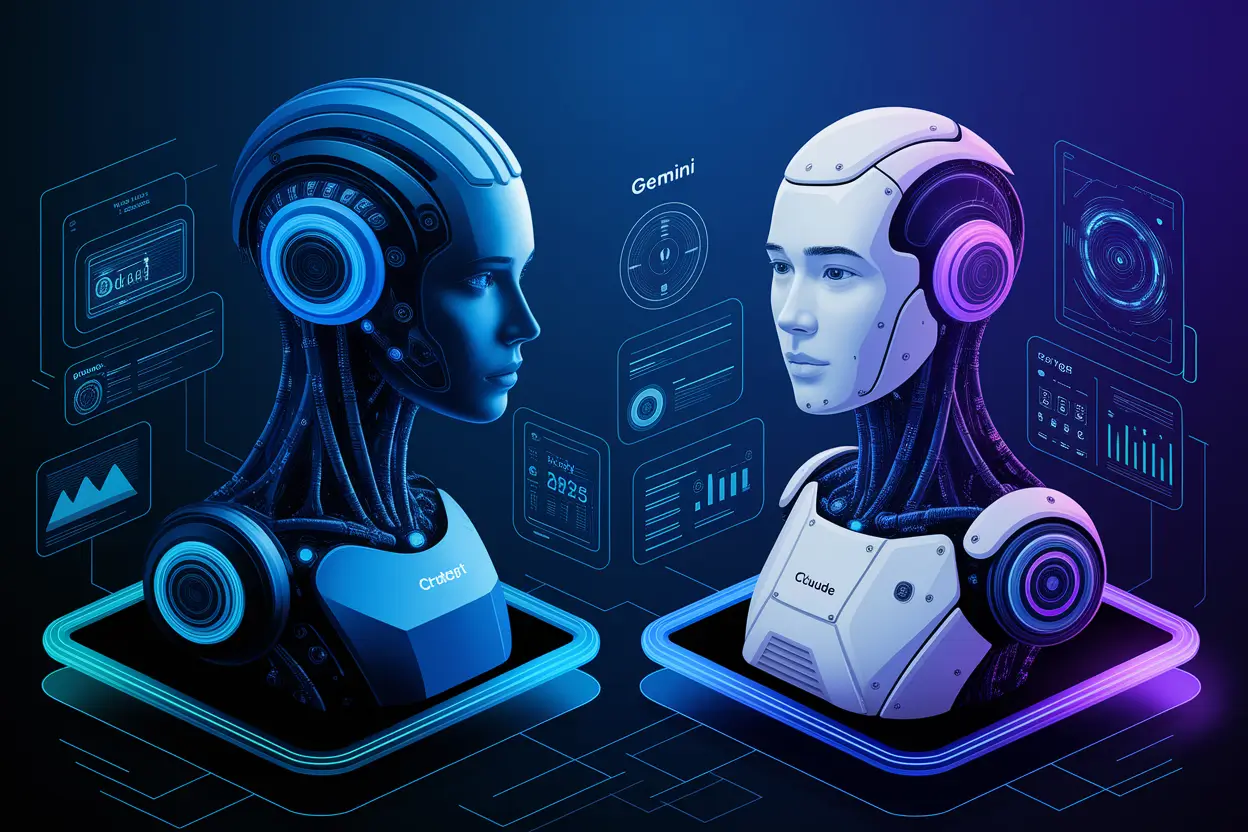
ChatGPT vs Gemini vs Claude is one of the most important debates in artificial intelligence for 2026. These three large language models (LLMs) represent the leading edge of AI-powered tools for text generation, automation, and cognitive assistance. Each of them is backed by a major company—ChatGPT by OpenAI, Gemini by Google DeepMind, and Claude by Anthropic. As they evolve rapidly, understanding their differences, strengths, architectures, and use cases is crucial for businesses, developers, and general users deciding which AI best aligns with their goals.
Over the past few years, large language models have transformed from simple chatbots to multimodal systems that understand text, images, audio, and even video. 2026 marks a mature phase in this revolution, as these models integrate reasoning, grounding, and real-time data capabilities. The purpose of this article is to explain how ChatGPT, Gemini, and Claude compare in architecture, capabilities, performance, and practicality—helping readers make informed decisions when choosing one for their particular use case.
Understanding ChatGPT vs Gemini vs Claude in 2026
As of 2026, the competition between ChatGPT, Gemini, and Claude defines the AI productivity landscape. ChatGPT remains the most widely adopted due to its accessibility via OpenAI’s ChatGPT app and API. Gemini, formerly known as Bard, has been reengineered by Google DeepMind to integrate tightly with Google Search and Workspace. Claude, developed by Anthropic, has gained traction for its safety-first design and ethical reasoning approach.
Each model builds upon transformer architecture but diverges significantly in fine-tuning objectives, training data governance, and real-time integration. ChatGPT 5 utilizes reinforcement learning from human feedback (RLHF) and reinforcement learning from AI feedback (RLAIF), Gemini leverages hybrid multimodal models combining text, image, and video pretraining, while Claude emphasizes constitutional AI principles—meaning it follows a transparent set of ethical rules built into its training process.
How ChatGPT vs Gemini vs Claude Works Technically
All three models use transformer-based architectures, but their underlying workflows differ slightly. In ChatGPT, tokenized sequences of words are processed through multiple attention layers to understand relationships and context. Gemini extends this process to visual and auditory inputs, adding multimodal fusion layers. Claude uses similar architecture but combines it with a layered moderation framework to filter harmful or ambiguous queries.
Training Datasets
- ChatGPT: Trained on a filtered mixture of web data, textbooks, and specialized datasets, followed by safety fine-tuning with human-in-the-loop annotations.
- Gemini: Uses Google-scale canonical datasets including YouTube transcripts, code repositories, and synthetic data generated using smaller in-house models.
- Claude: Uses ethically sourced data, high-quality text corpora, and reinforcement learning guided by its Constitutional AI system, which defines explicit behavioral principles.
Inference Speed and Infrastructure
Inference time depends on hardware optimization. ChatGPT 5 uses OpenAI’s optimized NVIDIA H100 and custom hardware to reduce latency. Gemini 2 operates on Google’s TPUs and offers near-real-time reasoning speed. Claude 3 leverages Anthropic’s scalable cloud APIs with dynamic context window expansion, allowing longer conversations—up to one million tokens in 2026.
Strengths and Weaknesses of ChatGPT vs Gemini vs Claude
Each model has its unique strengths and limitations that users and organizations must consider:
ChatGPT Pros and Cons
- Pros: Industry-wide adoption, wide integration via APIs, versatile multimodal capabilities, exceptional coding assistance.
- Cons: Some limitations on proprietary data accuracy, occasional factual hallucinations, limited customization for enterprises without specialized plans.
Gemini Pros and Cons
- Pros: Deep integration with Google products, real-time web access, and state-of-the-art multimodality.
- Cons: Limited availability for external developers, dependency on Google ecosystem, less flexible deployment options.
Claude Pros and Cons
- Pros: Strong focus on ethical reasoning, high-context retention, safety-first principles.
- Cons: Slightly slower inference times, limited multimedia capabilities.
Use Cases of ChatGPT vs Gemini vs Claude
Each AI model serves distinct enterprise and personal applications. Businesses deploy them for automation, customer support, research, and content generation, while developers use them for coding and problem-solving.
- ChatGPT: Best for interactive tutors, coding copilots, and dynamic chatbots integrated with enterprise knowledge bases.
- Gemini: Excellent for businesses already within Google Workspace, SEO research, and multimodal marketing workflows.
- Claude: Leading for legal, compliance, and sensitive reasoning applications due to its explainability and grounded logic.
Real-World Examples of ChatGPT vs Gemini vs Claude
Large corporations are using these AIs differently. A global consulting firm might use ChatGPT 5 to generate reports and automate code documentation. A media company might rely on Gemini for video-to-text summarization and SEO optimization. A law firm might prefer Claude 3 for drafting contracts aligned with ethical standards.
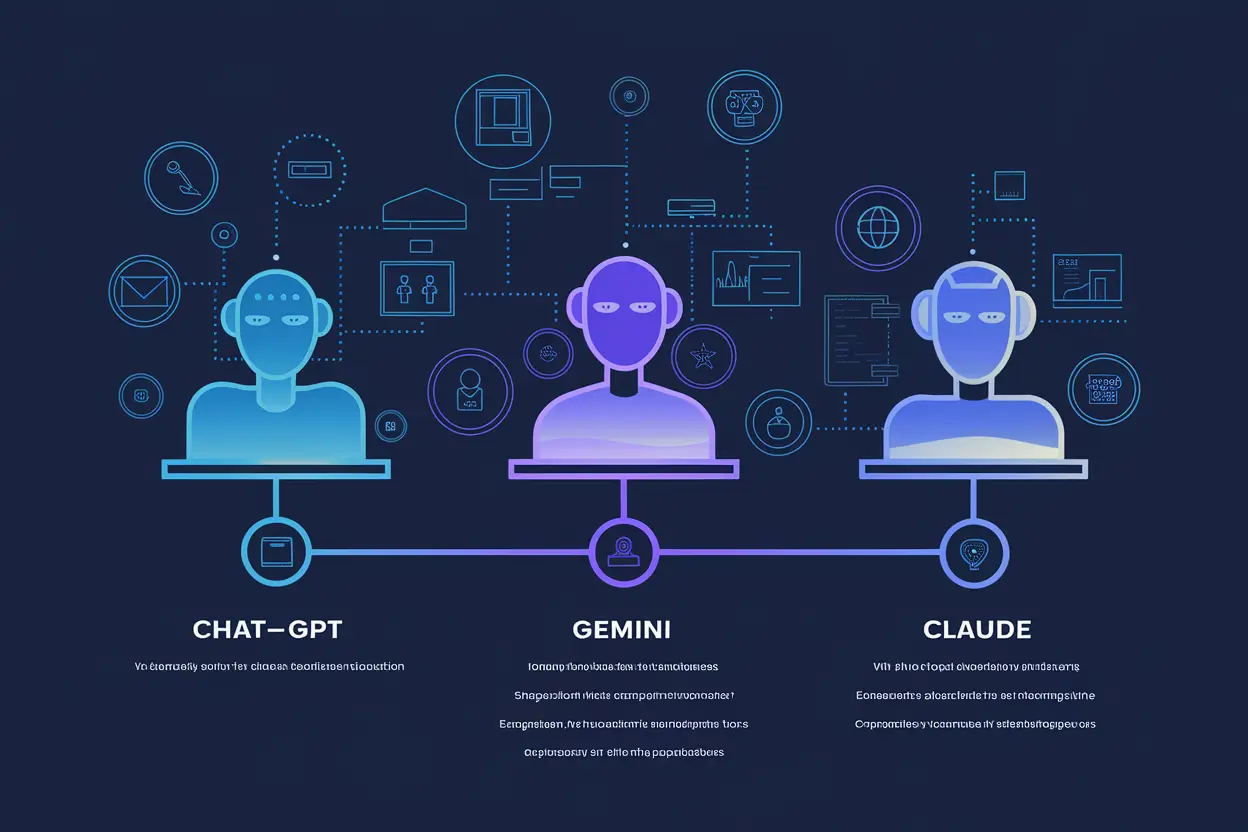
In education, universities deploy ChatGPT for personalized tutoring systems, Gemini for educational multimedia search, and Claude for analyzing research ethics documents. Healthcare applications include Claude’s safe diagnosis prompting, Gemini’s image-based symptom analysis, and ChatGPT’s conversational triage assistants integrated into electronic health record systems.
Latest Trends in ChatGPT vs Gemini vs Claude for 2026
In 2026, the main trend is personalization and contextual grounding. ChatGPT, Gemini, and Claude now enable memory features and context persistence across sessions, offering more continuity in user experience. ChatGPT 5 provides adaptive personality modes; Gemini integrates user activity across Google products; Claude customizes responses based on conversational tone and moral reasoning.
Technical Setup and API Integration
Developers can integrate these models via REST APIs. A common Python setup might include sending HTTP POST requests with user prompts, API keys, and temperature parameters. Although syntax differs slightly between APIs, the structure remains similar:
Example workflow using Python for general LLM API integration:
- 1. Install SDK or use requests library.
- 2. Define API endpoint URL.
- 3. Pass authentication key and prompt parameters.
- 4. Capture and format the response text.
While Gemini uses Google’s Vertex AI SDK, ChatGPT integrates via OpenAI’s platform, and Claude uses Anthropic’s API structure.
Performance Comparison Table: ChatGPT vs Gemini vs Claude
| Feature | ChatGPT 5 | Gemini 2 | Claude 3 |
|---|---|---|---|
| Context Window | 512k tokens | 1M tokens | 1M tokens |
| Multimodal Support | Text, Image, Audio | Text, Image, Video | Text only |
| Speed | Very Fast | Real-time | Moderate |
| Customization | High for Developers | Medium | Moderate |
| Security | Strong | Strong | Exceptional |
Business Impact of ChatGPT vs Gemini vs Claude
Enterprise adoption metrics reveal that ChatGPT dominates open API usage, Gemini excels in corporate integrations, and Claude leads in compliance-sensitive sectors. Each model’s pricing structure reflects this: OpenAI offers ChatGPT Plus and Enterprise tiers, Google bundles Gemini under Workspace, and Anthropic uses usage-based API billing for Claude Pro and Business tiers.
Ethical and Privacy Considerations
Ethics remains central in 2026 discussions. Claude’s Constitutional AI guides its moral reasoning. Gemini leverages Google’s data governance model, anonymizing inputs. ChatGPT integrates stronger privacy controls and memory reset options. End-users can now audit AI memory, delete stored data, and limit contextual adaptation to maintain confidentiality.
Challenges in ChatGPT vs Gemini vs Claude Adoption
The greatest challenges are model hallucinations, latency in long-context applications, and ethical limitations. Developers must build mechanisms to verify outputs, integrate trust layers, and monitor performance. Enterprise-level governance frameworks ensure that AI-generated content meets brand standards and regulatory guidelines.
Future Outlook for ChatGPT vs Gemini vs Claude
The future points toward hybrid reasoning systems. By 2027, experts anticipate cross-model collaboration, real-time multimodal perception, and personalized AI instances that understand users over time. ChatGPT will likely integrate deeper with Microsoft ecosystems, Gemini may power enterprise search and assistant technologies, and Claude will continue leading in safe AI development.
Expect advanced grounding techniques using retrieval-augmented generation (RAG), which allows models to fetch verified information dynamically from trusted databases. Quantum computing acceleration could further reduce inference delays, enabling AIs to handle complex tasks such as predictive analytics, manufacturing optimization, and medical diagnostics.
Common Mistakes When Choosing Between ChatGPT vs Gemini vs Claude
- Choosing only based on popularity instead of use-case alignment.
- Ignoring data privacy policies and compliance standards.
- Overestimating AI autonomy without human oversight.
- Underutilizing custom APIs or integration features.
Actionable Tips for Using ChatGPT vs Gemini vs Claude
- Run small-scale tests before enterprise rollout.
- Define clear metrics: accuracy, latency, integration ease.
- Customize prompts for the model’s strengths.
- Continuously fine-tune prompt templates based on user feedback.
Case Study: Using ChatGPT vs Gemini vs Claude in a Tech Startup
A software startup in 2026 uses ChatGPT 5 for documentation and coding help, Gemini 2 for video-based product demos, and Claude 3 for drafting privacy policy content. After three months, productivity improves 40%, content turnaround time halves, and compliance review errors drop by 25%. This highlights the potential synergy among all three tools when used strategically.
FAQs About ChatGPT vs Gemini vs Claude
Which AI is best for business automation?
ChatGPT generally excels for business automation due to its API flexibility and integration tools. Gemini is better for data-heavy content workflows, and Claude is ideal where decision transparency and safety are priorities.
Can I use all three models together?
Yes. Multi-AI integration frameworks allow connecting ChatGPT, Gemini, and Claude through APIs. Each can be assigned distinct tasks—for example, Claude for compliance checking, Gemini for search intelligence, and ChatGPT for response generation.
Which AI performs better for coding?
ChatGPT remains slightly ahead in coding assistance with advanced contextual understanding and support for multiple programming languages. Gemini follows closely with deep integration into Google Colab and Workspace coding tools.
What are the data privacy differences?
Claude offers the strongest built-in privacy protections, Gemini leverages Google’s ANA-compliance framework, and ChatGPT continually updates privacy dashboards and local data deletion options.
Will these models replace human roles?
Not entirely. Instead of replacing humans, these AIs augment capabilities—handling repetitive knowledge tasks, summarizing data, and assisting with reasoning—allowing humans to work creatively and strategically.
Conclusion: The Verdict on ChatGPT vs Gemini vs Claude
By 2026, the ChatGPT vs Gemini vs Claude debate is less about superiority and more about suitability. ChatGPT leads for general-purpose versatility and API depth, Gemini dominates in multimodal integration with Google tools, and Claude’s ethical reasoning defines best-practice standards. Businesses should align their choice with desired capabilities—productivity for ChatGPT, information breadth for Gemini, and trustworthy reasoning for Claude. Together, these three shape the future of responsible AI-driven innovation.