

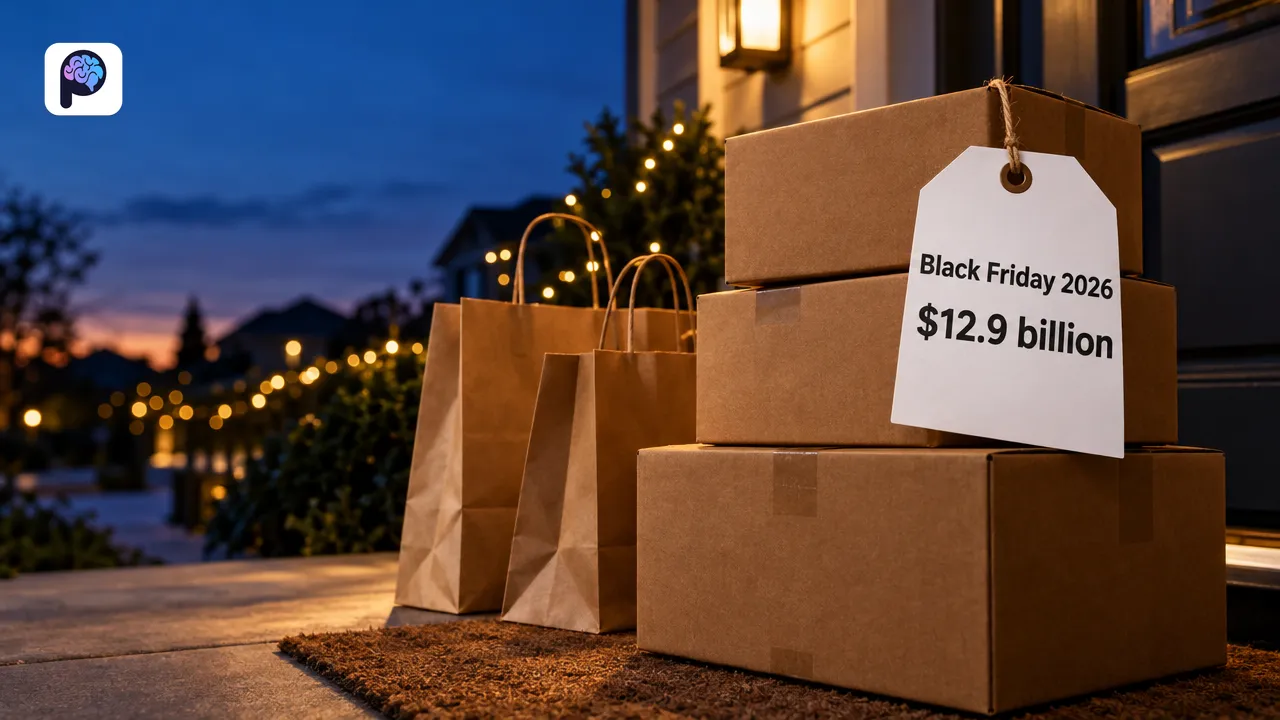
Black Friday 2026 is forecast to bring $12.9 billion in US online spending, according to Adobe. That is up 9.2% on last year. Here is what the forecasts say, where they come from, and how to check whether a deal really saves you money.
What Happened: Black Friday 2026 by the Numbers
Two sets of figures shape the coverage today. Adobe tracks online sales on US retail sites. The National Retail Federation (NRF) surveys how many people plan to shop. In its September holiday forecast, Adobe expects US online spending of $275.1 billion from November 1 to December 31, up 6.7% year over year.
Spending is running ahead of that pace so far. Adobe data reported by Digital Commerce 360 showed more than $82.5 billion spent online from November 1 to November 22, up 9.1%.
| Measure | 2026 figure | Change vs 2025 | Source |
|---|---|---|---|
| Black Friday online spending (forecast) | $12.9 billion | +9.2% | Adobe |
| Thanksgiving Day online spending (forecast) | $6.9 billion | +8.5% | Adobe |
| Cyber Monday online spending (forecast) | $15.1 billion | +6.2% | Adobe |
| Cyber Week, Thanksgiving to Cyber Monday (forecast) | $47.5 billion | +7.4% | Adobe |
| Online spending, Nov 1 to Nov 22 (actual) | More than $82.5 billion | +9.1% | Adobe via Digital Commerce 360 |
| Thanksgiving weekend shoppers (survey) | 182.7 million | 186.9 million last year | NRF |
| People planning to shop on Black Friday | 126 million (69%) | Not given | NRF |
So the money spent online is forecast to rise, while slightly fewer people plan to shop over the weekend than last year.
What These Forecasts Are and How They Are Measured
Adobe’s numbers come from Adobe Analytics, which measures direct online transactions. Its forecast is based on more than 1 trillion visits to US retail sites and 100 million products across 18 categories. Adobe counts online sales only, not store sales.

The NRF figures are survey answers, not sales. The NRF Thanksgiving weekend survey, run by Prosper Insights & Analytics, asked 7,956 adults between October 30 and November 9. Its margin of error is plus or minus 1.1 percentage points. Of Black Friday shoppers, 67% said they were likely to shop in stores and 89% online.
Why shoppers are cautious
The same NRF survey found that 82% of holiday shoppers are taking steps to manage costs. These include buying less expensive gifts (25%), cutting back in other areas (24%) and buying for fewer people (20%). Deals that were “too good to pass up” were the top reason to shop that weekend, named by 48%.
Separately, in its holiday sales forecast, the NRF expects total holiday retail sales in November and December to grow 4.2% to $1.013 trillion. That forecast excludes car dealers, gas stations and restaurants.
What Black Friday 2026 Means for Your Money
A forecast of deep discounts does not mean every price tag is a bargain. Adobe expects discounts of up to 30% off listed prices during Cyber Week. Its forecast peak discounts are 30% for electronics, 29% for toys and 23% each for TVs, computers and apparel. Use the numbers below to test any deal before you pay.
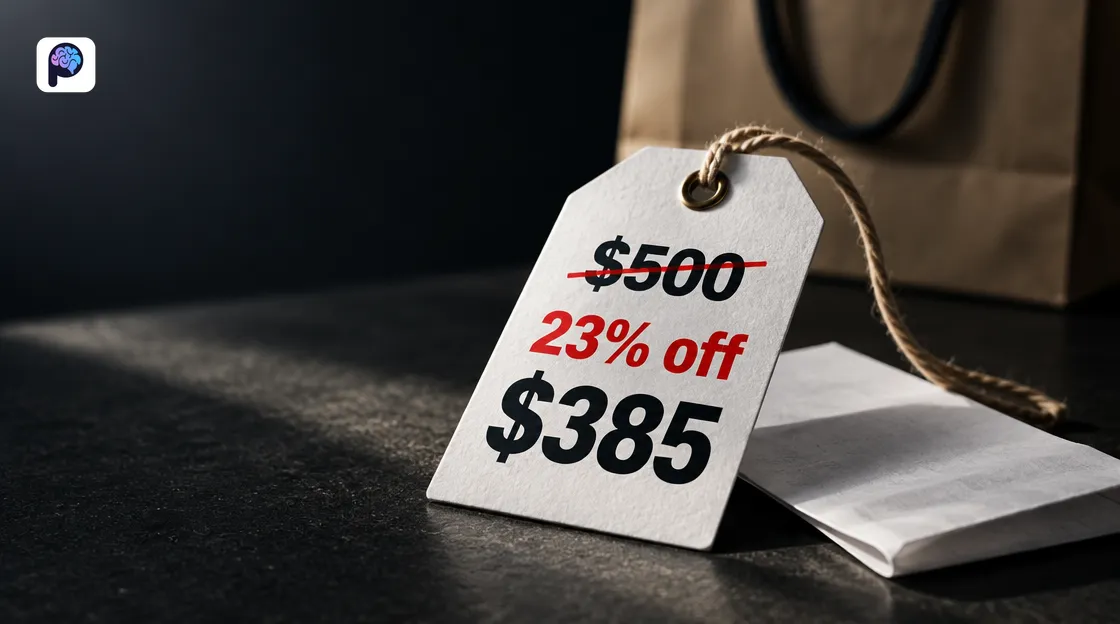
Worked example 1: the real saving on one item
Example with round numbers. A TV listed at $500 is 23% off. The saving is $500 × 0.23 = $115, so you pay $385. A discount calculator does this in one step, and a percentage calculator helps when a store shows only the dollar saving.
Worked example 2: stacked discounts do not simply add up
Example with round numbers. A store offers 20% off, then an extra 10% off at checkout. That is not 30% off. On a $100 item, 20% off leaves $80. An extra 10% off $80 leaves $72. Your total discount is 28%, because the second discount applies to the lower price.
Worked example 3: compare with the price you saw before the sale
Example with round numbers. A jacket shows a list price of $450 and 20% off, so the sale price is $360. If the same jacket sold for $400 in October, your real saving against that price is $40, or 10%. The percentage change formula gives this: ($360 minus $400) divided by $400 = minus 10%.
Buy now, pay later is growing too
Adobe forecasts $21.3 billion of buy now, pay later (BNPL) spending in November and December, up 6.6%. It expects $807 million of that on Black Friday and $1.09 billion on Cyber Monday. Example with round numbers: a plan that splits a $400 order into four payments of $100 still adds $100 to each of your next four due dates. If you instead carry a card balance, a loan calculator shows how interest adds to the cost over the months you take to repay. Read each plan’s terms for late fees before you agree.
What Happens Next
After Black Friday 2026, the next big date is Cyber Monday on November 30, which Adobe forecasts at $15.1 billion, more than Black Friday. Adobe’s forecast says electronics and computer discounts should be deepest on Cyber Monday, while TVs, toys, apparel, appliances and furniture discounts are expected to peak on Black Friday.
Adobe’s season forecast runs to December 31. It expects discounts of up to 10% to 15% in December, lower than the Cyber Week peak. Actual Black Friday results will replace today’s forecasts once Adobe and the NRF publish them.
Conclusion
Black Friday 2026 is part of what Adobe forecasts as a record online holiday season, even as slightly fewer people plan to shop over the weekend and most say they are watching costs. The headline numbers are forecasts and survey answers, so treat them as a guide to the season, not to any single price. Check the real discount, remember that stacked discounts are smaller than they look, and plan BNPL payments as you would any bill. This article is general information, not financial advice.