


US GDP growth was stronger from July to September than first reported. On 25 November 2026 the Bureau of Economic Analysis (BEA) revised its estimate of real gross domestic product for the third quarter of 2026 to an annual rate of 4.3%, up from 3.4% in its advance estimate. Here is what changed, what the number means, and how it connects to your savings and loans.
What Happened: Q3 GDP Growth Revised Up to 4.3%
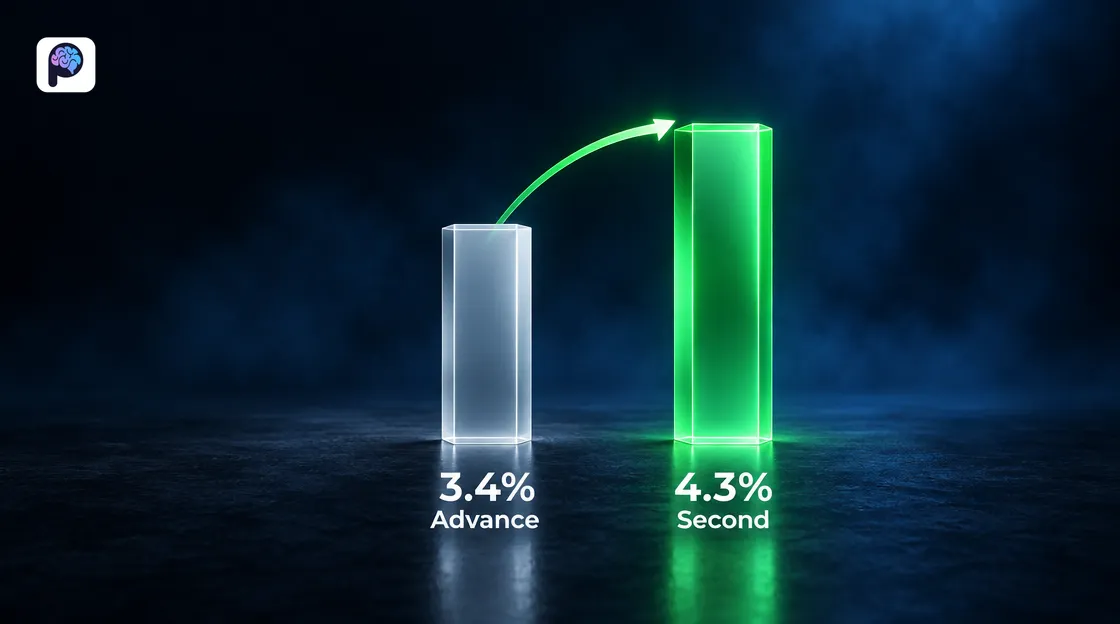
The BEA’s second estimate was released at 8:30 a.m. EST on Wednesday, 25 November. It covers July, August and September 2026. In the agency’s words, real GDP “increased at an annual rate of 4.3 percent in the third quarter of 2026” in its second estimate. Growth in the second quarter was 2.2%.
The upgrade of 0.9 percentage point mainly reflected upward revisions to investment and consumer spending. Within investment, the revision was led by intellectual property products, notably software. Spending on goods was revised up. That was partly offset by a downward revision to services, led by health care.
| Measure (Q3 2026, annual rate) | Advance estimate | Second estimate |
|---|---|---|
| Real GDP | 3.4% | 4.3% |
| Real final sales to private domestic purchasers | 4.9% | 5.8% |
| Current-dollar GDP | 5.6% | 6.2% |
| Gross domestic purchases price index | 3.0% | 2.7% |
| PCE price index | 2.1% | 2.1% |
| Core PCE price index (excluding food and energy) | 2.5% | 2.5% |
Two more figures from the same release are worth knowing. Real gross domestic income (GDI), which measures the economy from the income side, rose 4.4% after 2.3% in the second quarter. Corporate profits from current production rose $206.0 billion in the third quarter, a smaller gain than the $384.0 billion in the second quarter.
Source: BEA, GDP (Second Estimate) and Corporate Profits, 3rd Quarter 2026.
What GDP Growth Measures

GDP is the value of the goods and services produced in the United States. “Real” GDP strips out price changes. It shows how much more the economy produced, not how much more it charged.
Why the figure is an annual rate
The BEA reports quarterly growth as if it continued for a full year. The release’s technical notes put the plain quarter-on-quarter increase at 1.1%. Turning an annual rate back into a quarterly one works like compounding on a savings account: (1.043)^(1/4) - 1 = 0.0106, or about 1.1% per quarter. Our compound interest formula guide walks through the same idea step by step.
Advance, second and third estimates
The BEA publishes three estimates for each quarter, and each one uses more complete source data. In this round, the downward revision to health care spending was based on newly available Census Bureau Quarterly Services Survey data. A third estimate follows in December, so the 4.3% figure can still change.
What It Means for Your Money
GDP growth does not land in your bank account. It matters because the Federal Reserve looks at economic data such as growth and inflation when it sets its policy rate, with goals of maximum employment and stable prices. In the US, many savings, CD, credit card and variable-rate loan rates are influenced by that rate, although banks and lenders set their own rates.
Prices are the other half of the story. The PCE price index in this release rose at a 2.1% annual rate in the third quarter. A separate BEA report on the same day put the PCE price index 3.8% higher in October than a year earlier, which we cover in our PCE inflation explainer. The two figures cover different periods, so they are not directly comparable.
Worked example 1: percentage points versus percent
This is an illustrative example. GDP growth went from 3.4% to 4.3%. The difference is 4.3 – 3.4 = 0.9 percentage point. As a relative change, the estimate rose by 0.9 / 3.4, or about 26%. Headlines quote the first number. Our percentage change formula guide explains when to use each.
Worked example 2: savings against inflation
This is an illustrative example with round numbers, not a forecast or a rate quote. Say you hold $10,000 in savings that earn 4% a year, and prices rise 2.1% over the year, the same pace as the third-quarter PCE price index.
- Interest after one year: $10,000 x 4% = $400, so the balance is $10,400.
- Value in today’s prices: $10,400 / 1.021 = about $10,186.
- Real gain: about $186, not $400.
If prices rose 3.8% instead, the October year-on-year pace, the same $10,400 would be worth about $10,019 in today’s prices ($10,400 / 1.038). The real gain shrinks to about $19. For your buying power, what counts is the gap between the rate on your account and inflation.
Worked example 3: a variable-rate loan
This is also illustrative. On a $20,000 variable-rate balance, each 0.25 percentage point change in the rate changes a year’s interest by about $20,000 x 0.0025 = $50, before any repayments. To work out a full monthly payment for your own balance, use our calculate loan payment formula guide.
What Happens Next
These are the next official dates that bear on this story:
- 8 December 2026: BEA report on US international trade in goods and services for October.
- 8 to 9 December 2026: Federal Open Market Committee meeting, with a Summary of Economic Projections, according to the Federal Reserve meeting calendar.
- 23 December 2026, 8:30 a.m. EST: GDP third estimate for the third quarter, with corporate profits, plus Personal Income and Outlays for November, according to the BEA release schedule.
Conclusion
US GDP growth ran at a 4.3% annual rate in the third quarter of 2026, faster than the 3.4% first reported. Upward revisions to investment, notably software, and to consumer spending drove the upgrade. For your money, the useful questions are what your savings earn compared with inflation, and how a change in rates would move your loan costs. Watch the Fed meeting on 8 to 9 December and the third GDP estimate on 23 December.
This article is general information, not financial advice.