

AI vs Blockchain is one of the most transformative debates in modern technology. Both Artificial Intelligence (AI) and Blockchain are redefining how data, automation, and digital trust function in a hyperconnected world. AI focuses on learning and decision-making through data, while Blockchain secures, decentralizes, and verifies that data without intermediaries. Understanding the intersection, divergence, and future dominance of these two technologies is key for businesses, developers, and innovators planning for the digital future.
Understanding AI vs Blockchain: A Foundational Overview
Artificial Intelligence (AI) is a branch of computer science that enables machines to simulate human intelligence, make predictions, and automate decision-making using large datasets. Blockchain, on the other hand, is a distributed digital ledger that records transactions in a secure and immutable way across multiple nodes. While AI relies on data for predictive insights, Blockchain provides a tamper-proof record of that data for transparency and trust.
AI consists of subfields such as machine learning (ML), deep learning, computer vision, and natural language processing. Blockchain technology encompasses distributed ledgers, consensus mechanisms, cryptographic hashing, and smart contracts. Both technologies have unique strengths and limitations yet complement each other when applied correctly.
How AI Works in the Context of AI vs Blockchain
AI systems learn from data through mathematical models and algorithms. The process typically includes data collection, preprocessing, training, validation, and deployment. Once trained, AI models can perform tasks such as recognizing images, translating text, or predicting weather. Key techniques include supervised learning, unsupervised learning, reinforcement learning, and neural networks.
AI models require large amounts of clean, structured data to perform optimally. This reliance on centralized data sources introduces issues of privacy, transparency, and bias. As Blockchain can decentralize and secure how data is stored and shared, combining the two technologies can significantly enhance trust and data integrity.
How Blockchain Works in Relation to AI vs Blockchain
Blockchain is structured as a chain of blocks linked together by cryptographic hashes. Each block contains transaction data, a timestamp, and a reference to the previous block. This structure ensures immutability, meaning no data can be altered once added to the Blockchain. The network operates on consensus mechanisms like Proof of Work (PoW), Proof of Stake (PoS), or Practical Byzantine Fault Tolerance (PBFT) to validate transactions without centralized authority.
Blockchain’s distributed nature ensures data availability and resistance to tampering. Unlike AI, which uses data for analysis, Blockchain ensures the authenticity of that data. The union of these technologies creates a system that is both intelligent and trustworthy.
Core Concepts Behind AI vs Blockchain Technologies
Key AI concepts include neural networks, algorithms, learning models, cognitive computing, and pattern recognition. For Blockchain, core components include nodes, smart contracts, consensus, and cryptographic security. Both operate on data but approach it differently—AI interprets and acts on data, while Blockchain records and validates its integrity.
Combining these systems results in enhanced models for data-driven decision-making. For instance, an AI can propose optimal supply chain routes, while Blockchain verifies and tracks every material movement transparently.
Pros and Cons of AI vs Blockchain
Pros of AI:
- Automation and increased efficiency
- Advanced data analytics and predictions
- Continuous self-improvement through learning
- Enhanced user experiences via personalization
Cons of AI:
- Data bias and lack of transparency
- High computational requirements
- Privacy and ethical challenges
- Dependence on centralized data storage
Pros of Blockchain:
- Security and immutability
- Transparent data tracking
- Decentralized network structure
- Smart contracts enabling trustless interactions
Cons of Blockchain:
- Scalability challenges
- Energy-intensive consensus mechanisms
- Slower transaction speeds compared to centralized systems
- Complex integration with legacy systems
Understanding these can help determine the areas where each technology thrives—and where they can coexist.
AI vs Blockchain Use Cases in Real-world Scenarios
AI applications are vast—spanning healthcare diagnostics, self-driving cars, predictive analytics, chatbots, and fintech fraud detection. Blockchain is revolutionizing sectors like cryptocurrency, supply chain management, identity verification, and digital contracts.
For example, in healthcare, AI models analyze patient data to predict diseases, while Blockchain ensures that medical records remain secure and untampered. In finance, AI algorithms detect fraudulent activities in real-time, and Blockchain records transparent and immutable transaction histories.
AI vs Blockchain Integration Possibilities
Integrating AI and Blockchain can yield powerful systems where data is both trustworthy and actionable. Decentralized AI networks can use Blockchain to record training data provenance, ensuring that models aren’t corrupted by malicious or biased datasets. Similarly, Blockchain-enabled federated learning allows multiple parties to train AI models collaboratively without exposing private data.
This integration could be transformative for privacy-centric markets like healthcare, government, and finance.
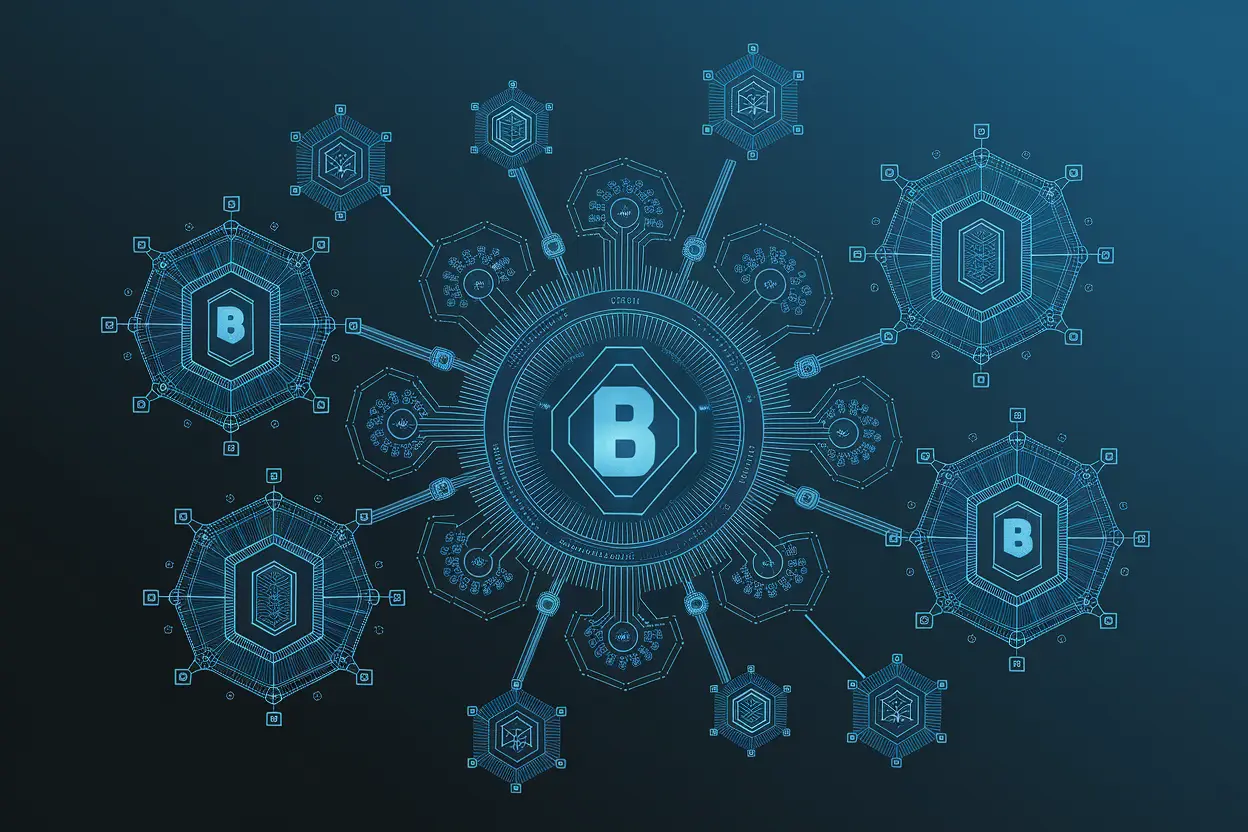
Systems where AI models make decisions based on Blockchain-verified data could lead to full automation in trust-based environments.
Technical Comparisons and Data Flow of AI vs Blockchain
In typical architecture, AI uses a central data repository to process and learn from data. Blockchain, however, eliminates the central point by spreading data across nodes. Integrating both requires careful orchestration using APIs and smart contracts. For example, a smart contract might trigger automatic retraining of an AI model based on new validated data entries.
Developers can use frameworks like TensorFlow or PyTorch for AI and Ethereum or Hyperledger for Blockchain. Combining them often involves using off-chain computation for AI processing while storing model hashes on-chain for verification.
Example (simplified pseudocode):
1. Gather data via Blockchain entries.
2. Extract and preprocess for AI model.
3. Train AI model using validated data.
4. Store AI model hash to Blockchain.
5. Verify inference transactions with on-chain records.
Real-World Examples of AI vs Blockchain Applications
Several pioneering companies are merging AI and Blockchain. Ocean Protocol structures decentralized data marketplaces enabling AI training on Blockchain-verified data. SingularityNET offers an AI marketplace powered by Blockchain, letting developers share and monetize AI services transparently. IBM’s Food Trust links supply chains using Blockchain for traceability, while AI optimizes logistics and waste reduction.
These examples show how the synergy of trust (Blockchain) and intelligence (AI) drives innovation across industries.
AI vs Blockchain Latest Trends and Industry Insights
Emerging trends show growing investments in combining AI and Blockchain for secure data trading, autonomous decision-making, and digital identity verification. DeFi (Decentralized Finance) platforms integrate AI-based trading bots for risk management. Governments explore Blockchain-based record systems enhanced by AI-driven analytics. Edge computing paired with Blockchain promises decentralized AI model execution in IoT networks.
Another hot trend is Generative AI using Blockchain proofs to verify content authenticity, addressing deepfake and misinformation risks.
Comparing AI vs Blockchain with Other Alternatives
While AI and Blockchain dominate tech innovation, alternatives exist. Cloud computing scales data operations but lacks immutable verification. Traditional databases are fast but centralized. Edge computing delivers low-latency solutions but cannot verify trust. Thus, Blockchain provides transparency while AI introduces adaptiveness. Their integration outperforms both isolated and competing technologies like centralized analytics systems or legacy ERP setups.
Technical Suggestions for Implementing AI vs Blockchain Systems
- Use decentralized storage (e.g., IPFS) for accessible yet secure AI training data.
- Leverage smart contracts for AI model authorization and traceability.
- Ensure AI model explainability to maintain ethical standards.
- Choose energy-efficient consensus algorithms to reduce environmental impact.
- Implement cryptographic privacy-preserving techniques like Zero-Knowledge Proofs when handling sensitive data.
For developers, establishing interoperability between off-chain AI computations and on-chain verification layers is essential to scale hybrid systems effectively.
Security and Ethical Aspects in AI vs Blockchain
AI raises ethical issues around bias, surveillance, and autonomy, while Blockchain presents challenges regarding identity anonymity and energy usage. When integrated, AI can detect fraudulent patterns in Blockchain transactions, and Blockchain can create audit trails verifying AI model decisions. Ethical standards like transparency, explainability, and sustainability become crucial to adoption.
Future Outlook of AI vs Blockchain
The future will likely see AI and Blockchain working together rather than competing for dominance. Blockchain provides the structure for trust, while AI offers cognitive capabilities for analysis. Combined, they will power autonomous economies, decentralized governance systems, and human–machine collaboration at unprecedented scales.
By 2030, organizations may rely on Blockchain-secured AI models for nearly every digital process. The convergence could also accelerate fields like quantum computing and global trade automation.
AI vs Blockchain FAQs
What is the main difference between AI and Blockchain?
AI focuses on data-driven decision-making and learning, while Blockchain emphasizes data trust, decentralization, and immutability.
Can AI and Blockchain work together?
Yes. AI and Blockchain complement each other—Blockchain secures datasets for AI training, and AI enhances Blockchain efficiency through predictive analytics and automation.
Which industry benefits most from AI vs Blockchain integration?
Industries like healthcare, finance, and supply chain management benefit the most as they demand both accuracy and transparency in data operations.
Will AI or Blockchain dominate the future?
Neither will entirely dominate. Their combination will likely shape digital ecosystems—AI providing intelligence, Blockchain offering trust infrastructure.
What skills are needed to work on AI and Blockchain integration?
Knowledge in programming (Python, Solidity), cryptography, data science, distributed systems, and machine learning frameworks are essential for working in this hybrid tech domain.
Conclusion: AI vs Blockchain Will Shape the Intelligent, Trusted Future
AI vs Blockchain represents not just a comparison of two technologies, but a convergence shaping the future digital world. AI delivers smart, adaptive decision-making; Blockchain ensures transparent and secure foundations. Together, they promise a new era of decentralized intelligence—where data is trusted, automated, and ethical. As industries evolve, mastering AI and Blockchain will be vital for innovation-driven success.