


AI Mobile App Development is reshaping how companies build, optimize, and interact with digital platforms. It combines artificial intelligence with mobile development to create smarter, more adaptive, and user-centered applications. Through machine learning, natural language processing, and computer vision, apps can now anticipate user needs, automate decisions, and deliver personalized experiences that traditional apps simply cannot match.
Understanding AI Mobile App Development
AI Mobile App Development refers to the process of integrating artificial intelligence technologies into mobile applications. This involves using algorithms and models that enable apps to process data, learn from patterns, and perform complex tasks automatically. Rather than being limited to pre-programmed instructions, AI-driven apps continuously evolve through data input and feedback.
The major components involved include neural networks, data analytics, machine learning frameworks, and APIs that connect intelligent functionalities like speech recognition or image classification. The integration can range from simple chatbots to fully autonomous decision-making systems embedded in mobile interfaces.
How AI Mobile App Development Works
The functional workflow of AI Mobile App Development begins with data collection. The quality and quantity of data determine how effectively the AI model learns. From there, data preprocessing cleans and structures the dataset. Machine learning algorithms are then trained using this data to identify relationships and predict outcomes. Once models are tested and validated, they are deployed into mobile environments via APIs or embedded libraries. Apps then continuously collect user data, refine predictions, and improve performance over time.
Technical Workflow
- Data collection from sensors, servers, or external APIs
- Data cleaning and preprocessing
- Training AI models using machine learning or deep learning algorithms
- Model testing and optimization for mobile constraints
- Integration with app backend or directly on-device
- Continuous feedback loop for improvements
Core Concepts in AI Mobile App Development
Several core concepts drive the success of AI Mobile App Development. These include supervised and unsupervised learning, neural networks, reinforcement learning, and natural language processing. Each plays a unique role. For instance, supervised learning is useful for classification problems, while reinforcement learning helps in dynamic decision-making processes like gaming or real-time suggestions.
Machine Learning Models
The foundation of AI Mobile App Development lies in machine learning models trained to detect patterns from large datasets. These models can be classification, regression, or clustering-based depending on the app’s purpose. Frameworks like TensorFlow Lite, Core ML, and PyTorch Mobile allow developers to embed these models efficiently into mobile devices.
Benefits of AI Mobile App Development
There are substantial benefits to adopting AI Mobile App Development practices:
- Enhanced personalization: AI analyzes user behavior and customizes experiences in real-time.
- Automation: Tasks like data entry, recommendations, and customer support become automated.
- Improved user engagement: Personalized notifications and interactions increase retention rates.
- Predictive analytics: Apps can forecast user preferences, sales, and interactions.
- Efficient resource management: Optimized data and workload distribution improves performance and battery usage.
Drawbacks and Limitations of AI Mobile App Development
Despite its potential, AI Mobile App Development brings several challenges:
- High development cost: Building and training models require significant time and computing resources.
- Data dependency: AI models rely heavily on high-quality data.
- Privacy risks: AI apps process sensitive personal data, raising compliance and ethical issues.
- Maintenance: Continuous updates and retraining are needed as user behavior changes.
Major Use Cases of AI Mobile App Development
AI Mobile App Development is prevalent in multiple industries. Some core use cases include:
- Healthcare: AI-driven apps monitor patient habits, detect anomalies, and predict diseases.
- Finance: Fraud detection, automated trading bots, and expense tracking.
- E-commerce: Personalized product recommendations and visual search.
- Education: Adaptive learning systems that tailor courses based on user performance.
- Travel: Intelligent booking systems and predictive fare analysis.
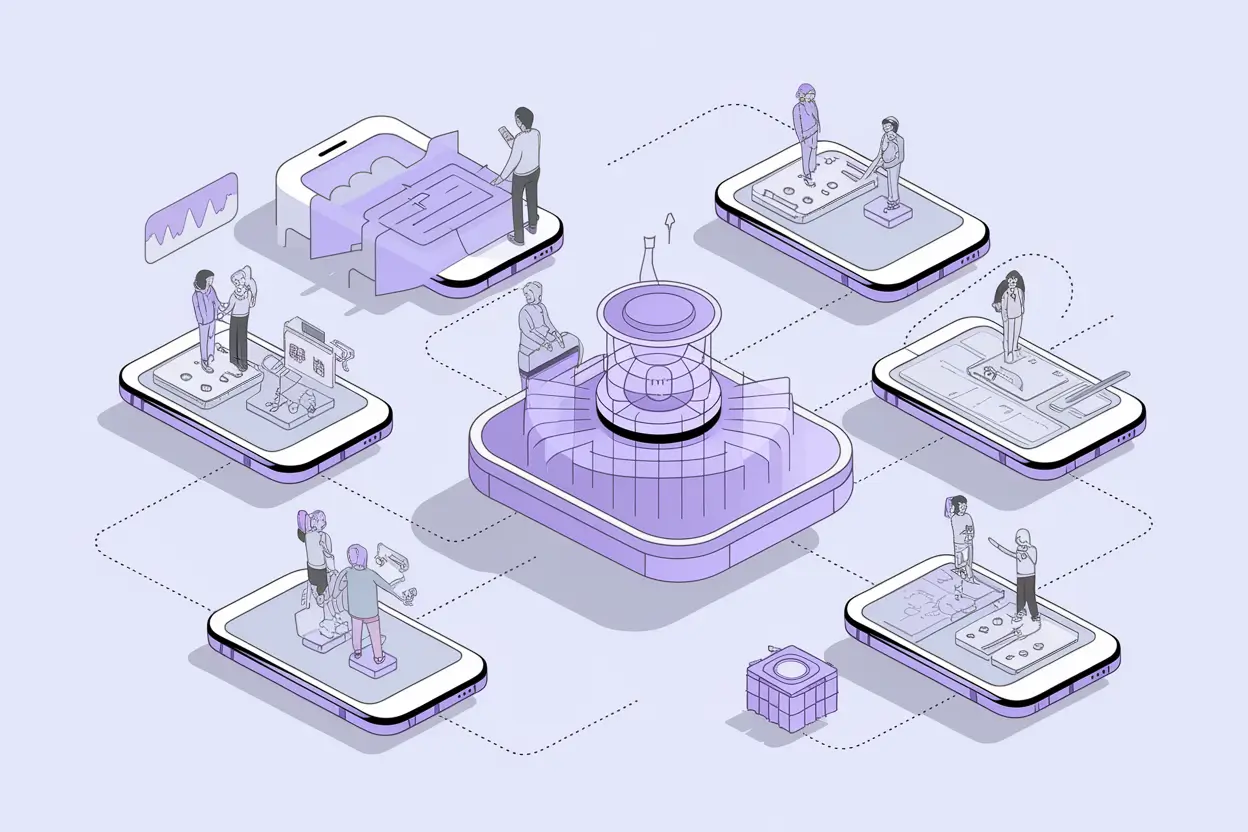
Real-World Examples of AI Mobile App Development
Some leading apps exemplify powerful AI Mobile App Development:
- Spotify: Uses AI for music recommendation based on listening patterns.
- Google Assistant: Applies natural language processing for human-like conversations.
- Grammarly: Uses AI for grammar correction and contextual suggestions.
- Snapchat: Implements AI for real-time facial detection and filters.
These examples showcase the potential of integrating adaptable algorithms that continually enhance user experience through data-driven feedback cycles.
Latest Trends in AI Mobile App Development
The latest trends in AI Mobile App Development center on making intelligence on-device, enhancing security, and creating multi-modal interactions. Some current shifts include:
- On-device AI: Performing AI computation locally using frameworks like TensorFlow Lite.
- Edge computing: Reducing latency by processing data closer to the user.
- Explainable AI: Making AI decision-making more transparent for users.
- Voice and vision AI: Integration of multi-sensory interfaces.
- Low-code AI tools: Platforms simplifying AI integration for developers without deep technical expertise.
Technical Aspects of AI Mobile App Development
Developers focusing on AI Mobile App Development must balance performance with intelligent features. It’s essential to optimize models for mobile hardware, manage memory constraints, and accelerate processing with GPU or neural engines. Popular tools and frameworks include:
- TensorFlow Lite for Android and iOS implementation.
- Core ML for iOS machine learning model integration.
- PyTorch Mobile for lightweight model deployment.
- Firebase ML Kit for easy mobile AI features like text recognition and translation.
Sample Setup
For instance, integrating TensorFlow Lite in Android apps typically involves converting a trained TensorFlow model to TensorFlow Lite format and loading it into an application as an asset for inference. Developers must handle model initialization, input tensor feeding, and output tensor reading with optimized threading for performance.
Comparisons: AI Mobile App Development vs Traditional Development
| Feature | AI Mobile App Development | Traditional App Development |
|---|---|---|
| User Experience | Dynamic, personalized | Static and linear |
| Data Interaction | Real-time and predictive | Rule-based |
| Maintenance | Continuous model updates | Occasional fixes |
| Cost | Higher upfront but sustainable | Lower initial cost |
The Future of AI Mobile App Development
The future of AI Mobile App Development is shaped by continuous advancement in hardware and software integration. Mobile devices are becoming AI-ready, capable of running complex neural networks locally. The incorporation of quantum computing, augmented reality, and real-time data fusion will push mobile applications to unimaginable levels of intelligence and adaptability.
AI ethics, data privacy laws, and sustainable computing will also play major roles in defining responsible AI practices. As AI becomes more intuitive, mobile experiences will blur the line between physical and digital interactions.
Common Mistakes in AI Mobile App Development
- Neglecting model accuracy and bias testing.
- Underestimating dataset preparation requirements.
- Failing to monitor data drift post-deployment.
- Ignoring computational overhead and battery drain.
Understanding these pitfalls ensures long-term system reliability and user trust.
Best Practices for AI Mobile App Development
- Choose lightweight AI models optimized for mobile inference.
- Focus on privacy-preserving methods such as federated learning.
- Implement continuous model monitoring and retraining.
- Integrate explainability to help users trust AI outputs.
Step-by-Step Process for AI Mobile App Development
- Define objectives: Identify exact use case and target audience.
- Collect data: Ensure dataset quality with clean labeling.
- Train model: Choose suitable algorithm and test for performance.
- Integrate model: Use frameworks that support mobile scalability.
- Monitor and update: Track model performance and retrain regularly.
Case Study Example
Consider a virtual fitness app integrating computer vision through AI Mobile App Development. Using a smartphone camera, the AI identifies body movements, counts reps, and provides personalized fitness feedback in real-time. With TensorFlow Lite, the model runs locally, keeping user data private while maintaining low latency. This demonstrates how complex functionality can be brought directly to users without cloud dependency.
FAQs About AI Mobile App Development
What programming languages are best for AI Mobile App Development?
Languages like Python for model creation and Swift or Kotlin for mobile integration are most effective. Python’s vast AI libraries and mobile support frameworks simplify the workflow.
How can small startups benefit from AI Mobile App Development?
Even with limited resources, startups can leverage open-source AI frameworks and cloud APIs to integrate powerful features like chatbots or recommendations, enhancing user value and engagement.
Are AI-based apps expensive to maintain?
They can be initially resource-intensive. However, continuous optimization and edge processing reduce costs over time while improving efficiency.
Which industries are investing most in AI Mobile App Development?
Healthcare, retail, finance, education, and entertainment are currently leading in AI adoption to streamline customer interactions, automate operations, and personalize engagement.
Is on-device AI better than cloud AI?
On-device AI enhances security and reduces latency by limiting data transfer, while cloud AI offers more computational power. The choice depends on application needs and scale.
Conclusion: The Transformative Power of AI Mobile App Development
AI Mobile App Development is redefining mobile technology by making apps smarter, faster, and more intuitive. As machine learning evolves and becomes more accessible, AI-driven features will no longer be a luxury but a standard expectation. Businesses that embrace AI Mobile App Development today position themselves at the forefront of innovation, delivering unmatched user experiences and operational efficiency.
The journey toward intelligent mobile apps is only beginning, and those investing in this evolution now will lead the future of digital transformation.