

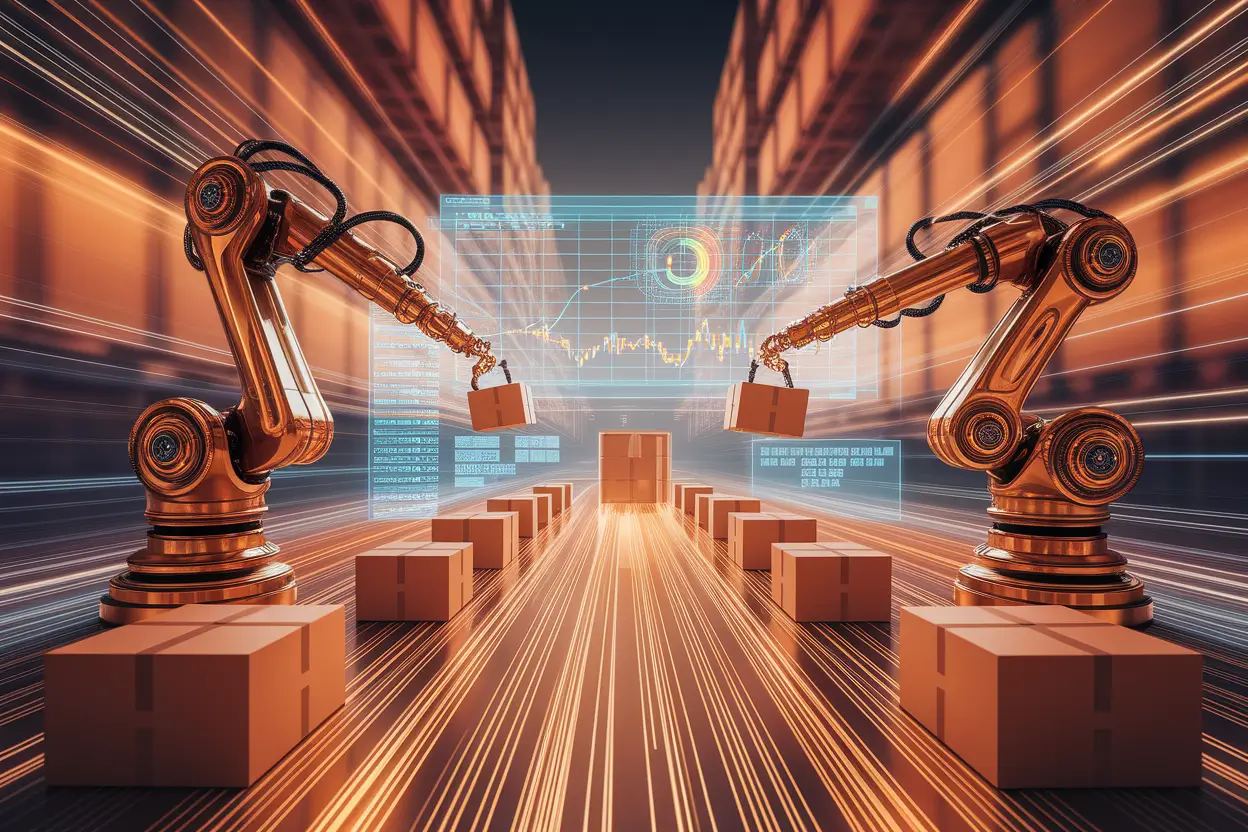
AI in Supply Chain Management is transforming how businesses forecast demand, manage logistics, and optimize production. Artificial Intelligence brings data-driven intelligence to a traditionally complex network of procurement, manufacturing, and distribution. With AI, organizations can predict market shifts, reduce waste, and boost operational accuracy, resulting in faster, leaner, and more resilient supply chains.
Understanding AI in Supply Chain Management
AI in Supply Chain Management involves using machine learning, neural networks, and analytics tools to enhance supply chain operations. These systems process massive amounts of structured and unstructured data to detect patterns and forecast outcomes that traditional models cannot capture. From warehouse automation to supplier performance tracking, AI intelligently augments human decision-making throughout the logistics lifecycle.
How AI in Supply Chain Management Works
AI-powered systems work by collecting data from multiple supply chain touchpoints such as procurement systems, IoT sensors, and ERP solutions. Machine learning models then analyze this data to identify inefficiencies or bottlenecks. Predictive analytics tools forecast future demand and supply scenarios. Natural language processing simplifies communications and order tracking. Robotics process automation handles repetitive tasks like invoice matching or inventory updates, allowing teams to focus on strategic improvements.
Key Technical Components
- Data Integration: Combining data from suppliers, transportation systems, and market sources.
- Machine Learning Models: Used for predictive demand forecasting and anomaly detection.
- Optimization Algorithms: Improve inventory placement and distribution routes.
- Computer Vision: Supports automated inspection and quality assurance.
- Intelligent Agents: Provide dynamic decision support in real-time operations.
Core Concepts Behind AI in Supply Chain Management
Integrating AI in Supply Chain Management depends on several foundational concepts. These include predictive analytics for anticipating demand and disruptions, cognitive automation for operational execution, and prescriptive analytics for suggesting best courses of action. Reinforcement learning helps systems adapt to changing supply dynamics over time, continually improving efficiency.
Pros of Implementing AI in Supply Chain Management
- Enhanced Forecast Accuracy: Reduces overproduction and shortages by learning from historical data.
- Operational Efficiency: Minimizes human errors and accelerates repetitive workflows.
- Cost Reduction: Predictive models enable proactive maintenance and reduce logistics costs.
- Improved Customer Experience: Real-time insights enhance delivery accuracy and transparency.
- Risk Management: Detects potential disruptions before they cause significant impact.
Cons and Limitations of AI in Supply Chain Management
- High Implementation Costs: Developing and integrating AI systems requires initial investment.
- Data Dependence: Performance depends heavily on data quality and volume.
- Skills Gap: Requires specialized AI and data analysis expertise.
- Privacy Concerns: Handling sensitive supplier and customer data necessitates strict compliance protocols.
- Integration Challenges: Connecting legacy systems to AI platforms can be complex.
Use Cases of AI in Supply Chain Management
AI in Supply Chain Management finds applications across numerous stages. Predictive demand forecasting allows retailers to plan orders based on consumption patterns. Manufacturers use AI for asset maintenance scheduling. Logistics firms utilize AI to optimize route planning and dynamic pricing models. Warehouse operations leverage robotics for picking and sorting tasks. Procurement teams incorporate AI to evaluate supplier reliability and sustainability metrics.
Real-World Examples of AI in Supply Chain Management
Several organizations have successfully deployed AI to streamline supply chain processes. Amazon uses predictive analytics and robotics for warehouse operations, reducing order processing time. IBM’s Watson integrates real-time data analytics for supply chain visibility. Unilever applies machine learning to analyze over 75 million data points to forecast demand and manage raw materials efficiently.
Latest Trends in AI in Supply Chain Management
Modern developments include AI-driven sustainability initiatives, blockchain-integrated traceability solutions, and digital twins for process simulation. Companies increasingly use AI to monitor carbon emissions, enhance supplier diversity, and automate intelligence-based decision-making. The shift from reactive to proactive logistics is now driven by autonomous software agents that communicate across supply systems.
Technical Implementation Suggestions for AI in Supply Chain Management
Implementing AI systems requires a layered architecture that integrates data pipelines, learning algorithms, and analytics dashboards. Businesses should start with structured pilot programs targeting specific inefficiencies. For instance, use machine learning to predict seasonal inventory fluctuations or optimize transportation routes. Over time, incremental adoption enhances scalability and ROI.
Example Setups Using Python
Developers can use Python libraries like scikit-learn, TensorFlow, and Pandas to build predictive models. A basic code example involves:
Demand Forecasting Example
Import data via Pandas, train a regression model (RandomForestRegressor), and forecast based on historical data series. Integrate results into ERP dashboards for real-time analytics. This allows continuous learning from new sales and logistics data to fine-tune forecasts.
Comparing AI in Supply Chain Management with Traditional Supply Chain Systems
The main difference lies in adaptability and intelligence. Traditional systems rely on historical records and human prediction, while AI systems actively learn and self-optimize. AI-driven supply chains quickly detect anomalies and recommend corrective actions in real time. In contrast, conventional systems follow static rule-based protocols. A simplified comparison:
| Aspect | Traditional Supply Chain | AI-Driven Supply Chain |
|---|---|---|
| Decision Making | Manual | Automated and Predictive |
| Data Use | Historical | Real-Time and Predictive |
| Adaptability | Low | High, Self-learning |
| Operational Cost | Static | Optimized Continuously |
Case Study: AI in Supply Chain Management for Retail
A major retail chain adopted AI to track supply flow across several continents. Using deep learning, the system predicted product shortages weeks ahead, prompting faster replenishment. Inventory accuracy improved by 30%, transportation costs fell by 12%, and waste from expired goods dropped significantly.
Common Challenges in Deploying AI in Supply Chain Management
Challenges include data silos, lack of standardization, and cultural resistance to automation. Businesses should prioritize clean data architecture, cross-departmental integration, and transparent governance frameworks. Laying proper groundwork is essential for achieving the full potential of AI-driven optimization.
Best Practices for Integrating AI in Supply Chain Management
- Standardize data collection formats across departments.
- Adopt modular AI solutions to allow gradual scaling.
- Create pilot programs before full implementation.
- Train teams on AI ethics, interpretation, and decision-making.
- Continuously monitor model performance and data drift.
Common Mistakes and How to Avoid Them in AI in Supply Chain Management
- Rushing Implementation: Skipping feasibility studies often leads to misalignment.
- Ignoring Data Governance: Unstructured or outdated data hampers model accuracy.
- Neglecting Human-AI Collaboration: Over-reliance on automation can cause oversight.
- Single-Use Focus: Broaden use cases to maximize ROI across processes.
Future Outlook of AI in Supply Chain Management
The future of AI in Supply Chain Management lies in full automation, AI explainability, and hybrid intelligence combining human strategic input with algorithmic precision. AI systems will orchestrate complex global supply networks, dynamically adjusting to economic trends, natural disasters, or geopolitical events in real-time. Predictive logistics combined with autonomous delivery drones, blockchain records, and adaptive manufacturing will define next-generation supply ecosystems.
FAQ on AI in Supply Chain Management
How does AI improve supply chain forecasting?
AI helps identify demand patterns, seasonal trends, and anomalies by analyzing historical and real-time data, improving accuracy significantly over manual forecasting methods.
Can small businesses use AI in Supply Chain Management?
Yes, affordable cloud-based AI tools allow small organizations to analyze inventory performance and optimize procurement without extensive infrastructure costs.
What are the security concerns with AI in supply chains?
Security risks include unauthorized data access and model tampering. Using encrypted data pipelines and multi-tier authentication mitigates these concerns.
Is AI replacing humans in supply chain operations?
No, AI complements human work by automating repetitive tasks and providing decision support, allowing professionals to focus on strategy and innovation.
What technologies combine with AI in Supply Chain Management?
Technologies like IoT, blockchain, and robotic process automation synchronize with AI to enhance transparency, traceability, and efficiency across the supply network.
Conclusion: The Strategic Edge of AI in Supply Chain Management
AI in Supply Chain Management represents a revolutionary leap in logistics and operations. By uniting predictive analytics, automation, and cognitive intelligence, it ensures accuracy, agility, and sustainability. Companies implementing AI-based strategies can expect dynamic adaptability, minimized volatility, and measurable performance gains. As AI technology matures, embracing it early positions businesses to thrive in the era of intelligent supply ecosystems.