


Agentic AI in Customer Support is revolutionizing how businesses interact with customers by enabling intelligent systems to independently execute tasks through contextual understanding and goal-directed behavior. This transformative approach provides not only speed and cost-efficiency but also a personalized, proactive customer experience at scale.
What Is Agentic AI in Customer Support?
Agentic AI in customer support refers to intelligent agents that operate autonomously to manage customer service processes. These systems leverage technologies like natural language processing (NLP), machine learning, and integration with enterprise infrastructure to comprehend, respond, and resolve customer issues without constant human intervention. They excel at performing repetitive tasks and proactively addressing queries while maintaining seamless escalation to human agents when necessary.
Core Components Powering Agentic AI in Customer Support
Understanding the key components of agentic AI in customer support helps grasp its capability to transform service delivery:
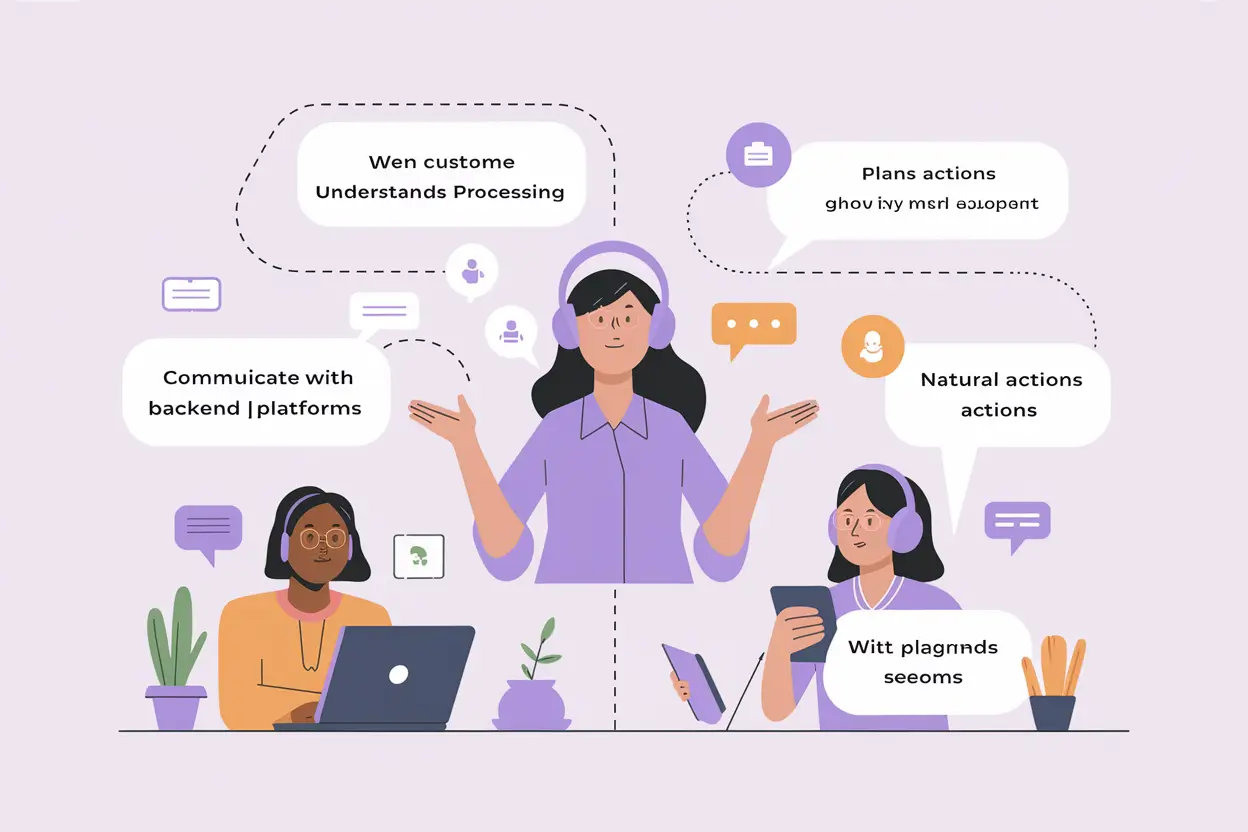
- Contextual Orchestration: Interprets customer queries using NLP to extract intent and sentiments.
- Goal-Oriented Planning: Sets strategies to achieve user-defined or system-inferred objectives.
- Autonomous Execution: Carries out tasks such as updating accounts or issuing refunds by interfacing with backend systems.
- Adaptive Decision-Making: Adjusts responses depending on real-time context and feedback.
- Learning Capabilities: Enhances performance over time using data from past interactions.
- Seamless Escalation: Hands off complex queries to human agents with full conversational context.
Benefits of Agentic AI in Customer Support
Implementing agentic AI in customer support brings several advantages that directly impact customer satisfaction and organizational efficiency:
- Operational Efficiency: Automates repetitive tasks, minimizing response times and optimizing staff allocation.
- Scalability: Handles thousands of queries concurrently without compromising service quality.
- Consistency: Ensures uniform responses, maintaining brand voice and accuracy.
- Cost Reduction: Decreases dependence on large support teams, cutting overhead.
- Round-the-Clock Support: Provides uninterrupted service across time zones and holidays.
Agentic AI in Customer Support vs. Traditional Chatbots
| Aspect | Agentic AI | Traditional Chatbots |
|---|---|---|
| Autonomy | Fully autonomous | Rule-based, limited to scripts |
| Adaptability | Adaptive decision-making | Fixed responses |
| Integration | Integrates deeply with systems | Minimal integration |
| Handling Complexity | Manages complex issues | Fails at complexity |
Process Flow of Agentic AI in Customer Support
Agentic AI interacts with customers through a systematic and strategic process:
- Analyzes input using NLP.
- Maps inquiry to intent and goal.
- Formulates and executes action plan.
- Learns from feedback and outcomes.
- Escalates to human support when uncertain.
Key Features of Agentic AI in Customer Support
Rich feature sets empower agentic AI to deliver superior service:
- Personalized Responses: Uses customer history to tailor replies.
- Proactive Engagement: Addresses potential issues before customer initiates contact.
- Omnichannel Support: Functions across multiple platforms like chat, email, or voice.
- Security-Compliant Actions: Operates under strict guidelines to protect data.
Real-World Use Cases of Agentic AI in Customer Support
Many leading sectors have successfully deployed agentic AI in customer support:
- E-commerce: Resolves return issues, provides alternate product suggestions, and streamlines order inquiries.
- Banking: Detects fraud, executes dispute processes, and keeps customers informed.
- Telecommunications: Runs diagnostics, arranges technician visits, and adjusts billing autonomously.
Challenges of Using Agentic AI in Customer Support
Despite its strengths, there are limitations and concerns associated with agentic AI in customer support:
- Complex Implementation: Requires time, resources, and specialist knowledge.
- Limited Empathy: Cannot replicate human empathy during sensitive conversations.
- Security Risks: Systems must rigorously adhere to data privacy laws.
- System Dependence: Over-reliance might cause failures if AI malfunctions or misinterprets scenarios.
How to Implement Agentic AI in Customer Support
Deploying agentic AI strategically requires the following steps:
- Assess Needs: Identify repetitive, automatable customer support functions.
- Select Technology: Choose platforms that support advanced AI and enterprise integration.
- Integrate Systems: Connect the AI with CRM, ERP, and other essential tools.
- Train AI: Use historical interactions to train the system on scenarios and behaviors.
- Monitor Performance: Continuously collect data to refine interactions and decision policies.
Latest Trends in Agentic AI in Customer Support
Current industry trends are accelerating the adoption of agentic AI in customer support:
- Security Integration: AI automates threat identification in support channels.
- AI for Developers: Tools now include agentic features to help tech teams manage customer systems proactively.
- Projected Growth: By 2029, 80% of support issues may be resolved autonomously, massively reducing costs.
Best Practices for Using Agentic AI in Customer Support
For a successful AI deployment, businesses must:
- Balance Automation with Human Interaction
- Ensure Data Privacy and Compliance
- Continuously Fine-Tune the Model
- Incorporate Feedback Mechanisms
Common Mistakes to Avoid When Using Agentic AI in Customer Support
Businesses often encounter setbacks due to the following errors:
- Neglecting to configure escalation paths
- Using outdated customer data for responses
- Underestimating complexities in real-life customer scenarios
- Not aligning AI tone with brand identity
Agentic AI in Customer Support and Its Future Outlook
The growth trajectory of agentic AI in customer support is undeniable. As organizations continue to digitize workflows and enhance customer engagement, agentic AI systems are poised to become a critical technological pillar. Their ability to operate with autonomy, integrity, and intelligence will not only reduce operational bottlenecks but also redefine customer satisfaction benchmarks.
FAQs: Agentic AI in Customer Support
What is agentic AI in customer support?
Agentic AI in customer support refers to smart systems that manage customer interactions autonomously by understanding context, setting goals, and executing actions without ongoing human input.
How is agentic AI different from chatbots?
Agentic AI functions autonomously and adaptively, whereas traditional chatbots operate through rule-based scripts with limited flexibility.
What industries are adopting agentic AI in customer support?
Industries such as e-commerce, banking, telecommunications, and security operations are leading in adopting agentic AI solutions.
Is agentic AI secure for handling customer data?
When implemented with proper compliance and encryption protocols, agentic AI can securely manage sensitive customer data.
What is the future of agentic AI in customer service?
Agentic AI is projected to handle 80% of customer inquiries autonomously by 2029, improving efficiency, reducing costs, and enhancing user experience.
Conclusion: Why Agentic AI in Customer Support Matters
Agentic AI in customer support is not just a technological upgrade; it’s a strategic cornerstone for future-ready businesses. By delivering smart automation, real-time decisions, and personalized interactions, agentic AI is setting new standards for customer experience. Organizations embracing it today gain a crucial advantage in customer loyalty, operational cost, and scalability. The choice is clear: evolving with agentic AI is no longer optional—it’s essential.