

The Brain2Qwerty system has officially transformed how we think about brain-computer interfaces.
Meta has recently unveiled its latest neural decoding technology, Brain2Qwerty v2. This groundbreaking artificial intelligence system translates non-invasive brain recordings directly into readable sentences. Crucially, the technology requires zero surgical implants.
For years, high-performance mind-reading tech required invasive surgery. Brain-computer interfaces (BCIs) often relied on direct implants in the cortex. Now, Meta FAIR lab has bridged this performance gap. By combining magnetoencephalography (MEG) and deep learning, they can decode continuous thought processes.
What is Brain2Qwerty and How Does It Work?
Meta’s Brain2Qwerty is an end-to-end deep learning system. It maps raw brain activity to characters, words, and sentences in real time. The first version launched in early 2025. It demonstrated that non-invasive tools could decode individual characters. However, v2 has introduced full-sentence translation.
The system measures tiny magnetic fields produced by neuronal activity. It uses a high-temporal-resolution MEG device. Nine volunteer participants spent ten hours each typing sentences. From this massive dataset, the model maps neural waves to corresponding text.
This process relies heavily on modern Natural Language Processing Nlp techniques. Unlike traditional invasive methods, it is entirely safe. Users wear a specialized scanner helmet. There is no risk of infection or brain tissue damage.
Inside the Brain2Qwerty Neural Pipeline
Decoding raw brain signals is incredibly challenging. The signals are noisy and vary between individuals. To solve this, Meta created a highly sophisticated pipeline. It mimics the architecture designed by a leading Deep Learning Development Company. The framework relies on three critical components.
First, a convolutional encoder segments the raw MEG signals. These segments represent brief windows of cognitive activity. Next, a transformer network captures relationships across these windows. Finally, a language model decodes the sequences into structured characters.
This structure ensures that local errors are quickly corrected. It is highly similar to advanced Text Generation systems. The system also leverages specialized Llm Fine Tuning Services. This refines the contextual accuracy of translated sentences.
Key Breakthroughs of Brain2Qwerty v2
The performance metrics of Brain2Qwerty v2 are outstanding. Prior non-invasive systems struggled to exceed single-digit word accuracy. This new iteration achieves an average word accuracy of 61%. This translates to a word error rate of 39%.
For the best-performing participants, the results were even better. The system achieved a word accuracy of 78%. More than half of their typed sentences had one word error or less. This performance rivals several invasive intracranial implants.
Such results prove that we can bridge the gap between surgery and non-invasive tech. The team at Meta noted that accuracy scales log-linearly with data. More training data will continue to boost these figures. This is a massive step forward for safe clinical neurotechnology.
Practical AI Applications and Real-World Impact
The potential for this technology spans multiple sectors. The most immediate impact lies in healthcare. It offers massive hope for patients with speech impairments. Individuals who have lost the ability to speak due to stroke or injury can communicate again.
This research provides practical Ai Applications that could change lives. It is not limited to clinical environments. In the future, it might integrate with consumer products. Imagine controlling virtual avatars or drafting messages by just thinking.
Furthermore, it shows how smart systems are evolving. We see similar rapid advancements in other commercial spheres. For instance, similar technologies are helping patients with emotional challenges, where Ai Matches Therapists In Treating Anxiety And Depression to deliver better care. Additionally, the software acts in a way reminiscent of how Ai In Human Resources platforms automate talent matching.
Comparing Non-Invasive BCI to Traditional Methods
For a long time, researchers debated the feasibility of non-invasive BCIs. Many believed that scalp sensors could not capture high-fidelity details. This debate mirrors the Ai Tools Vs Freelance Experts discussion. It is about whether general algorithms can outperform tailored manual approaches.
Traditional methods relied on physical electrodes touching the brain. While precise, they are highly restrictive. Meta’s approach proves that advanced pattern recognition can overcome physical barriers. It highlights the Difference Between Ai Generative Ai 2023 architectures and modern cognitive models.
Every commercial-grade system begins with a strong foundation. Developing this required a rigorous Prototype Model In Software Engineering. The researchers iteratively refined the software using automated AI agents. This allowed the system to auto-develop code and optimize its decoding pipelines.
Data Security and Brain Privacy Concerns
Reading thoughts naturally raises security concerns. If an AI can translate brain waves, who owns that data? Safely storing neural information is paramount. This issue requires security protocols as strict as Securing Customer Data Financial Sector systems.
The system must ensure that neural data is processed locally. It should never be leaked to third-party servers. Experts suggest using decentralized tech to protect user identities. We already see this in Blockchain Technology Revolutionizing the web security space.
Additionally, developers must build robust verification systems. The interface needs to distinguish intentional thoughts from background noise. If the AI acts like Question Answering Systems, it must only answer deliberate queries. Otherwise, private inner monologues could be exposed to the public.
The Road Ahead for the Brain2Qwerty Project
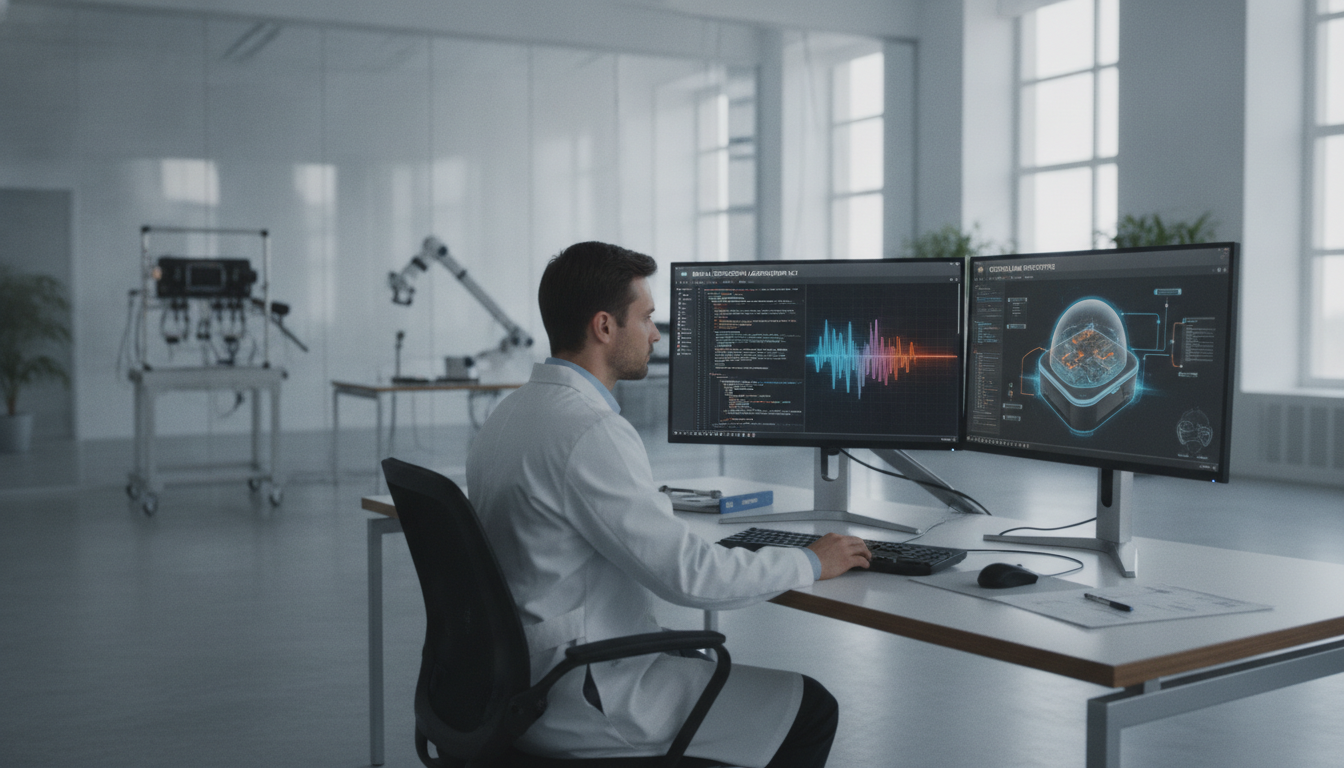
Meta has released the full training code for both v1 and v2. The repository is available under a CC BY-NC 4.0 license. According to the official Engineering at Meta blog, this encourages open scientific research. Scientists worldwide can now analyze and improve the neural decoding model.
We are still years away from consumer headwear. Current MEG machines are large and extremely expensive. However, portable neural scanners are in development. Just as we have custom Ai Assistant Development Services today, we may soon have personalized neural assistants.
The Brain2Qwerty project is a glimpse into a hands-free future. It proves that our thoughts can be understood without invasive surgical chips. As data volumes scale, we expect accuracy to climb even higher. Telepathic communication is moving out of science fiction and into reality.