

Tokyo-based AI lab Sakana AI recently released Sakana Fugu, introducing a highly resilient approach to LLM orchestration.
This innovative framework addresses a massive problem in the current tech ecosystem: geopolitical export bans.
Instead of competing directly by training a larger monolithic system, this model coordinates a pool of rival engines.
It dynamically routes queries to the most suitable agent for the job.
This ensures continuous operations even if a primary vendor cuts off access.
For developers and global enterprises, this represents a massive shift toward AI sovereignty.
The Risk of Geopolitical Vendor Lock-In
The geopolitical landscape of artificial intelligence is changing rapidly.
Recent export restrictions on elite models like Anthropic’s Claude Fable 5 and Mythos Preview highlight this volatility.
Many international developers suddenly found themselves locked out of high-performance tools overnight.
For a modern Ai Development Company In Uk, relying on a single API provider has become an unacceptable business risk.
If your core systems rely on a single vendor, a change in government policy can halt your progress.
Even a standard server outage can severely disrupt daily business.
This vulnerability is prompting global teams to seek alternatives.
Are you working at an Ai Development Company In Toronto?
Or do you run a remote engineering squad?
Either way, system resilience is now a top priority.
This is where Sakana Fugu shines.
It bypasses single-source risks by acting as an intelligent coordinator over a swappable agent pool.
How Sakana Fugu Solves the Resiliency Crisis
In essence, Sakana Fugu is not a standard monolithic model.
Instead of brute-force scaling, it achieves frontier performance via learned collective intelligence.
The system is named after “Fugu,” the Japanese pufferfish.
The pufferfish is a celebrated delicacy when prepared perfectly, but dangerous if handled incorrectly.
Similarly, multi-agent orchestration delivers incredible results when managed with precise coordination.
If done poorly, it can result in endless loops or high latency.
The core engine of Sakana Fugu is itself a language model trained specifically to manage other systems.
It delegates tasks, coordinates communication, and aggregates final results.
Behind the scenes, it routes queries to a flexible pool of frontier engines, including GPT-5.5, Gemini, and Claude Opus.
If a particular vendor becomes unavailable due to an outage or an export ban, the system automatically redirects the query.
This ensures your workflows continue moving forward without interruption.
This strategy is highly relevant for teams exploring Embedding Models Powering Ai Systems 2026.
Rather than manually coding complex routing graphs, users can interact with a single OpenAI-compatible API endpoint.
It handles all the background routing automatically.
The Technical Lineage: Evolved Orchestration
The creators of Sakana Fugu based this model on advanced evolutionary and reinforcement learning research.
It directly implements methodologies from Sakana AI’s noted research papers, “Trinity” and “The Conductor.”
Trinity is a highly efficient 0.6B-parameter coordinator.
It uses evolutionary strategies to assign specialized roles, such as Thinkers, Workers, and Verifiers, across the worker pool.
Meanwhile, the Conductor is a 7B-parameter model trained with reinforcement learning.
It discovers natural-language delegation strategies and can call itself recursively to scale compute during testing.
This is a major departure from traditional hand-coded routing logic.
Normally, developers build static graphs in frameworks like LangChain or CrewAI.
This requires tedious maintenance and fails when APIs change.
By contrast, this model learns how to coordinate dynamically.
It can adapt to new model updates without requiring any retraining of the core router.
This makes it highly valuable for developers studying How To Build An Ai Model For An Enterprise.
It provides a flexible infrastructure that handles complex, multi-step tasks autonomously.
You get the benefits of a custom multi-agent network without the coding headache.
Fugu vs. Fugu Ultra: Speed versus Quality
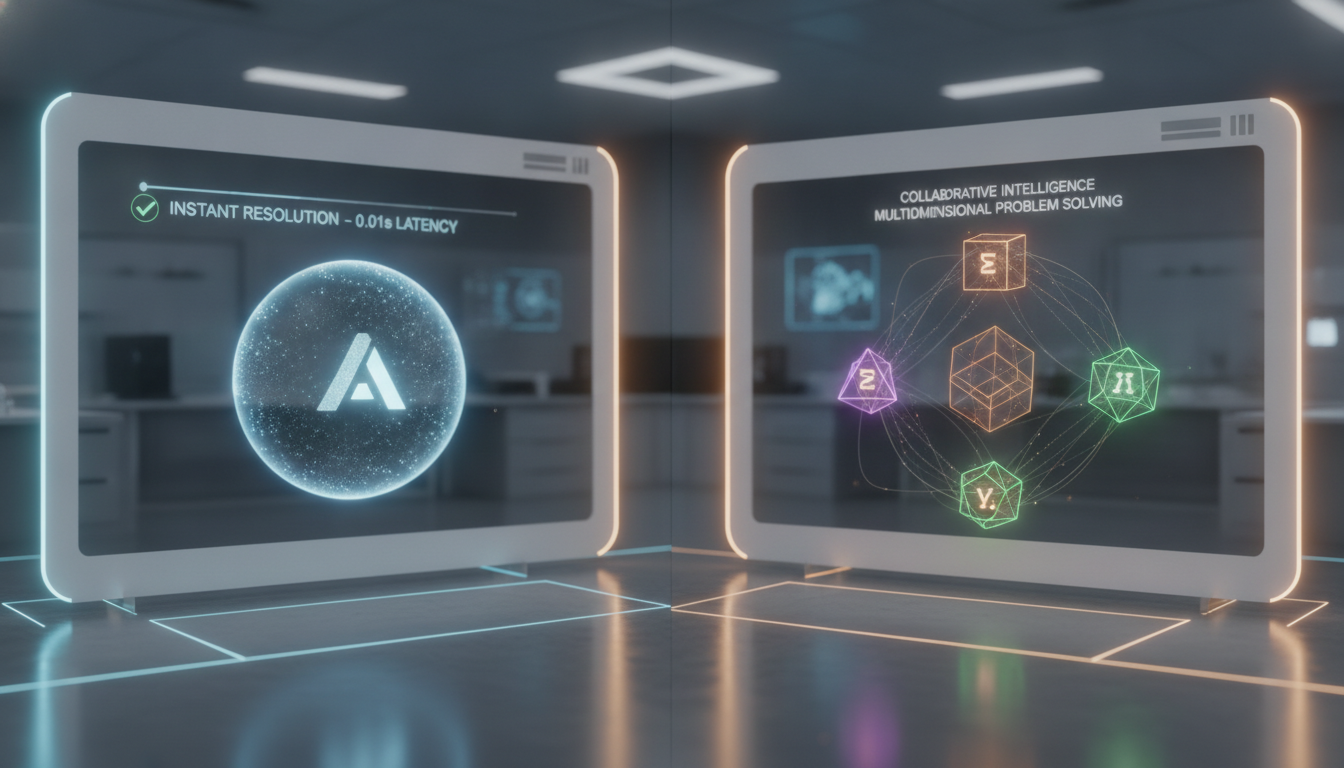
The two main versions of Sakana Fugu provide distinct options for different enterprise needs.
The first version, standard Fugu, balances speed and output quality.
For each user request, it quickly identifies the single best worker model.
This approach keeps latency low and makes it highly suitable for daily chat and programming tasks.
It is fast, cost-effective, and works out of the box.
The second version, Fugu Ultra, is designed for the most complex, multi-step challenges.
It acts as a thorough planner, assembling a coordinated panel of multiple models per query.
While this panel approach is slower, it produces highly refined, accurate outputs.
It operates much like an advanced team of experts working together on a difficult project.
For companies looking to implement Retrieval Augmented Generation Rag, Fugu Ultra offers unmatched capabilities.
It helps maximize overall Business Productivity by automating complex analysis and verification.
It can even execute code and self-correct when errors arise.
Breaking Down the Benchmarks
According to the official Sakana AI’s official release, Fugu Ultra rivals restricted frontier models.
On the competitive LiveCodeBench coding evaluation, Fugu Ultra achieved a score of 93.2.
In comparison, Anthropic’s restricted Fable 5 model scored 89.8 on the same tests.
Furthermore, on the GPQA Diamond benchmark—a rigorous test of graduate-level scientific reasoning—Fugu Ultra scored 95.5.
This narrowly outperformed the Claude Mythos Preview model, which registered a score of 94.6.
These numbers demonstrate that collective intelligence can successfully substitute for a single giant model.
However, developers should remain cautious about self-reported benchmarks.
In real-world development, orchestration systems sometimes face challenges with long-context workflows or latency spikes.
This is why an Ai Development Company In Medina must test these systems under realistic production loads.
The same rule applies to an Ai Development Company In Birmingham.
How Multi-Agent Resiliency Impacts Emerging AI Trends
Nevertheless, the early performance data is highly encouraging for the wider industry.
This shift toward swappable model pools is creating a wave of Ai Business Ideas 2025 Upcoming Trends.
Companies no longer have to worry about being shut down by geopolitical tensions or sudden pricing hikes.
Instead, they can focus on building highly reliable consumer applications.
For example, integrating decentralized architectures can further protect against single points of failure.
This connects deeply with Real World Blockchain Use Cases.
Uptime and trustless coordination are critical when writing financial smart contracts.
The synergy between decentralized ledgers and resilient AI will reshape The Future Of Blockchain In Finance.
By employing an Ai Token Development Company, businesses can construct resilient networks.
These networks coordinate tasks and manage resources without relying on any single national infrastructure.
Ultimately, Sakana Fugu represents a fundamental shift in how we scale AI systems.
We are moving away from monolithic, centralized databases toward distributed, collaborative networks of specialized intelligence.
The Cost and Latency Trade-Offs in Daily Workflows
While the technology is incredibly promising, there are practical trade-offs to keep in mind.
When Exploring Ai In Daily Life, speed and cost are critical factors.
Fugu Ultra calls multiple underlying APIs sequentially or in parallel.
This inevitably increases the total token usage.
Consequently, your API billing can rise quickly if you run highly intensive workloads.
The latency can also be noticeable on simple prompts.
If a basic model call could have solved the query, the orchestration overhead is essentially wasted energy.
Therefore, developers must strategically decide when to deploy standard Fugu versus Fugu Ultra.
Implementing smart routing thresholds will help keep operating costs manageable.
This balance is vital for any commercial application.
The Future of Collaborative AI Systems
In conclusion, Sakana Fugu is a bold step forward for global AI engineering.
It demonstrates that we do not always need bigger models to achieve better intelligence.
By teaching smaller models to coordinate larger ones, we can build highly adaptive software.
Most importantly, it provides a much-needed defense against geographic export restrictions and vendor monopolization.
As the AI industry matures, collective intelligence will likely become the standard architecture.
Enterprises can now build with confidence, knowing their systems are resilient, swappable, and secure.