

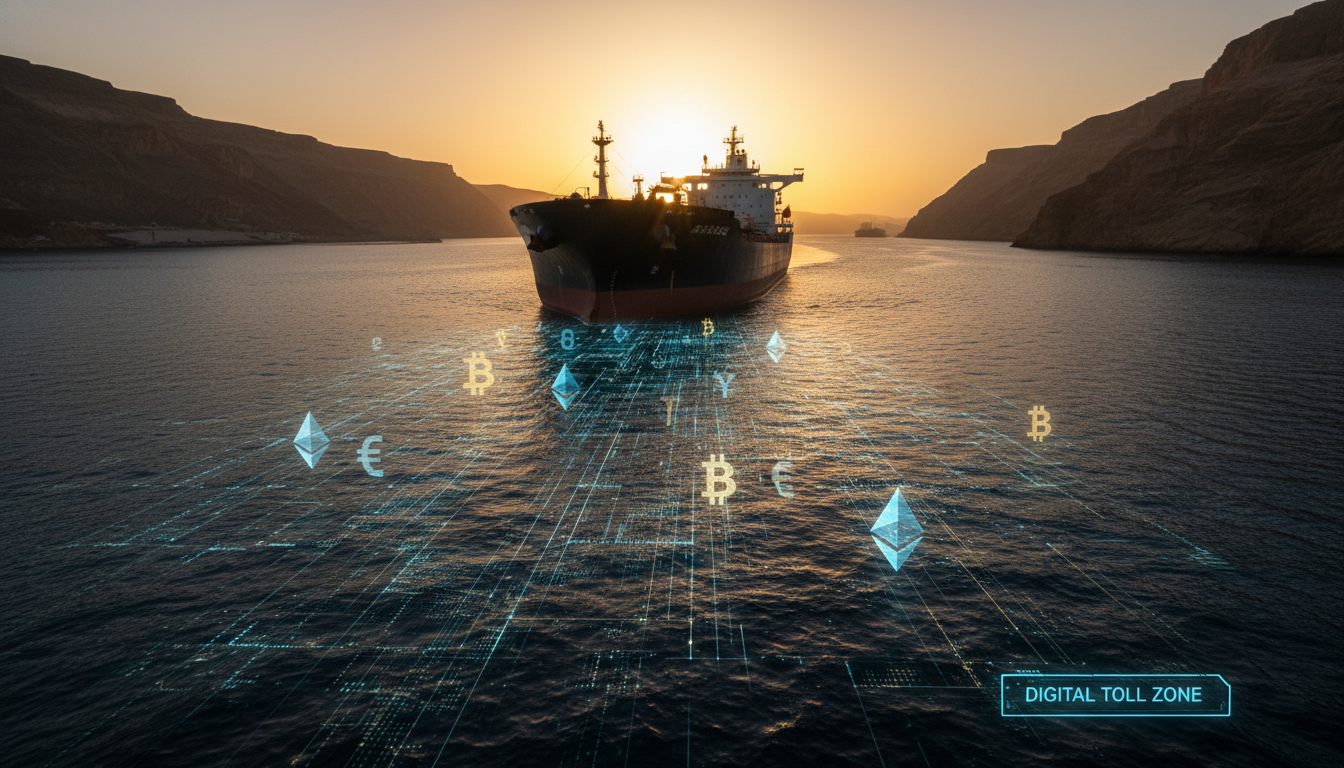
The implementation of Strait of Hormuz crypto tolls is entirely transforming global maritime trade. This critical shipping route has always been a highly contested geopolitical hotspot.
Currently, roughly 20% of all globally traded oil and LNG passes through this vital chokepoint daily. The economic stakes have simply never been higher for international shipping companies.
Iran has systematically decided that accessing these strategic waters now comes at a steep price. Traditional fiat currencies like the US dollar are officially no longer accepted.
Instead, the new maritime mandate strictly enforces payments outside the traditional dollar clearing system. This aggressive financial maneuver completely alters how global energy markets function today.
By introducing Strait of Hormuz crypto tolls, Tehran effectively bypasses the SWIFT banking network. Shipping operators must now urgently navigate both digital finance and intense geopolitical vetting.
The Origin of Strait of Hormuz Crypto Tolls

The sudden rise of Strait of Hormuz crypto tolls stems directly from ongoing economic sanctions. Iran has actively sought alternative, censorship-resistant financial networks for several years.
Traditional banking channels remain heavily restricted for all major Iranian corporate entities. This immense pressure created an urgent need for an entirely parallel settlement infrastructure.
In April 2026, Tehran officially rolled out this unprecedented maritime tolling system. The shocking announcement immediately paralyzed commodity traders and international energy markets worldwide.
The government recognized the incredible leverage they hold over essential global energy shipments. Every single vessel passing through the region is now an involuntary revenue source.
Through these Strait of Hormuz crypto tolls, Iran is aggressively monetizing its unique geographical advantage. The sheer volume of daily maritime traffic practically guarantees massive capital inflows.
IRGC Management of Strait of Hormuz Crypto Tolls
The operational framework for Strait of Hormuz crypto tolls is highly centralized and strictly monitored. A designated intermediary tied directly to the Islamic Revolutionary Guards Corps runs everything.
This powerful intermediary wields absolute authority over which cargo vessels may transit peacefully. They actively operate a remarkably strict geopolitical vetting process for every single ship.
Participating countries are systematically assigned a specific friendliness ranking by the authorities. This unique diplomatic scale ranges from one to five, directly influencing all transit approvals.
To comply with the Strait of Hormuz crypto tolls, operators must submit extensive physical paperwork. This strictly includes surrendering comprehensive ownership records and highly detailed crew lists.
Furthermore, cargo manifests, precise flag registration, and live AIS tracking data are entirely mandatory. Missing any of these crucial documents guarantees immediate and irreversible transit denial.
Geopolitical Vetting for Strait of Hormuz Crypto Tolls
Geopolitics dictate every single aspect of the Strait of Hormuz crypto tolls. Your host nation’s diplomatic stance directly impacts your shipping fleet’s financial viability.
Corporate relationships with the United States or Israel are objects of profound suspicion. Such associations almost always result in outright rejection by the Iranian authorities.
Any sovereign nation that Iran considers an enemy will face absolutely impossible transit barriers. Their vessels will be violently denied the critical VHF-broadcast passcode needed for passage.
Once thoroughly vetted and finally approved, compliant ships receive a Joint IRGC Navy escort. This military presence ensures strict compliance with the mandatory Strait of Hormuz crypto tolls.
Failing to pass this rigorous geopolitical vetting leaves multi-million dollar vessels completely stranded. Shipping companies are desperately scrambling to audit their complex international supply chain partnerships.
The Massive Costs of Strait of Hormuz Crypto Tolls
The total financial burden of the Strait of Hormuz crypto tolls is genuinely staggering. The baseline opening price is currently set at exactly $1 per barrel of oil.
This seemingly small arbitrary fee adds up incredibly fast for major maritime shipping corporations. A single Very Large Crude Carrier typically holds around two million barrels.
Therefore, one standard VLCC transit incurs an unbelievable $2 million digital toll. This enormous cost rapidly multiplies across one of the world’s most trafficked maritime routes.
Recent market reports indicate that some individual transits have already exceeded this base ceiling. The cascading financial strain on global energy supply chains is totally unprecedented.
Paying these mandatory Strait of Hormuz crypto tolls is strictly non-negotiable for passing ships. Energy retail costs worldwide will inevitably reflect this massive new corporate overhead.
Pakistan Case Study and Strait of Hormuz Crypto Tolls
Real-world application of the Strait of Hormuz crypto tolls is already highly visible today. The recent diplomatic situation involving Pakistan perfectly illustrates this new operational reality.
Iran eventually agreed to let precisely 20 Pakistani vessels transit the strategic chokepoint. However, a major logistical hurdle immediately presented itself on the actual ground.
There simply were not enough officially flagged Pakistani ships actively operating in the Gulf. This dangerous shortage forced Islamabad to implement a highly unconventional maritime backup strategy.
They urgently reached out to massive international commodity traders for immediate maritime assistance. Islamabad inquired if any third-party vessels would temporarily sail under a Pakistani flag.
This desperate workaround highlights the severe market distortions caused by Strait of Hormuz crypto tolls. Sovereign nations are adopting extreme logistical measures just to secure baseline energy shipments.
Why Stablecoins Power Strait of Hormuz Crypto Tolls
The specific currency choice for Strait of Hormuz crypto tolls is far from arbitrary. Transactions strictly mandate either Chinese yuan or specifically approved digital blockchain assets.
Chinese yuan clearing occurs entirely outside the dollar-dominated SWIFT international clearing system. This strategic separation provides immediate shelter from intense Western financial regulatory oversight.
More importantly, major stablecoins like USDT and USDC are the preferred medium of exchange. They are nominally pegged to the dollar but travel on independent, decentralized blockchain rails.
This advanced blockchain infrastructure completely circumvents traditional global correspondent banking. It successfully allows instant, borderless, and highly censorship-resistant international value transfer.
Using stablecoins for Strait of Hormuz crypto tolls ensures immediate and irreversible payment settlement. This technological guarantee ensures the IRGC receives its funds without any unpredictable banking delays.
Digital History Before Strait of Hormuz Crypto Tolls
The foundational technological infrastructure for Strait of Hormuz crypto tolls was built over several years. Iran is definitely not a naive newcomer to the complex digital asset space.
Tehran officially legalized commercial Bitcoin mining operations all the way back in 2019. At its absolute peak, the sovereign nation controlled roughly 4 to 5% of the global hash rate.
This aggressive early adoption provided deep technical expertise regarding decentralized payment networks. It perfectly laid the groundwork for large-scale, state-sponsored blockchain utilization.
By early 2025, Iranian-linked crypto activity on-chain reached a massive $7.8 billion valuation. The overwhelming majority focus of this immense volume was strictly on stablecoin settlement.
These historical milestones logically made the Strait of Hormuz crypto tolls the next inevitable step. They perfectly merged immense geopolitical leverage with highly proven technological payment infrastructure.
Global Oil Reactions to Strait of Hormuz Crypto Tolls
The immediate macroeconomic impact of the Strait of Hormuz crypto tolls was extremely severe. International oil markets aggressively reacted with historic and terrifying levels of pricing volatility.
Brent crude spot prices dramatically soared to a shocking $141.36 in early April 2026. This monumental peak marked the absolute highest energy valuation since the 2008 financial crisis.
Panicked commodity traders aggressively priced in the imminent threat of widespread global supply stoppages. Global equities subsequently plummeted as absolute panic spread throughout major Western financial hubs.
United States stock indexes were in a complete freefall before sudden diplomatic news finally broke. Iran and Oman eventually agreed on a temporary joint transit monitoring protocol.
This crucial geopolitical agreement slightly reversed the violently bleeding financial indexes. However, the overarching existential threat of Strait of Hormuz crypto tolls continues to violently dictate prices.
How Shippers Adapt to Strait of Hormuz Crypto Tolls
Desperate maritime companies are urgently developing novel strategies to handle Strait of Hormuz crypto tolls. This crisis requires a complete, ground-up overhaul of traditional maritime corporate finance.
First, corporate treasury departments must now actively hold and meticulously manage digital blockchain assets. Securing millions in unregulated USDT requires incredibly robust institutional digital custody solutions.
Second, massive legal teams are actively working overtime to analyze the strict Iranian vetting requirements. They must perfectly sanitize their entire crew lists and global corporate ownership records.
Step-by-Step Blockchain Payment Integration
Procuring the necessary digital funds for Strait of Hormuz crypto tolls is legally complex. Companies often use decentralized exchanges to swap corporate assets as quietly as possible.
- Asset Procurement: Firms secretly purchase millions in USDC via over-the-counter institutional digital brokers.
- Wallet Security: Funds are transferred to cold-storage multi-signature wallets to completely prevent malicious hacking.
- Execution Timing: Treasurers execute the exact token transfer minutes before the required IRGC maritime inspection.
This careful sequence successfully prevents traditional retail banks from flagging massive, unexpected stablecoin transfers. Incredible execution speed and digital privacy are now absolutely paramount for shipping treasury operations.
Legal Risks of Strait of Hormuz Crypto Tolls
Complying with Strait of Hormuz crypto tolls introduces truly enormous corporate legal liability. Western shipping companies suddenly find themselves violently trapped between completely conflicting international mandates.
Directly paying an active intermediary tied to the IRGC blatantly violates severe US financial sanctions. This horrifying reality exposes corporate executives to massive fines and potential federal criminal prosecution.
However, completely refusing to pay means abandoning billions of dollars in stranded, highly volatile cargo. The international maritime industry has genuinely never faced such an impossible, lose-lose regulatory dilemma.
Corporate lawyers are desperately seeking emergency compliance waivers directly from the US Treasury Department. They aggressively argue that global energy security must temporarily override existing strict financial embargoes.
Until these terrifying legal gray areas are formally resolved, the Strait of Hormuz crypto tolls remain universally hazardous. Every single blockchain transaction carries immense, company-ending existential risk for the paying corporate entity.
Technical Needs for Strait of Hormuz Crypto Tolls
Seamlessly handling the Strait of Hormuz crypto tolls requires sophisticated, enterprise-grade technological backend systems. Shipping firms absolutely cannot simply send funds from a standard retail mobile crypto wallet.
They must exclusively utilize verified enterprise-grade blockchain infrastructure to ensure perfect on-chain payment execution. This completely minimizes the terrifying risk of failed digital transactions during highly critical transit windows.
Essential Software for Crypto Transit Operations
To successfully process these globally monitored digital payments, vessels heavily rely on several vital technological components. These advanced tools guarantee perfect adherence to strict IRGC digital payment timelines.
- Multi-Signature Custody: Complex institutional solutions are mandatory to securely authorize massive, multi-million dollar stablecoin transfers.
- On-Chain Auditing: Corporate treasury departments demand live, uninterrupted tracking of network gas fees and token balances.
- Encrypted Transmissions: Submitting mandated flag registrations and crew lists safely requires absolute military-grade network encryption channels.
Without this highly specific digital infrastructure, actively managing Strait of Hormuz crypto tolls is essentially impossible. A single momentary technical failure could easily leave a valuable ship stranded indefinitely.
Alternative Routes vs Strait of Hormuz Crypto Tolls
Many terrified logistics companies are desperately seeking viable alternatives to the Strait of Hormuz crypto tolls. However, physically bypassing this precise geographical chokepoint is an absolute maritime engineering nightmare.
Physically rerouting massive cargo vessels adds thousands of extra nautical miles to a standard delivery journey. This drastically increases baseline fuel consumption, exhaustive labor costs, and overall global transit time.
Assessing the Brutal Rerouting Logistics
When actively evaluating alternatives, major shipping lines face a truly brutal mathematical reality. The extra physical fuel often costs significantly more than the violently imposed digital toll itself.
- Massive Fuel Costs: Giant crude carriers constantly burn truly enormous amounts of highly expensive bunker fuel daily.
- Catastrophic Delays: Extended international transit times thoroughly disrupt fragile global refinery schedules and vital local energy grids.
- Fleet Degradation: Noticeably longer physical voyages heavily increase the strict mechanical maintenance requirements for aging tanker fleets.
Therefore, simply paying the controversial Strait of Hormuz crypto tolls often remains the most strictly economical choice. Inescapable geography ultimately forces corporate compliance regardless of the severe, underlying geopolitical risks.
Consumer Impact of Strait of Hormuz Crypto Tolls
The terrifying downstream economic effects of the Strait of Hormuz crypto tolls are deeply devastating. Ordinary, working-class consumers will ultimately bear the entire devastating financial burden of these unyielding fees.
When global shipping companies suddenly incur massive multi-million dollar transit fees, they rapidly adjust their corporate pricing. These newly inflated core logistics costs are passed entirely directly to consumer energy distributors.
Rising Living Costs Across the Globe
This inescapable cascading financial effect guarantees highly immediate, painful spikes in everyday consumer gasoline retail prices. Baseline transportation costs for absolutely basic retail consumer goods will also surge dramatically overnight.
- Residential Heating: Freezing winter energy utility bills will violently skyrocket as global LNG supplies face these highly restrictive tolls.
- Agricultural Logistics: Surging diesel prices violently dictate the entire agricultural and modern trucking supply chain baseline economics.
- Commercial Aviation: Standard airline travel ticket costs will instantly reflect the heavily increased premiums on global crude oil imports.
These mandatory Strait of Hormuz crypto tolls effectively act as a massive, unavoidable global consumer tax. It rapidly drains precious discretionary income from struggling working-class families across multiple affected continents.
Oman’s Role Regarding Strait of Hormuz Crypto Tolls
The sovereign nation of Oman’s highly strategic geographical positioning has suddenly become an incredibly vital diplomatic asset. They rightfully share direct, physical territorial oversight of this incredibly crucial maritime passage.
In a desperate effort to immediately calm panicking markets, Oman officially initiated highly urgent backchannel diplomatic negotiations. Their ultimate goal was to rapidly stabilize the terrifying rollout of the Strait of Hormuz crypto tolls.
Diplomatic Stabilization and Global Market Relief
Oman highly successfully brokered a crucial, temporary joint transit monitoring protocol with deeply entrenched Tehran officials. This totally unexpected diplomatic breakthrough massively helped prevent a complete, irreversible global market collapse.
- Shared Naval Oversight: Highly trained Omani naval forces will actively assist in monitoring the incredibly contested local transit corridors.
- Immediate De-escalation: Their active diplomatic involvement provides a remarkably crucial physical buffer against unilateral, highly aggressive military posturing.
- Restoring Market Confidence: The protocol’s sudden public announcement immediately helped violently pull Brent crude valuations back from their historic highs.
While certainly not a permanent solution to the Strait of Hormuz crypto tolls, it noticeably helps. Oman currently remains the absolute critical diplomatic bridge between terrified Western markets and strict Iranian authorities.
Future of Trade and Strait of Hormuz Crypto Tolls
The terrifying long-term implications of Strait of Hormuz crypto tolls are truly alarming for international commerce. This highly localized financial tactic could incredibly easily inspire similar physical chokepoint monetization globally.
Other opportunistic nations controlling highly vital shipping lanes might quickly aggressively adopt this exact digital blueprint. The unified global supply chain would violently fragment into heavily taxed, highly unstable regional zones.
Additionally, this aggressive posturing massively accelerates the broader, unstoppable de-dollarization of vital global energy commodities. Forcing mandatory oil payments in decentralized digital assets fundamentally, permanently weakens historical Western financial hegemony.
We are actively witnessing the rapid, unprecedented weaponization of decentralized global finance on a sovereign, state-sponsored level. The traditional, long-standing rules of international maritime commerce are being violently and permanently rewritten today.
Ultimately, the devastating Strait of Hormuz crypto tolls represent a completely permanent macroeconomic paradigm shift. The incredibly volatile intersection of global geopolitics, raw energy, and decentralized blockchain is now permanently solidified.
Conclusion: Navigating Strait of Hormuz Crypto Tolls
The completely unprecedented implementation of Strait of Hormuz crypto tolls is a truly historic, terrifying geopolitical flashpoint. It seamlessly, violently merges physical naval military dominance with highly advanced, censorship-resistant digital finance.
Global shipping logistics companies must absolutely immediately adapt to these terrifying, highly complex new operational realities. Failure to diligently maintain perfectly compliant geopolitical vetting guarantees catastrophic, completely unrecoverable global supply chain disruptions.
The entirely mandatory use of stablecoins perfectly bypassing the SWIFT network simply cannot be safely ignored anymore. This bold move completely redefines exactly how highly vital international commodity tolls will be permanently settled moving forward.
As surging Brent crude global prices highly accurately reflect this unprecedented tension, global financial markets remain incredibly fragile. The highly profitable, peaceful era of completely frictionless international energy transit is officially, permanently over forever.
Completely understanding and flawlessly adapting to the strict Strait of Hormuz crypto tolls is now completely mandatory. It is genuinely the only possible way to successfully survive the incredibly turbulent future of global maritime trade.
Frequently Asked Questions About Strait of Hormuz Crypto Tolls
What are the new digital transit fees in the Middle East?
Iran has strictly instituted completely mandatory digital asset payments for all large vessels traversing these specific waters. Ships must pay precisely $1 per barrel using highly liquid stablecoins or alternative Chinese yuan.
Why are traditional US dollars strictly not accepted for safe passage?
The managing military authority specifically requires alternative currencies that operate completely entirely outside the traditional SWIFT network. This ensures that aggressive Western economic sanctions absolutely cannot freeze or successfully intercept the incoming digital transit funds.
How much does a standard international crude carrier actually pay?
A massive Very Large Crude Carrier actively holding two million barrels incurs a truly staggering $2 million digital charge. This immense, unprecedented financial cost incredibly heavily impacts the completely interconnected global maritime supply chain.
What exactly happens if a commercial vessel simply refuses to pay?
Non-compliant, unpaid vessels will be violently denied the completely required VHF-broadcast passcode and protective IRGC naval escort. This essentially permanently strands the targeted ship and completely prevents its highly valuable international cargo delivery.