

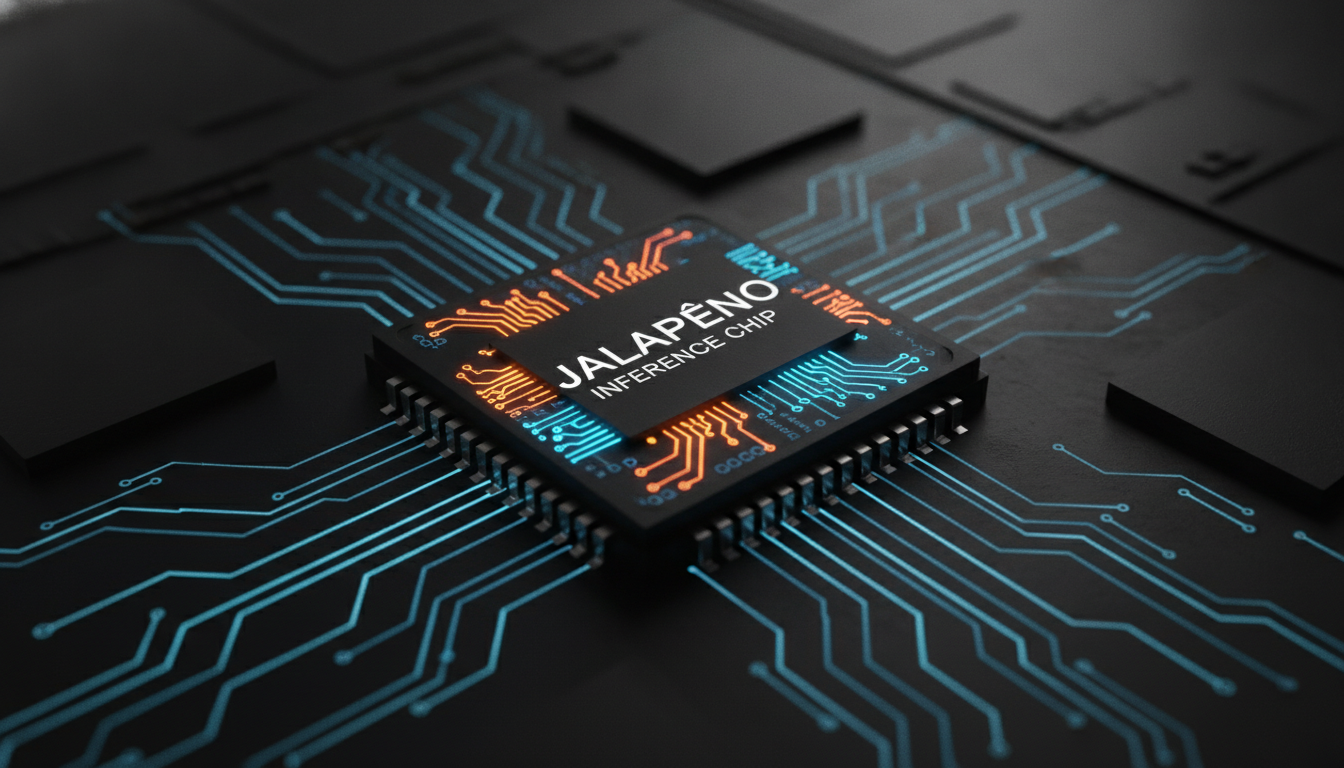
In an industry-defining moment, OpenAI and Broadcom unveil LLM-optimized inference chip named Jalapeño. This represents OpenAI’s first custom-designed intelligence processor, built from scratch for large language model inference.
The tech landscape has reached a massive milestone with this chip. Nvidia has long held a dominant position in the AI infrastructure market. Now, custom silicon is ready to disrupt the entire industry. Early testing of Jalapeño shows incredible promise. It delivers performance per watt substantially better than current state-of-the-art accelerators.
This chip marks a shift in how AI companies manage physical infrastructure. It was co-developed in just nine months. This record timeline shows how software-hardware co-design can yield immense results. It is the first step in a multi-generation compute platform aimed at democratizing advanced AI.
The Strategic Need: Why OpenAI and Broadcom unveil LLM-optimized inference chip Now
The demand for AI compute has grown exponentially. As platforms like ChatGPT expand, the cost of serving tokens increases. For years, general-purpose GPUs handled both training and inference. However, inference has different computational demands than training. It requires low latency and high energy efficiency rather than raw parallel processing power alone.
Enterprises worldwide are noticing the rising costs of AI tokens. Agencies like an Ai Development Company In New York have witnessed rising costs. High costs limit how quickly businesses can integrate AI features. By optimizing the hardware specifically for inference, OpenAI intends to lower token costs. This ensures that intelligence becomes more affordable and accessible.
Similarly, an Ai Development Company In Florida can pass savings down to clients. Custom silicon gives OpenAI the freedom to control its pricing structures. In a highly competitive model market, hardware ownership provides a massive strategic moat. It allows OpenAI to stay ahead of competitors while maintaining profitable margins.
The Architecture of Jalapeño: Designed from Scratch for LLMs
Jalapeño is not an adaptation of an older chip design. It is a blank-slate architecture engineered specifically for modern large language models. The chip was designed using OpenAI’s deep understanding of LLM fundamentals. It reflects how systems run ChatGPT, Codex, and APIs every day. It balances compute, memory, and networking resources to minimize bottlenecks.
For specialized deployment, partnering with a Deep Learning Development Company is essential. This custom chip handles the precise mathematical operations of transformers. The architecture reduces data movement. This is crucial because moving data between memory and processing units wastes time and power.
While many teams focus on Computer Vision Development, LLM inference has different bottleneck issues. LLMs require massive memory bandwidth to process tokens sequentially. Jalapeño addresses this with high-performance memory and Tomahawk networking silicon. It achieves realized utilization much closer to theoretical peak performance. This design combines the throughput of top accelerators with ultra-low latency.
A Record Nine-Month Tape-Out, Powered by AI
Typically, developing a custom application-specific integrated circuit (ASIC) takes multiple years. However, Jalapeño was designed and manufactured to tape-out in just nine months. This represents what is believed to be the fastest ASIC development cycle ever achieved. This speed was made possible by deep collaboration with Broadcom.
Incredibly, OpenAI used its own advanced AI models to accelerate the chip design process. The same models served to global users helped engineers optimize the physical circuits. This creates a self-improving loop in technology. AI designs the hardware that will eventually run even larger AI models.
This accelerated physical creation mimics how we see Ai Automation Impacting Workforce Training Dev in other corporate fields. Using AI to automate complex processes saves time and money. It lowers the barrier to entry for building complex high-performance systems. If AI can design better chips faster, hardware costs will continue to fall.
The Full-Stack Advantage and Flywheel Effect

OpenAI’s strategy is built on a full-stack approach. The company does not just build models or software products. It now designs the underlying infrastructure. This includes chip architecture, kernels, memory systems, and deployment schedules. When every layer is optimized for the same goal, performance skyrockets.
This full-stack approach powers a powerful flywheel. Better infrastructure drives compute efficiency. High compute efficiency enables better model serving and training. Better models lead to superior products for developers and consumers. This drives more usage, which generates more revenue to reinvest in infrastructure.
Developers looking for a Build Crypto Ai Agents 2025 Guide will see how lower latency enables real-time responses. Whether you are working on Blockchain Wallet Development or complex generative models, cheap inference changes everything. It turns slow agentic workflows into snappy, interactive customer experiences.
Scaling to Gigawatt-Scale with Industry Leaders
Jalapeño is the first step in a multi-generation platform. OpenAI and Broadcom are working with Celestica for board and system integration. Together, they are building scalable production systems. These systems will be deployed starting in late 2026. They are designed for gigawatt-scale data centers with partners like Microsoft.
To understand how we reached this point, we must look at the roots of AI, as discussed in our guide on What Is Machine Learning How It Works 2025. Today, machine learning has transitioned from laboratory tests to massive physical infrastructure projects. Gigawatt-scale data centers represent the next phase of human compute power. This requires highly efficient chips to keep carbon footprints and power costs under control.
This global scalability is already being evaluated by any leading Ai Development Company In Germany looking to expand. European enterprises are highly conscious of carbon footprints and energy efficiency. Jalapeño’s focus on performance per watt makes it highly attractive for international markets. It opens the door for greener, more efficient artificial intelligence globally.
Enterprise Applications: Making AI More Accessible
Many businesses seeking Ai Consulting Erp System Transformation find that inference expenses hinder progress. They want to automate tasks but fear high token costs. A dedicated inference processor reduces this barrier. It makes complex AI agents affordable for daily business operations.
For instance, running a heavy AI system like an Ai Healthcare App Aq Ant Group 2025 can be extremely compute-intensive. Patients require instant, accurate, and cheap diagnostic assistance. Lowering hardware costs makes health-tech tools available to underserved regions. This democratizes access to intelligence across medical, educational, and scientific sectors.
To stay updated with the latest in technology and AI advancements, feel free to explore our Blogs and case studies. Hardware innovations like Jalapeño will reshape how software is built. Software developers will no longer need to compromise between model size and cost. They can deploy larger models at a fraction of the current cost.
Conclusion: The Future of AI Infrastructure
The announcement that OpenAI and Broadcom unveil LLM-optimized inference chip changes the competitive landscape. OpenAI is moving from a pure software provider to a physical infrastructure pioneer. By partnering with Broadcom and Celestica, OpenAI is building its own destiny. The era of relying solely on third-party hardware is coming to an end.
While final benchmarks are still being compiled, the early results are clear. Jalapeño will deliver remarkable energy efficiency and speed. It sets a new standard for application-specific chips. As we march toward 2026 and beyond, this chip will power the next generation of conversational and agentic AI systems.