


How Governments Are Using AI and Smart Contracts is an evolving area where artificial intelligence and blockchain technologies intersect to enhance governance, public service efficiency, and transparency. Across the world, national and local governments are experimenting with these tools to automate legal agreements, optimize processes, and strengthen digital trust. This comprehensive overview explores what AI and smart contracts are, how they work, the technologies behind them, key benefits, challenges, real-life applications, and potential future directions. Understanding their synergy provides insight into how governance is shifting toward technological empowerment that blends intelligent systems with immutable decentralized infrastructures.
Understanding How Governments Are Using AI and Smart Contracts
Governments are increasingly embracing digital transformation frameworks that integrate AI systems with smart contracts. AI expands the ability of governments to process large datasets, while smart contracts provide a blockchain-based foundation for secure and autonomous execution of transactions. Combined, these technologies create a protocol that eliminates manual delays, prevents corruption, and minimizes bureaucratic inefficiencies. By leveraging machine learning models and distributed ledgers, governments can ensure that digital rules execute transparently according to predefined policies.
How Governments Are Using AI and Smart Contracts in Practice
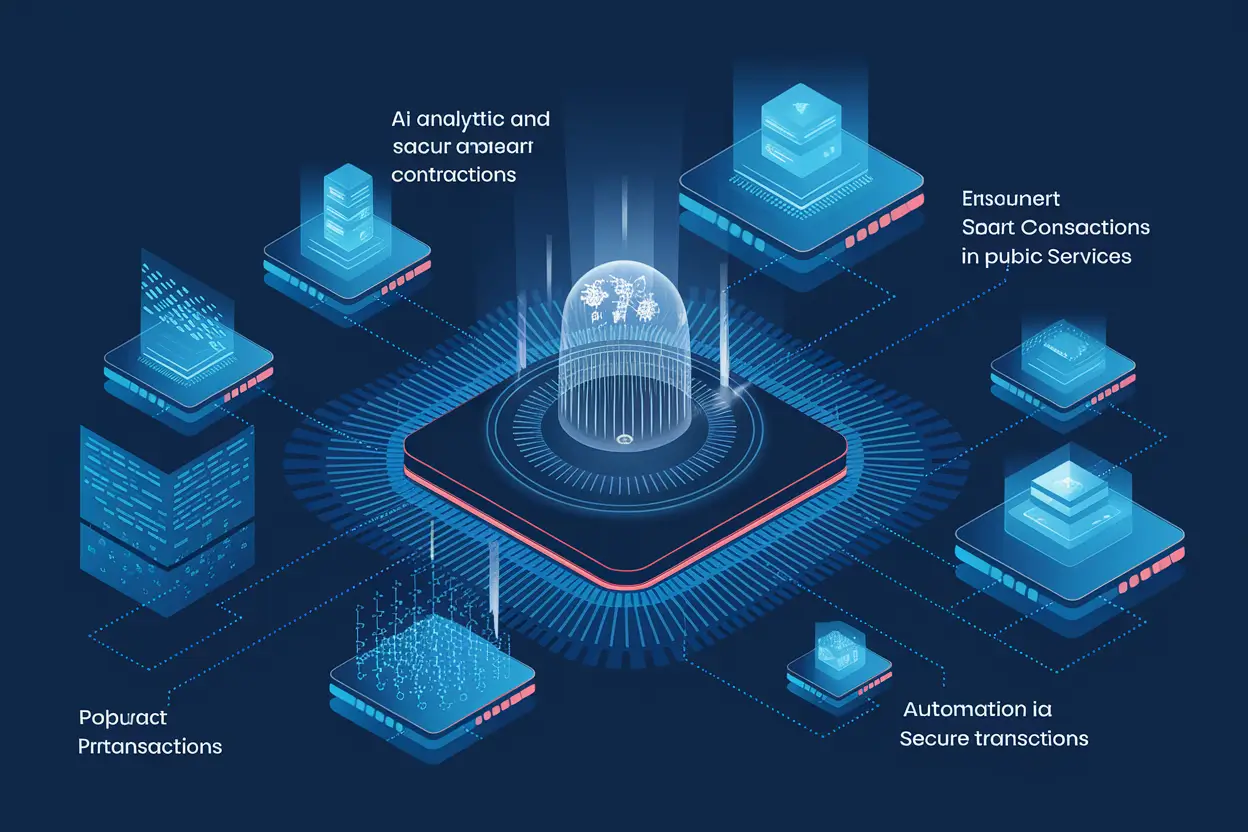
The integration typically follows a layered approach. AI handles data analysis, prediction, and decision-making support, while smart contracts act as trustless executors of rules or policies. For instance, if a tax incentive is triggered by business conditions that AI models evaluate, a corresponding smart contract could automatically distribute funds when conditions are met. This synchronized mechanism creates a dynamic policy environment capable of real-time adjustments with minimal human intervention. Such applications enhance accountability in public spending and citizen services.
Core Concepts Behind How Governments Are Using AI and Smart Contracts
The union of these technologies is based on four core ideas: automation, transparency, immutability, and autonomy. Automation ensures repeatable execution of administrative workflows without human delays. Transparency enables all transactions to be visible and verifiable by relevant authorities. Immutability guarantees that recorded contracts and transactions cannot be tampered with, fostering trust. Autonomy provides systems capable of managing complex relationships and policies independently through pre-programmed logic informed by AI-driven insights.
Technical Framework of How Governments Are Using AI and Smart Contracts
Technically, smart contracts operate on blockchain ecosystems such as Ethereum or Hyperledger Fabric. They contain coded rules that define how agreements are executed. AI algorithms contribute through pattern recognition, policy recommendation, and dynamic data interpretation. Integrating these systems requires API bridges that link AI-driven applications to blockchain nodes. Model outputs from AI are validated by smart contracts, ensuring deterministic behavior while allowing probabilistic inputs. Governments often deploy hybrid structures—on-chain smart contracts interacting with off-chain AI tools—to balance scalability, privacy, and computational cost.
Benefits of How Governments Are Using AI and Smart Contracts
- Efficiency: Automated execution reduces time and administrative burden.
- Transparency: All operations are logged publicly, reducing fraud and mismanagement.
- Accountability: Smart contracts are rule-based, minimizing human discretion.
- Predictive governance: AI assists in forecasting needs and adjusting policy dynamically.
- Cost savings: Streamlined operations minimize redundant tasks.
These benefits collectively contribute to citizen trust, improved data management, and faster policy implementation.
Challenges in How Governments Are Using AI and Smart Contracts
Though promising, several challenges persist. Legal recognition of smart contracts varies globally, creating regulatory uncertainty. Ethical concerns about AI bias may lead to unfair results in automated decision-making. Integration complexity between legacy government systems and blockchain architectures also presents obstacles. Data privacy compliance under frameworks such as GDPR remains an issue, given blockchain immutability. Balancing transparency and confidentiality becomes difficult when sensitive citizen information is at stake.
Real-World Examples of How Governments Are Using AI and Smart Contracts
Estonia’s e-Government platform has been one of the earliest adopters of blockchain-based digital identity and AI governance systems. The United Arab Emirates implements AI observatories that collect data for predictive policy planning, linking results with smart contract-based procurement processes. Singapore’s Smart Nation initiative uses machine learning algorithms integrated with digital civic platforms to improve service efficiency. The United Kingdom and Canada are researching blockchain-driven social benefit disbursement models, where smart contracts automate eligibility checks and fund releases.
Use Cases Demonstrating How Governments Are Using AI and Smart Contracts
- Procurement Automation: Smart contracts execute supplier agreements automatically once AI verifies delivery criteria.
- Welfare Distribution: AI assesses eligibility while contracts disburse benefits in real time.
- Tax Collection: AI-powered systems analyze data patterns for compliance, triggering smart contract-based payment enforcement.
- Voting Systems: Blockchain ensures vote immutability while AI monitors security anomalies.
- Public Health Management: AI predicts resource needs, and contracts handle logistics execution.
These use cases highlight the innovative potential for digitizing institutional governance structures.
Technical Implementation of How Governments Are Using AI and Smart Contracts
A government deploying these systems typically follows a sequence: design policy logic, encode it as smart contract code, train AI models to evaluate real-world data, and establish interaction protocols. For example, a smart contract might enforce an energy rebate to consumers based on AI-verified energy-saving data. The simplified pseudocode can look like this:
Smart Contract Example:
contract EnergyIncentive {
function releaseRebate(address citizen, uint energySaved) public {
if(AIDataVerifier.validate(energySaved)) {
transfer(citizen, calculateReward(energySaved));
}
}
}
In this code structure, the AIDataVerifier represents an external oracle validating information through an AI model before allowing the blockchain to proceed with payment actions.
Comparing How Governments Are Using AI and Smart Contracts vs Traditional Systems
| Aspect | AI & Smart Contracts | Traditional Systems |
|---|---|---|
| Execution Speed | Instant and automated | Manual and delayed |
| Transparency | Immutable record | Opaque documentation |
| Cost | Lower operational overhead | High due to bureaucracy |
| Security | Blockchain-secured | Vulnerable to data tampering |
| Flexibility | Adaptive through AI feedback | Rigid administrative processes |
This comparison emphasizes why governments increasingly explore blockchain-AI hybrids to enhance performance and resilience.
Latest Trends in How Governments Are Using AI and Smart Contracts
Emerging trends include decentralized identity solutions, AI-assisted policy analytics, and distributed procurement ecosystems. Many governments are adopting AI-driven auditing tools that integrate with smart contracts for programmatic compliance enforcement. Intergovernmental cooperation has also grown, with common protocols being developed for cross-border digital governance. The rise of generative AI allows natural-language rule creation that is compiled into executable smart contract logic, simplifying deployment.
Security and Ethical Dimensions of How Governments Are Using AI and Smart Contracts
Security remains a central focus. Governments must protect AI training datasets against manipulation and smart contracts against logical vulnerabilities. Secure multi-party computation and zero-knowledge proofs are gaining traction to address data exposure concerns. On the ethical side, ensuring algorithmic accountability is crucial. Governments are creating AI ethics boards to audit decision models. Transparency in both data sources and model logic supports public trust and compliance with fairness requirements.
Case Study: How Governments Are Using AI and Smart Contracts in Digital Taxation
In South Korea, experimental frameworks for automated tax collection leverage AI to evaluate business performance metrics. When specific conditions are met, a blockchain-based smart contract executes a taxation rule or rebate issuance. This reduces tax fraud while increasing efficiency. Similarly, Brazilian municipal projects employ smart contracts to track infrastructure payments, ensuring every dollar corresponds to verified work completion according to AI-assisted progress assessments.
Technical Suggestions for How Governments Are Using AI and Smart Contracts
- Adopt standardized blockchain frameworks compatible with public sector compliance requirements.
- Utilize oracle networks that securely transmit AI verification results to smart contracts.
- Implement explainable AI systems to ensure model interpretability.
- Deploy hybrid off-chain computation for intensive AI tasks while keeping contract logic on-chain.
- Invest in governance-focused cybersecurity and model validation protocols.
These technical recommendations provide a scalable and secure roadmap for integration.
Pros and Cons of How Governments Are Using AI and Smart Contracts
| Pros | Cons |
|---|---|
| High transparency and traceability | Regulatory complexity |
| Enhanced efficiency and automation | Ethical concerns over AI bias |
| Reduced administrative costs | Scalability challenges with blockchains |
| Increased public trust | Integration cost with legacy systems |
| Data-driven decision making | Potential privacy issues |
This balanced view highlights that responsible innovation and governance frameworks are necessary to maximize positive outcomes.
Future Outlook of How Governments Are Using AI and Smart Contracts
The next decade will likely see full digital policy lifecycle automation. Smart contracts will not only execute static rules but also evolve dynamically based on AI-informed feedback. Governments may create global regulatory frameworks to ensure interoperability between national digital systems. Decentralized autonomous organizations (DAOs) might emerge in the public sector, enabling collective citizen participation. Improved cryptographic standards and AI regulatory sandboxes will make these systems safer and more accessible.
Frequently Asked Questions on How Governments Are Using AI and Smart Contracts
How do AI and smart contracts work together in government?
AI provides analytical insights and rule triggers, while smart contracts automatically enforce those rules on a blockchain. This collaboration ensures efficiency, accuracy, and transparency in public operations.
Which governments are leading in using AI and smart contracts?
Countries like Estonia, Singapore, the UAE, and South Korea are leading adopters, with active pilot projects and policy innovation labs testing blockchain-AI integrations.
Can AI and smart contracts reduce corruption?
Yes. By removing manual intervention from administrative transactions, these technologies prevent unauthorized changes and enable immutable auditing trails.
What are the risks of implementing AI and smart contracts?
Key risks include biased AI decisions, high implementation costs, data security vulnerabilities, and uncertain legal validity of automated contracts in some jurisdictions.
What is the future of AI and smart contracts in governance?
The future points toward autonomous digital governance networks, with algorithmic, transparent administration and integrated citizen engagement channels powered by real-time data.
Conclusion: The Promise of How Governments Are Using AI and Smart Contracts
As global digital evolution continues, How Governments Are Using AI and Smart Contracts symbolizes a fundamental shift in administrative design toward automation, accountability, and participatory transparency. By merging the analytical power of AI with the reliability of blockchain-based smart contracts, public governance can overcome inefficiency and corruption challenges. While technical barriers and ethical dilemmas remain, continuous innovation and policy refinement will define a future where governments serve citizens faster, fairer, and more securely than ever before.