

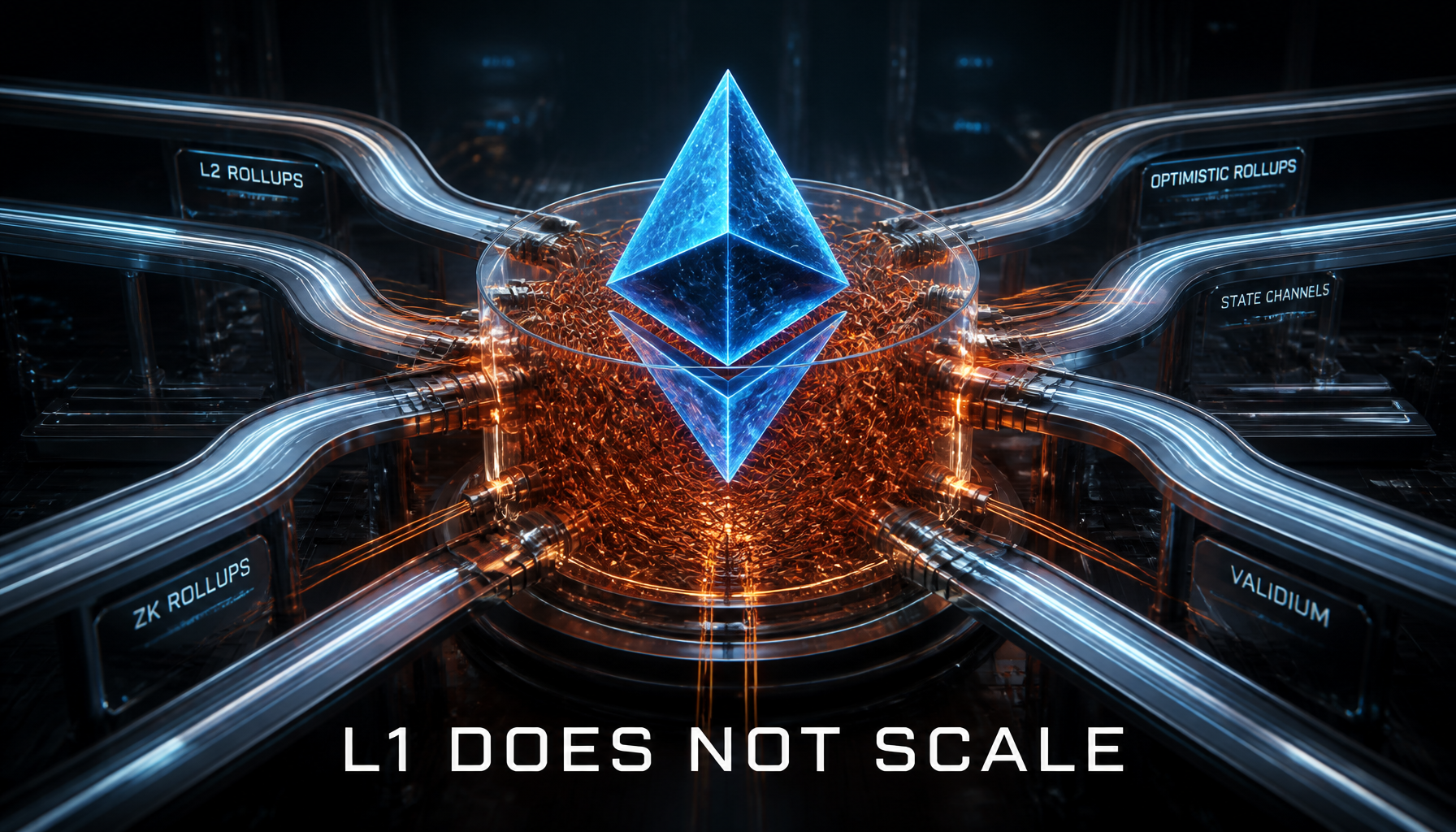
Ethereum’s L1 Does Not Scale. This simple claim is the core of Mert Mumtaz’s recent critiques. For him, this is not a vibes argument. It is a fundamental problem of physics, architecture, and alignment.
Mert, the CEO of Helius, is a prominent Solana builder. He believes that if the engine of a system is weak, the rest cannot fix it. You can build a beautiful Formula 1 car. But if the engine lacks power, the car still fails.
This analogy describes Ethereum’s rollup roadmap. Rollups were meant to help scale the system. However, they fragmented the economic structure. Today, developers and users navigate a fractured landscape, which shapes debates on Why Is Crypto Going Up across various ecosystems.
Ethereum’s L1 Does Not Scale: Decoding the Physics of Rollups
The original vision for Ethereum’s Layer 2 (L2) networks was simple. They would process transactions off-chain and settle on Layer 1 (L1). This was supposed to keep the base layer secure while lowering fees.
Unfortunately, this roadmap created unexpected economic side effects. Activity on one L2 does not help other L2s. Instead, these layers compete with each other for users. Meanwhile, the base layer loses activity to secondary networks.
Instead of one economic system growing stronger, we see a fragmented structure. Different layers fight over value. His core premise remains firm: Ethereum’s L1 Does Not Scale without creating economic compromises. A startup must choose a specific rollup to deploy. They often partner with an Ethereum Token Development Company to launch. However, their user base remains isolated. Mert argues that builders must stop pretending this architecture has no physical limits.
Why Incentives and Physics Matter More Than Narratives
If we accept that Ethereum’s L1 Does Not Scale, then we must look at how narratives paper over structural issues. The crypto industry often explains away technical flaws with stories. A blockchain can have an amazing community, a rich history, and a strong ideology. None of these traits change how a system works under pressure.
If activity leaks away from the base layer, the economics fail. If L2s cannot scale past monolithic systems while remaining centralized, narratives will not save them.
This is why Mert emphasizes incentives. On Solana, activity happens directly on the L1. The RPC provider, front-end, router, app, and users sit inside one unified system. Everyone benefits from the same transaction volume.
This alignment makes monolithic designs highly efficient. When teams consult with Top Blockchain Development Companies, they realize unified liquidity is easier to manage. Monolithic systems scale without breaking the base layer’s economic flywheel.
Crypto Without Privacy Becomes a Surveillance Machine

Mert made a surprising statement recently. He said that if Solana disappeared tomorrow, he would immediately build on Zcash. His reason is simple: privacy.
Bitcoin made internet money legitimate, Ethereum made it programmable, and Solana made it scalable. Yet, crypto still has not solved privacy.
Privacy was a core part of crypto’s original spirit. Early cypherpunks worked on private messaging and financial confidentiality. Today, a completely transparent ledger poses severe risks. Permanent, public records can turn the blockchain into a surveillance tool.
When you combine public ledgers with KYC, privacy disappears. This reality changes the traditional Ai Smart Contracts Value Proposition. Public financial data can easily be scraped and weaponized. To combat this, working with a Defi Smart Contract Development Company is essential.
Privacy Is Choice, Not Secrecy
When discussing why Ethereum’s L1 Does Not Scale, we must also consider the privacy tradeoffs of other chains. Mert’s argument is not about hiding illegal activity. It is about personal choice. Just as you choose whether to post a photo online, you should choose who sees your financial history. Privacy is individual autonomy.
Money reveals intimate details about our lives. It shows where we live, what we buy, and who we support. If all of this remains permanently on-chain, there is no real way to opt-out.
AI tools make this even more dangerous. They map scattered data into a clear financial profile. With traditional banks, financial data is fragmented. Accessing it requires formal legal processes.
On a public blockchain, anyone can inspect your balance without permission. This makes privacy a necessity. Analysts sharing the Best Ai Crypto Predictions For 2025 point to privacy-centric protocols as major growth areas.
Why Transparent Ledgers Break the Fungibility of Money
Physical cash works because it is fungible. One dollar bill can always be exchanged for another. A physical bill does not carry its entire transaction history with it. You are not treated differently based on who held it before.
Digital assets are different. Because every coin has a visible on-chain history, assets risk losing their fungibility. People can treat certain tokens differently based on where they have been. This is a dangerous property for any form of money.
A transparent ledger is useful for public audits. However, mandatory transparency for every transaction breaks the core utility of money. This is a key design challenge for any Blockchain Development Company In California trying to build enterprise-grade payment solutions.
Most Marketing Problems Are Actually Product Problems
When discussing startup failures, Mert pointed to a toxic trend: fake distribution. Many founders build a product that nobody uses. Instead of refining the product, they assume they need more marketing or artificial incentives.
In reality, they have a product problem. Mert believes you do not need 10,000 users to prove a concept. You only need 12 people who care enough to use it daily and tell their friends.
If you cannot get a tiny group of organic users, paid distribution will not save you. Farming games and artificial airdrops create a temporary illusion of activity. But they do not build durable value. Founders should focus on organic retention before exploring complex Crypto Fundraising Models In 2025.
Stop Building for Short-Lived Twitter Metas
Another common mistake is chasing temporary social media trends. When a new narrative appears on Twitter, hundreds of founders pivot. They build launchpads, AI coins, or whatever the current meta demands. Then they act surprised when the hype dies.
A meta is temporary by definition. Building an entire company around a passing trend is a weak strategy. Founders should stop outsourcing their strategic thinking to social media timelines. The edge must come from a contrarian belief.
If an AI model can summarize the top trends and write your pitch, you lack a true moat. Builders need to work with a Top Smart Contract Companies 2026 to focus on durable utility rather than chasing temporary Twitter hypes.
The Unsolved Challenge of Crypto Self-Custody
While developers realize Ethereum’s L1 Does Not Scale, they also face UX hurdles with custody. Direct asset ownership is one of crypto’s greatest promises. However, it also demands absolute responsibility. If a user loses their seed phrase, their assets are gone forever. This is practically and psychologically terrifying for normal users.
This fear explains why many users keep their assets on centralized exchanges. The missing product in Web3 is a custody model that offers both freedom and recovery. This is a fundamental barrier to mass adoption.
Before moving funds, users must learn How To Set Up Your Metamask Crypto Wallet safely. To bridge the gap, the industry is exploring solutions like account abstraction. Understanding What Is A Smart Contract Wallet is crucial for this transition. Achieving Crypto Wallet Development Blockchain Success requires balancing sovereignty with human-friendly recovery mechanisms.
Why the Market Needs a Truly Decentralized Stablecoin
Since Ethereum’s L1 Does Not Scale, decentralized stables have to rely on complex L2 bridges. Mert is highly passionate about the future of stablecoins. Today, the most dominant stablecoins are managed by centralized entities. This means governments can freeze funds and demand private user data. This cannot be the permanent end-state for an open financial system.
The collapse of Terra/Luna made the industry fearful of algorithmic stables. However, this failure does not prove that decentralized stablecoins are physically impossible. Unless there is a mathematical proof saying they cannot work, the problem is worth solving.
A decentralized financial ecosystem requires a stable asset that cannot be blacklisted. Builders learning How To Build A Defi Staking Platform must consider these collateral dynamics. Furthermore, finding Ways To Ensure Smart Contract Security is essential to protect these assets from devastating protocol exploits.
Concentrated Liquidity Over Endless Interoperability
If the base engine works poorly, then Ethereum’s L1 Does Not Scale in any meaningful sense. The idea of thousands of separate chains connected by endless bridges is highly inefficient. Financial markets only function well when liquidity is deeply concentrated. If liquidity for a single market is split across ten different chains, the price signal is weak.
Fragmented liquidity makes markets easier to manipulate and harder to trust. Furthermore, bridges and middleware create massive security risks. Many of the largest hacks in crypto history occurred because of vulnerabilities in cross-chain bridges. Concentrating activity on a few dominant chains is a safer, more efficient alternative.
According to industry reports on CoinDesk, the future will likely mirror the mobile ecosystem. We will have a few major networks, like iOS and Android, rather than thousands of fragmented chains. In the end, networks must work like machines. And to succeed, the machine must scale natively.