

AI for Smart Contract Testing is transforming how blockchain developers ensure the reliability, security, and accuracy of decentralized applications. As smart contracts continue to power critical blockchain ecosystems, from decentralized finance (DeFi) to supply chain management, the need for advanced, automated testing has never been greater. Artificial Intelligence (AI) introduces faster, smarter, and context-aware testing mechanisms, minimizing vulnerabilities and optimizing performance with precision that manual testing simply cannot match.
In this detailed guide, we’ll explore everything you need to know about AI for Smart Contract Testing — from the basic concepts and tools to the technical processes, benefits, drawbacks, and future outlook. Whether you’re a blockchain developer, security analyst, or curious enterprise, this complete resource will help you understand how AI reshapes smart contract assurance.
Understanding AI for Smart Contract Testing
AI for Smart Contract Testing refers to the integration of artificial intelligence and machine learning technologies into the verification and validation processes of blockchain-based smart contracts. Smart contracts are self-executing agreements coded on blockchain networks that automatically enforce rules and transactions. The AI layer enables automated vulnerability detection, code optimization, and logical verification, leading to more efficient and error-free contracts.
How AI for Smart Contract Testing Works
The process combines natural language processing (NLP), deep learning, and static or dynamic code analysis. First, AI models analyze the smart contract’s codebase to identify logic inconsistencies and security vulnerabilities. Machine learning algorithms are trained on historical smart contract exploits to recognize patterns associated with known threats like reentrancy attacks, integer overflows, or improper access control. Once trained, the AI system can scan new contracts at scale to highlight risky code areas before deployment.
The workflow generally follows these steps: source code ingestion, AI-powered pattern detection, automated test generation, and continuous retraining of the model based on new vulnerabilities discovered in the blockchain world.
Core Concepts Behind AI for Smart Contract Testing
- Machine Learning-Based Detection: Models learn from historical exploit data to identify risks in new contracts.
- Predictive Security Scanning: Uses heuristic and probabilistic analysis to forecast potential attack vectors.
- Automated Code Validation: AI tools automatically validate compliance with token standards (e.g., ERC-20, ERC-721).
- Reinforcement Learning: Models continuously improve through feedback loops from prior testing results.
- Data-Driven Smart Contract Verification: Analyzes gas usage, execution steps, and transaction patterns for anomalies.
Benefits of Using AI for Smart Contract Testing
The benefits of AI for Smart Contract Testing span from speed and cost-efficiency to deeper vulnerability coverage:
- Speed and Automation: AI tools conduct thousands of tests in seconds, drastically reducing development cycles.
- Cost Reduction: Automated analysis lowers dependency on large QA teams and expensive audits.
- Enhanced Security: AI detects hidden logical flaws and exploits that human testers might overlook.
- Continuous Learning: Models adapt and evolve as new smart contract vulnerabilities emerge over time.
- Comprehensive Analysis: AI maps intercontract interactions, ensuring complete systemic verification.
Challenges and Limitations of AI for Smart Contract Testing
While powerful, AI for Smart Contract Testing is not without challenges. These include limited training data diversity, model overfitting, and dependence on accurate feature engineering. Additionally, the interpretability of AI-based results can be difficult — developers might struggle to understand why the system flagged certain code sections. Regulatory acceptance also remains limited, as AI-based auditing hasn’t yet achieved institutional certification.
Popular AI Tools for Smart Contract Testing
The current ecosystem offers several leading tools that integrate AI or ML capabilities into blockchain testing workflows:
- MythX: One of the most established tools combining machine learning models with traditional symbolic execution for Ethereum-based smart contracts.
- Securify 2.0: Developed at ETH Zurich, it leverages AI-based reasoning to assess contract correctness.
- SmartCheck and Slither: Tools enhanced with AI-driven pattern recognition modules for identifying common vulnerabilities.
- OpenZeppelin Defender: Integrates ML analytics for continuous monitoring and alert automation.
- DeepContract AI: A next-generation project utilizing NLP and reinforcement learning for auto-generating test cases.
AI Techniques Applied in Smart Contract Testing
AI for Smart Contract Testing relies on various computational techniques:
- Supervised Learning: Training models on labeled smart contract datasets with vulnerabilities tagged.
- Natural Language Processing: Analyses contract documentation and code comments for potential inconsistencies.
- Neural Network-based Code Embeddings: Represent contract code semantically to cluster logic flows and detect anomalies.
- Reinforcement Learning: Employed to optimize testing coverage dynamically.
Use Cases of AI for Smart Contract Testing
AI-based testing finds applications across industries and blockchain types:
- DeFi Platforms: Ensuring contracts managing millions in liquidity are free from exploits like flash loan attacks.
- Token Launch Audits: Faster validation of token issuance contracts against compliance benchmarks.
- Supply Chain Management: Validating multi-party agreements encoded in logistics smart contracts.
- Insurance Automation: Ensuring payout triggers are logically sound and tamper-proof.
- Cross-Chain Bridges: Detecting potential transactional consistency issues between chains.
Real-World Examples of AI for Smart Contract Testing
Several blockchain ecosystems now rely on AI-assisted testing. For example, startups like CertiK and OpenZeppelin are integrating AI to enhance traditional audits. CertiK’s platform combines AI and formal verification to deliver predictive security scores for contracts. Some enterprises build in-house AI models that monitor deployed contracts continuously, providing real-time alerts for vulnerability exposure. This real-time intelligence reduces the mean time to patch security bugs.
Technical Setups and Code Example for AI for Smart Contract Testing
Setting up AI for Smart Contract Testing typically involves integrating analytics APIs or configuring Python-based ML scripts within the development pipeline. A simplified workflow using Python and web3 libraries can be:
Example:
1. Collect smart contract code (Solidity files).
2. Tokenize code structure using an NLP model.
3. Feed extracted features into a trained classifier detecting anomalies.
4. Output a vulnerability map and recommendation score.
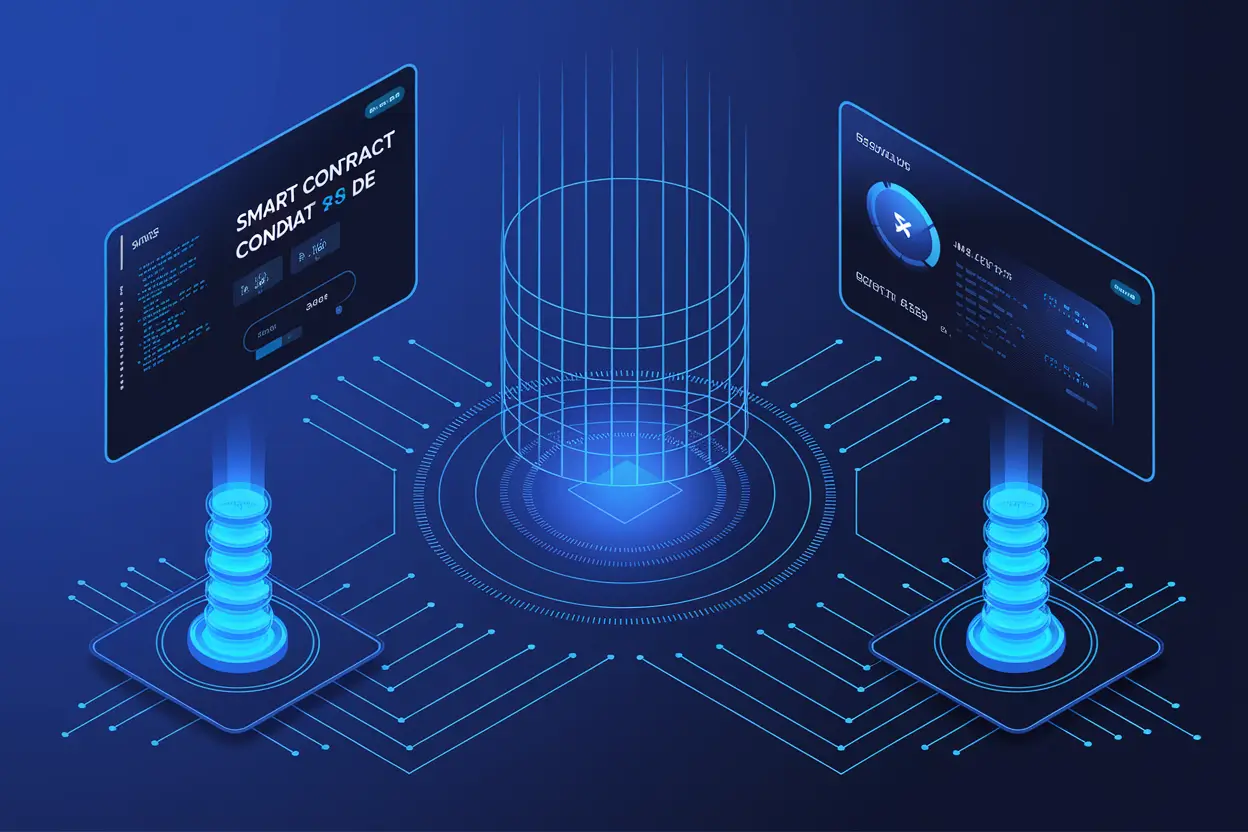
This process enables developers to automate code scanning every time a contract is updated.
Comparing AI for Smart Contract Testing with Traditional Methods
| Aspect | AI Testing | Traditional Testing |
|---|---|---|
| Speed | Automated, instant feedback | Manual, slower cycles |
| Accuracy | High due to learning from prior data | Depends on tester expertise |
| Scalability | Can test large codebases quickly | Limited to team capacity |
| Adaptation | Continuously improves with training | Static until manually updated |
Best Practices When Using AI for Smart Contract Testing
- Start testing early in the development lifecycle.
- Combine AI testing with manual audits for comprehensive coverage.
- Keep training datasets updated with the latest exploit data.
- Validate AI results using human review before deployment.
- Integrate AI testing into CI/CD pipelines for continuous protection.
Common Mistakes and How to Avoid Them in AI for Smart Contract Testing
- Overreliance on automation: Always complement AI findings with expert auditing.
- Ignoring false positives: Calibrate models and thresholds regularly to minimize noise.
- Outdated models: Continuous retraining ensures the system stays relevant to evolving exploits.
- Insufficient data sources: Use diverse datasets including open-source vulnerabilities and security incident records.
Recent Trends in AI for Smart Contract Testing
Today’s trends revolve around decentralization and interoperability. AI models are now being embedded directly in blockchain nodes to perform localized testing. AI-driven oracles provide risk rankings, while federated learning ensures data privacy across decentralized testing networks. The combination of explainable AI (XAI) is also gaining traction, making AI predictions transparent to developers and auditors alike.
Future Outlook: The Next Era of AI for Smart Contract Testing
The future of AI for Smart Contract Testing looks promising, with hybrid frameworks expected to merge symbolic reasoning with neural computation, providing the best of both analytical worlds. In upcoming years, AI auditors might become blockchain-native entities, autonomously evaluating transactions and enforcing compliance. Blockchain ecosystems will likely adopt self-healing code modules, where detected flaws are patched via AI-generated proposals. As AI interpretability improves, institutional and regulatory adoption will increase rapidly.
FAQs on AI for Smart Contract Testing
What is AI for Smart Contract Testing?
It is the application of artificial intelligence to identify vulnerabilities and optimize smart contract code before and after deployment.
Is AI testing better than manual auditing?
AI testing excels in speed and consistency but is best used alongside manual reviews for maximum coverage.
Which AI frameworks are used in smart contract testing?
Frameworks like TensorFlow, PyTorch, and specialized platforms like MythX employ AI models tailored for blockchain code.
Can small projects afford AI-based testing?
Yes, open-source AI audit tools and freemium platforms make smart AI testing accessible for startups and small projects.
What is the future impact of AI on blockchain development?
AI will significantly reduce contract-related risks, leading to a more secure, trustworthy, and automated blockchain environment.
Conclusion: The Transformative Role of AI for Smart Contract Testing
AI for Smart Contract Testing is redefining blockchain security and reliability frameworks. By blending automation, learning algorithms, and predictive analysis, AI ensures safer deployments and faster time-to-market. As the technology evolves, its role will extend beyond testing — shaping how developers write, validate, and certify blockchain code. Businesses investing now in these solutions will be better positioned to minimize risk and lead the next wave of secure decentralized innovations.