

Ai Model Engineering is rapidly redefining the boundaries of human capability across medicine, aerospace, and robotics. Within a single historic week, several milestones have shattered previous records. Customized cancer vaccines are keeping patients cancer-free. Private rockets are sticking vertical landings on deployable legs. Humanoid robots are outrunning Olympic sprinters. This is not science fiction; it is the new reality of our physical world.
The Medical Milestone: Moderna’s mRNA Cancer Vaccine Succeeds
Moderna and Merck announced that their personalized cancer vaccine, intismeran autogene (mRNA-4157), succeeded in a Phase 3 trial. The INTerpath-001 trial evaluated high-risk stage IIB-IV melanoma patients who had undergone complete tumor resection. When paired with Keytruda, the custom vaccine met its primary endpoints of Recurrence-Free Survival (RFS) and Distant Metastasis-Free Survival (DMFS).
This personalized vaccine targets up to 34 unique tumor markers customized to each patient’s cancer DNA. It acts as an instructional manual, training the immune system to destroy microscopic cancer cells. Lead investigator Janice Mehnert noted patients only experienced minor side effects, such as brief fatigue and fever. According to official clinical updates from Moderna, this success could pave the way for a new wave of personalized mRNA therapies.
As medical systems adopt highly complex, data-heavy therapies, secure and reliable data platforms are becoming essential. Many of these modern digital health platforms look toward secure data management, where solutions like Blockchain In Healthcare Innovation ensure patient privacy and safe record-keeping.
The Robotics Revolution: Unitree’s Blockbuster STAR Market IPO
The financial markets recently felt the shockwaves of the robotics boom. Hangzhou-based Unitree Robotics made its spectacular debut on Shanghai’s STAR Market. Shares of the humanoid pioneer surged up to 629% on day one. The stock closed with a 460% gain at 845 yuan per share. This wildly successful listing raised $900 million and catapulted Unitree to a $50 billion valuation. It is the first humanoid company to list in mainland China.
The IPO created immense wealth for 36-year-old founder Wang Xingxing, whose stake is worth over $11 billion. Strategic backing from DeepSeek has created a highly optimized partnership. This “Brain & Body Flywheel” links DeepSeek’s reasoning models with Unitree’s physical hardware. In 2025, Unitree’s humanoid sales overtook its four-legged robots, making the firm highly profitable. This incredible physical milestone highlights why modern Ai Model Engineering is no longer confined to digital simulation.
As we examine the leading Ai Agents Companies 2025 and beyond, it is clear that physical platforms are advancing just as fast as pure software systems. For developers, writing the code that guides these complex mechanical systems is a highly specialized task. It is a process that sounds a lot like A Day In The Life Of An Ai Software Developer striving to perfect physical motion algorithms.
Unveiling “Superman”: Outrunning the Fastest Man Alive
Days before the IPO, Unitree unveiled its new humanoid prototype, “Superman.” The firm claims this robot hits a top running speed of 12.7 m/s. This speed comfortably edges out Usain Bolt’s record of 12.4 m/s. It also performs a 2-meter vertical jump, beating the standing high jump record. While these claims await independent verification, they highlight the speed of China’s robotics industry.
GEN-1.5 and the Future of Ai Model Engineering
While Unitree pushes physical limits, startup Generalist AI is changing how robots learn. The firm announced its new embodied foundation model, GEN-1.5, stirring up physical general intelligence debates. Traditionally, teaching a robot a skill took weeks of custom coding and simulation training. GEN-1.5 completely upends this slow paradigm.
Using GEN-1.5, a robot learns a skill from a single 3 to 12-second demo. It executes tasks autonomously on its first try with a 59% success rate. With five minutes of practice and 10 gradient updates, success climbs to 83%. It accomplishes this without retraining the base model, learning in-context.
The core of this breakthrough lies in advanced Ai Model Engineering. Rather than relying on rigid, hard-coded rules, the Top Generative Ai Development Companies build adaptive embodied networks. These systems use sophisticated Generative Ai Tools to simulate physical interactions. To train these models, developers use techniques like Chain Of Thought Prompting to guide physical reasoning. By adjusting the System Prompt Configuration, engineers define clear operational boundaries. They also apply rigorous Prompt Tuning Embedding Optimization to map visual inputs to joint movements. This approach ensures a robust, Developing Structure that allows robots to generalize to new environments without failing.
LandSpace’s Zhuque-3 and the Reusable Rocketry Club
In aerospace, private Chinese firm LandSpace successfully launched its Zhuque-3 Y2 rocket. Crucially, the mission achieved China’s first vertical land recovery of an orbital booster. The stainless-steel, liquid methane-fueled rocket placed its satellite payload in orbit. Its first stage then made a controlled touchdown on deployable legs in Gansu.
This achievement makes LandSpace only the third private firm—after SpaceX and Blue Origin—to pull off a leg-landed orbital recovery. The rocket can be reused up to 20 times, echoing SpaceX’s Falcon 9 playbook. It signals that China is closing the gap in reusable tech, making space launches genuinely affordable.
Flying Wings and Ancient Giants: Reshaping Air and Earth
Chinese researchers have run wind-tunnel tests on a flying-wing jet concept. It features an 85-meter wingspan, which is 1.6 times wider than a B-2 bomber. The blended-wing design fuses the fuselage and wings into one lifting body. This promises superior fuel efficiency on long hauls. Major hurdles remain, such as windowless cabins and emergency evacuations.
Fossils analyzed in Colombia reveal that Purussaurus neivensis once ruled South America. This giant relative of modern caimans stretched nearly 7 meters long and weighed 1,800 kilograms. It was the top predator of Miocene-era wetlands 11 to 16 million years ago. Bite marks prove it preyed on massive elephant-sized herbivores.
The Global Autonomous Shift: Rapid-Fire Updates
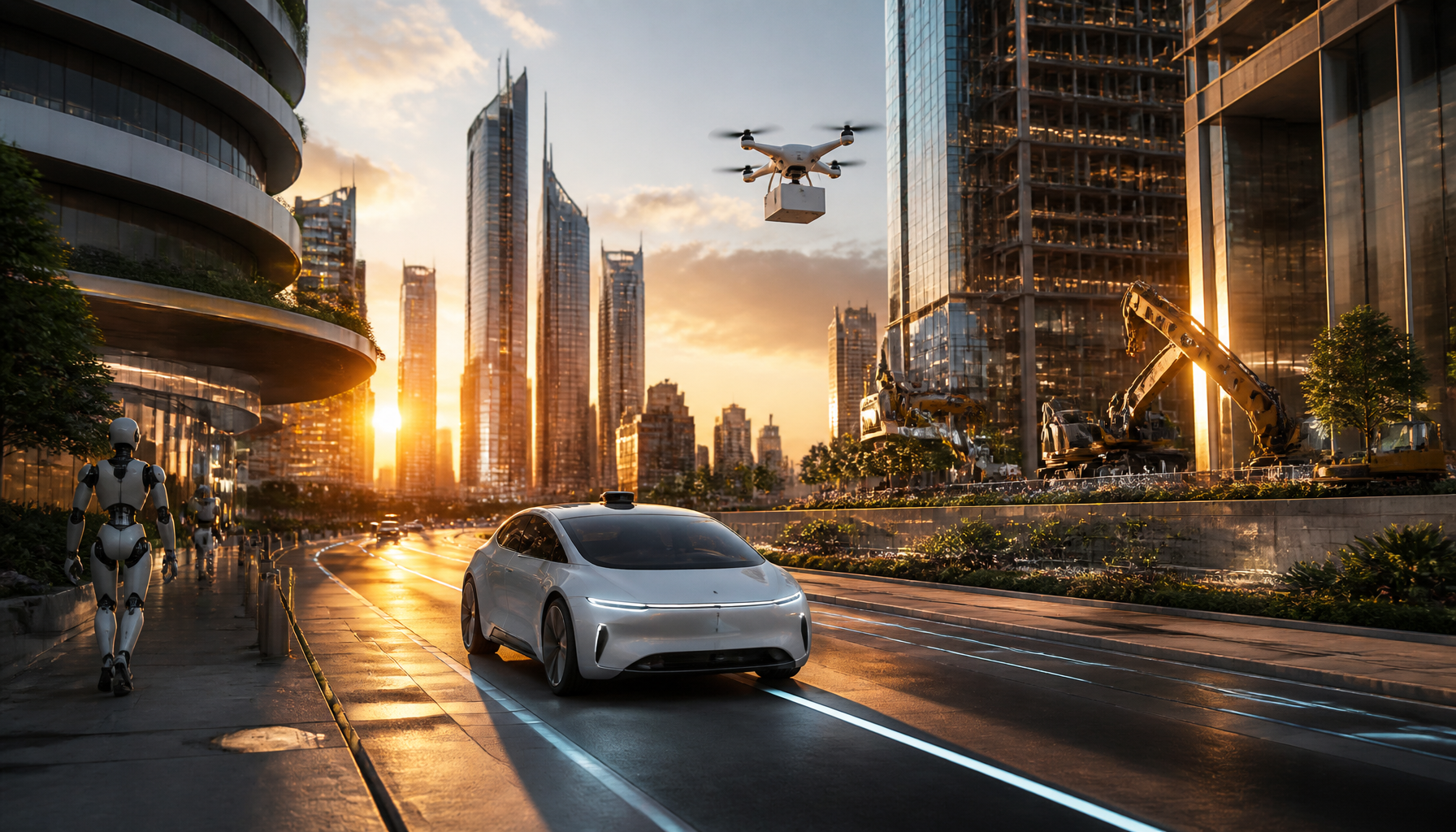
The pace of autonomous innovation is accelerating globally. Here are some of the most notable rapid-fire updates from the past week:
- Gravis Robotics: SoftBank invested $200M in Swiss startup Gravis Robotics to turn construction machinery into autonomous robots.
- Uber Eats & Zipline: Uber and Zipline partnered to bring drone delivery to Uber Eats, targeting 1M daily deliveries by 2029.
- Waymo: Waymo secured CPUC approval to expand robotaxis across the Bay Area and LA, with rollouts starting in Sacramento and San Diego.
- World Humanoid Robot Games: China is gearing up for the World Humanoid Robot Games, featuring 2,056 robots to showcase hardware scale.
- LG Electronics: LG Electronics unveiled plans to launch a bipedal humanoid robot, joining the global hardware race.
This rapid expansion is completely changing how modern businesses operate. Forward-thinking companies are turning to specialized Ai Operations Agent Development to automate complex logistics. Similarly, corporate marketing departments are adopting Ai Marketing Agent Development to drive automated campaigns. To stay ahead, professionals leverage modern Ai Productivity Tools 2025 Quick Solutions to streamline their development cycles.
Conclusion
From the microscopic scale of customized mRNA cancer vaccines to the colossal scale of reusable orbital boosters and lightning-fast humanoid robots, our world is transforming. The common thread driving these massive leaps is advanced Ai Model Engineering, robust AI reasoning, and high-precision physical hardware. As these breakthroughs continue to merge, the boundary between biological life and mechanical intelligence will continue to blur, ushering in an exciting, highly automated future.