


AI-powered identity fraud has officially breached the boundaries of science fiction, shifting from theoretical risk to a standard tool for digital adversaries. Somewhere in the Murcia region of Spain, a man was running a live video identification session, presenting himself as someone else, when his feed lagged. In that split-second gap, the illusion shattered. His real face showed through the deepfake he was wearing, and law enforcement was alerted.
This single frame drop exposed an industrial-scale operation. According to Spanish police, the suspect had allegedly posed as 30 different people across 38 attempts to obtain fraudulent digital certificates. This case represents a watershed moment for security professionals worldwide. It proves that the tools we rely on to establish digital trust are no longer sufficient.
The Murcia Incident: How a Single Glitch Exposed a Deepfake Ring
The suspect in Murcia did not rely on basic digital filters. He built a highly sophisticated physical and digital environment. He used a custom lighting rig with strategically placed colored bulbs. This rig was designed to mimic the security features, such as holograms, found on legitimate physical identity documents.
He combined this physical setup with real-time face-swap software and hijacked camera feeds. This allowed him to bypass traditional video verification systems. Traditional liveness detection was designed to catch printed photos or static masks. It looks for simple indicators like eye blinks or head turns. It is entirely blind to real-time stream injection.
The arrest was ultimately a matter of luck, not system capability. Had the software not lagged, his synthetic identity would have passed unnoticed. This case highlights why companies must completely rethink their verification architectures. For organizations seeking to build decentralized and unforgeable digital identities, understanding How Do Blockchain And Ai Work Together is a critical first step.
Interpol’s 2026 Assessment: A Continental Pivot to Synthetic Fraud
The vulnerability of our current biometric systems is a global crisis. According to INTERPOL’s African Cyberthreat Assessment Report 2026, cybercriminals have industrialised AI tools at an unprecedented pace. The report notes that AI was a component in 55% of all reported cybercrimes across Africa in 2025.
Furthermore, deepfake incidents spiked sevenfold between Q2 and Q4 of 2024 alone. This upward trajectory has continued to climb throughout last year. The financial impact is staggering. Reported cybercrime losses in Africa more than doubled, jumping from $192 million to $484 million.
Even national-level biometric defenses are struggling to keep up. Countries like Rwanda and Tanzania introduced biometric SIM registration to combat fraud. Yet, threat actors are already outpacing these databases. They utilize highly customized AI models built specifically to beat biometric checks.
To defend against these threats, organizations must move beyond generic security. Consulting with experts on Ai Consulting Services Benefits helps companies build resilient risk frameworks. This involves integrating continuous verification and advanced Ai Model Deployment And Integration pipelines. By running real-time injection attack detection, platforms can catch deepfakes before they access the system.
The Industrial Supply Chain Behind Fake Accounts
Modern fraud does not start with a single hacker. It runs on a highly structured, industrial supply chain. Every fraud scheme starts with a signup, and the signup gate is getting harder to secure. Akamai’s 2026 State of the Internet research found AI-powered bot traffic up 300% in a single year.
These bots are purpose-built to mimic human registration behavior. Sumsub’s Identity Fraud Report 2025-2026 highlights that the overall fraud rate across verified accounts has reached 2.2%. On high-risk platforms like dating and media, it climbs to 6.3%. Multi-step identity fraud has also surged, jumping from 10% to 28% of all attacks.
The supply chain behind these fake accounts is highly sophisticated. It utilizes synthetic identities, disposable VoIP numbers, and residential proxy networks. Attackers also use device farms and low-wage CAPTCHA-solving services. The FBI’s IC3 2026 annual report counted roughly 453,000 cyber-enabled fraud complaints. These complaints resulted in losses exceeding $17.7 billion.
Static checks at the gateway are no longer enough to stop this tide. Security teams must Deploy Intelligent Assistants capable of analyzing behavioral signals. These assistants evaluate typing cadence, mouse movements, and connection velocity. Developing these highly instrumented portals requires partnering with a top-tier Web Development Company to build secure, responsive frontends.
Social Engineering and Turnkey Persuasion Infrastructure
Fraudsters are no longer spending weeks developing technical exploits. Instead, they buy pre-built persuasion infrastructure off the shelf. Malwarebytes recently uncovered a $500 turnkey scam kit sold on underground forums. This kit includes fake dashboards, countdown timers, and admin panels for harvesting crypto recovery phrases.
BioCatch’s 2026 Digital Banking Fraud Trends in the U.S. report confirms this industrialization. Impersonation scam attempts more than doubled between 2025 and 2026. Phishing attempts climbed 50%, while remote-access-tool (RAT) sessions rose 45%. Over 83% of these fraud attempts originated from U.S.-based devices.
This regional concentration indicates scams that rely on manipulation rather than hacking. Attackers convince victims to authorize their own transactions. The FBI estimates that investment fraud losses alone topped $8.6 billion in 2025. BioCatch’s customers logged $46 million in attempted investment losses.
The human element is clearly failing. KnowBe4’s internal testing found that humans lost outright to AI bots in social engineering last year. Chief Deception Strategist Perry Carpenter warns that hyper-personalized, automated attacks are only 1-2 years away. Security teams must implement zero-trust frameworks to secure assets.
This makes finding secure Ways To Secure Your Cryptocurrency Exchange platforms highly critical. Some teams are bypassing traditional authentication altogether. They deploy a What Is A Smart Contract Wallet structure to enforce decentralized, multi-signature controls. This ensures that no single manipulated transaction can drain a user’s funds.
Tracking the Fraud Rings: Card Testing vs. Account Takeover
The financial damage of AI-powered identity fraud is rarely confined to a single target. Fraudsters operate in coordinated networks across multiple businesses. Sift’s Q2 2026 Digital Trust Index provides an inside look at how these rings function. In one case, a single email address cycled through 94 stolen cards.
The ring ran $4 transactions to validate which stolen cards were still active. They targeted five separate food and delivery businesses. None of the individual businesses saw more than a small slice of the pattern. Only a network-wide analysis exposed the full 94-card scale of the attack.
A second ring focused on account takeover (ATO) across 90 businesses. They attempted nearly 13,000 transactions using genuine, pre-existing accounts. A loyalty-account email change emerged as the clearest early signal of a takeover in progress. This shows that fraud signals are often behavioral rather than transactional.
Building systems that can detect these subtle shifts is a complex task. Organizations can partner with a specialized Generative Ai Development Company to build predictive behavioral models. Many top brands leverage the Top Blockchain Dev Companies 2025 to build secure, tamper-proof identity ledgers. For a complete guide on how to implement these systems, consult the Ai Agents Ultimate Resource.
The Speed Trap: Balancing Real-Time Verification and Consent
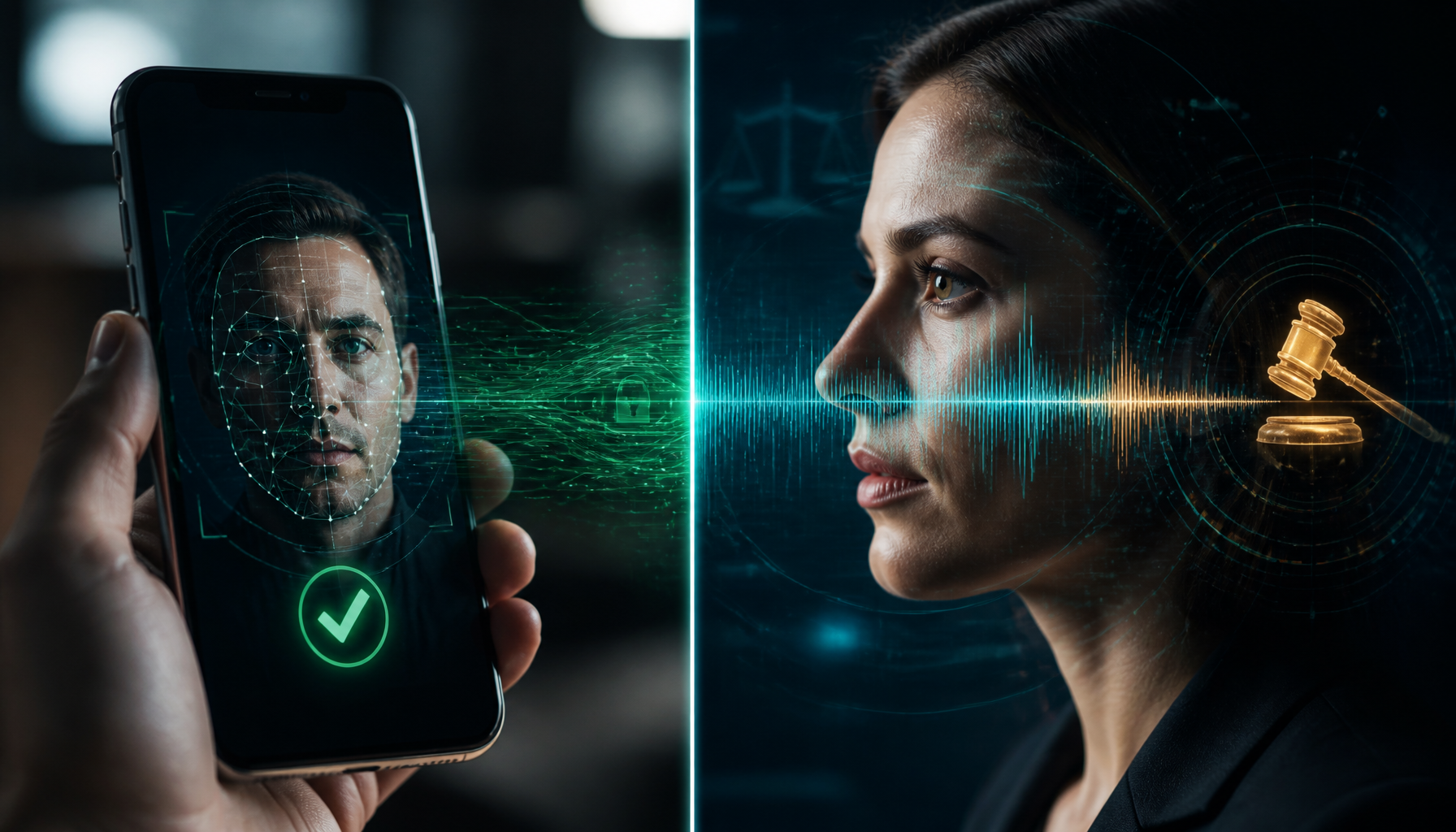
A major gap exists between the tools firms have and the coverage they deliver. A PYMNTS Intelligence and Plaid survey of 150 payments executives reveals a stark split. Firms verifying ownership in real time catch fraud before funds move 60% of the time. For firms without real-time checks, that rate drops to 23%.
Yet, building these continuous verification loops is legally risky. This is highlighted by the proposed class action lawsuit against Walmart in Illinois. Plaintiffs allege that Walmart’s AI silently converts customer service calls into biometric voiceprints without written consent. This practice violates Illinois’s Biometric Information Privacy Act (BIPA).
Under BIPA, damages range from $1,000 for negligent violations to $5,000 for intentional ones. While a 2024 amendment limits repeated collections, the controversy still exceeds $5 million. The irony is clear: continuous voice biometrics are exactly the kind of signals needed to fight fraud. Yet, the consent layer must be built alongside the security model, not added later.
To navigate these complex legal waters, security teams use automated Ai Workflow Automation Solutions to manage consent trails. Understanding the various Types Of Ai Agents Shaping The Future helps teams design compliance-first verification workflows.
If you wonder Why Choose Us, our strength lies in building security systems that respect local privacy regulations. We build strict consent and data retention controls during Ai Customer Support Agent Development. Additionally, implementing advanced systems like Devin Security Swarm Cognition Ai Agents allows for continuous, privacy-compliant monitoring across all user sessions.