

Google was just added to the Dow Jones Industrial Average, representing a monumental shift in market leadership. However, this historic milestone arrived under bizarre circumstances. On the exact same day, Google suffered a 6% stock drop, shedding nearly $250 billion in market value.
This timing highlights the fast-changing landscape of modern technology and global finance. While index committees honor long-term achievements, the market remains laser-focused on immediate competitive pressures. Today, those pressures are centered squarely on artificial intelligence.
Why Google was just added to the Dow Jones at a Turbulent Juncture
According to reports from Investing.com, S&P Dow Jones Indices replaced Verizon Communications with Alphabet (Google’s parent company). This change officially takes effect before the market opens on June 29, 2026.
The decision was highly strategic. Verizon’s share price had fallen significantly, reducing its index weight to a tiny 0.5%. Since the Dow Jones is a price-weighted index, low-priced stocks have an immaterial impact on performance. Alphabet’s higher stock price gives the index much stronger exposure to the modern tech economy.
Adding Google helps the Dow represent digital advertising, cloud infrastructure, autonomous vehicles, and artificial intelligence. Despite this honor, the index addition coincided with a harsh selloff. The fact that Google was just added to the Dow Jones reminds us that big tech is under immense pressure.
The Cost of the AI Talent Leak: Two Exits That Stung
Google’s recent stock drop was triggered by people, not products. Two of the firm’s most decorated AI researchers departed within five days. At the exact moment when Google was just added to the Dow Jones, its core leadership was dealing with a massive talent drain.
First, Noam Shazeer left Google to join rival OpenAI. Shazeer, a core architect behind the Gemini AI model and co-author of the foundational Transformer paper, had only returned to Google in August 2024. That return cost Google $2.7 billion in a partnership deal with Character.AI. Yet, he lasted less than two years before leaping to a direct rival.
Two days later, John Jumper announced his departure from Google DeepMind to join Anthropic. Jumper is the lead scientist behind AlphaFold, which revolutionized biology by mapping over 200 million protein structures. His groundbreaking achievements earned him a Nobel Prize in 2024 alongside DeepMind CEO Demis Hassabis.
These departures hit hard because of Google’s massive spending scale. Alphabet’s 2026 capital expenditure guidance stands between $180 billion and $190 billion. This represents a massive increase year-over-year. Most of these funds go toward expensive AI data centers and training models.
When elite researchers leave, investors worry that Google is building monuments rather than defensible moats. The modern artificial intelligence space is evolving rapidly. To keep pace with these shifts, understanding the Generative Ai Trends Outlook is essential for tech leaders.
Many organizations look to partner with an experienced Ai Development Company In Columbus to build their own capabilities. Navigating this architecture requires a clear roadmap, such as an Ai Application Development Guide 2025.
Distinguishing between advanced systems and simple workflows is also vital. The market is learning The Difference Of Ai And Automation to value assets accurately. Consequently, enterprises are moving to Deploy Intelligent Assistants to maintain operational efficiency.
Building specialized internal tools is another massive priority. Companies are focusing heavily on Ai Personal Assistant Agent Development to drive productivity. This allows firms to rely less on volatile external talent pools.
Meta’s Bold Play: Building the “Arena” Prediction Market App
While Google navigates talent drains, Meta is focusing on consumer engagement. Mark Zuckerberg recently directed a small, specialized team to build a standalone prediction market app called “Arena”.
The app will operate independently of Facebook, Instagram, and WhatsApp. Unlike existing platforms like Polymarket and Kalshi, Arena will initially use a virtual points system rather than real money. This points-based model helps Meta avoid heavy regulatory hurdles while testing user flows. However, the company has not ruled out real-money betting in the future.
This move highlights how tech conglomerates are racing to capture the growing demand for interactive event contracts. The public appetite for prediction mechanics is surging worldwide. Keeping track of these merging spaces is a core focus of Crypto Market Top News Today.
These prediction systems often cross over into Web3 ecosystems. Because of this, learning How To Choose And Set Up A Crypto Wallet is becoming a necessity for everyday users.
CryptoQuant’s Warning: Rebuilding Capital Buffers
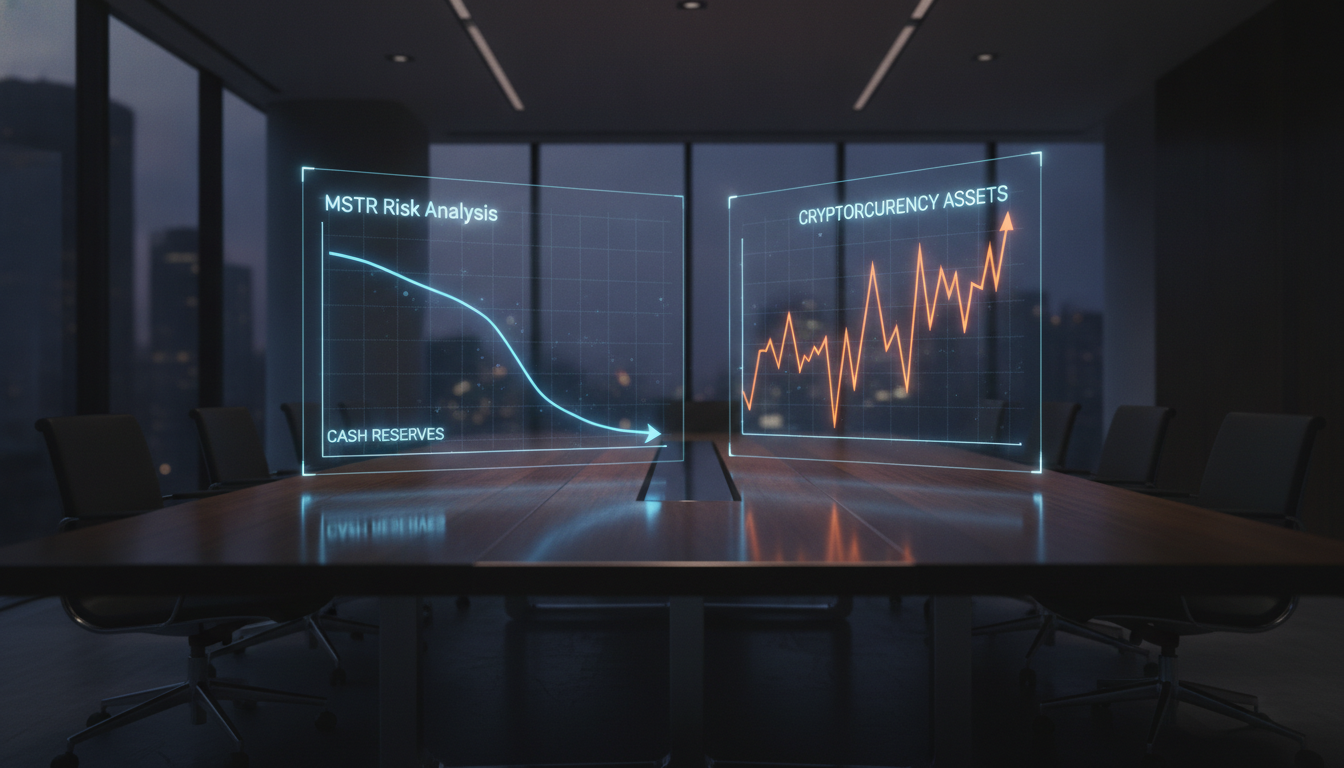
Financial pressures are not limited to big tech. On-chain analytics firm CryptoQuant recently warned corporate giant Strategy (MSTR) to pause its aggressive Bitcoin buying.
Strategy’s cash reserves have dropped 38% since the start of 2026. At the same time, the company committed to quadrupling its annual dividend obligations to $1.2 billion through preferred stock programs. As a result, its dividend coverage has collapsed from over seven years to just 14 months.
The company’s preferred stock, STRC, is currently trading roughly 17.5% below its $100 par value. CryptoQuant’s lead researcher, Julio Moreno, warned that buying Bitcoin whenever capital is available is a recipe for accumulating at cycle peaks. Meanwhile, selling Bitcoin is highly unappealing, as Strategy sits on billions in paper losses at current prices.
This capital stress test raises broader economic questions. Many retail traders are left wondering Why Is Crypto Going Up or crashing during these macroeconomic shifts. Determining Which Crypto Will Explode In 2025 requires deep fundamental analysis.
Understanding the core principles of What Is Blockchain remains crucial for any long-term investor. Furthermore, the role of Stable Token Development is becoming more pronounced as capital structures undergo intense pressure.
SpaceX’s Bond Frenzy and Micron’s Strategic Alliance
While Strategy faces liquidity constraints, SpaceX demonstrated immense capital market pull. The aerospace pioneer went to bond markets for a debut sale of $20 billion and received a staggering $90 billion in orders.
Bankers eventually raised the final deal size to $25 billion. However, despite holding a Moody’s Baa1 investment-grade rating, SpaceX had to pay yields well above its peers. This premium signals that the bond market is treating the firm as an entity with significant cash-burn hurdles to clear. Indeed, the day Google was just added to the Dow Jones will be remembered as a turning point for all high-growth capital.
Meanwhile, memory chipmaker Micron struck a monumental supply deal with Anthropic. Micron also made a strategic investment in Anthropic’s Series H funding round, which valued the AI lab at $965 billion. Micron is also deploying Anthropic’s Claude internally for coding and agent design.
These massive physical builds highlight the extreme reliance of next-generation AI models on hardware layer improvements. High-bandwidth memory is the central bottleneck for running frontier models. This computational push highlights the critical role of Embedding Models Powering Ai Systems 2026.
These advanced systems are starting to bridge with Web3 applications, as discussed in Top Ai News Today Blockchain Smart Contracts. Over time, optimizing these software stacks will show How Ai Reducing Smart Contract Costs at a global scale.
Conclusion: The Changing of the Guard
The news that Google was just added to the Dow Jones is a fitting tribute to its two decades of market dominance. Yet, the simultaneous talent departures and market volatility prove that previous achievements do not guarantee future success. As Meta builds Arena, SpaceX raises massive capital, and Anthropic expands its compute alliances, the frontier of tech innovation is shifting rapidly. The companies that secure the best talent and manage their capital wisely will lead the next economic era.