

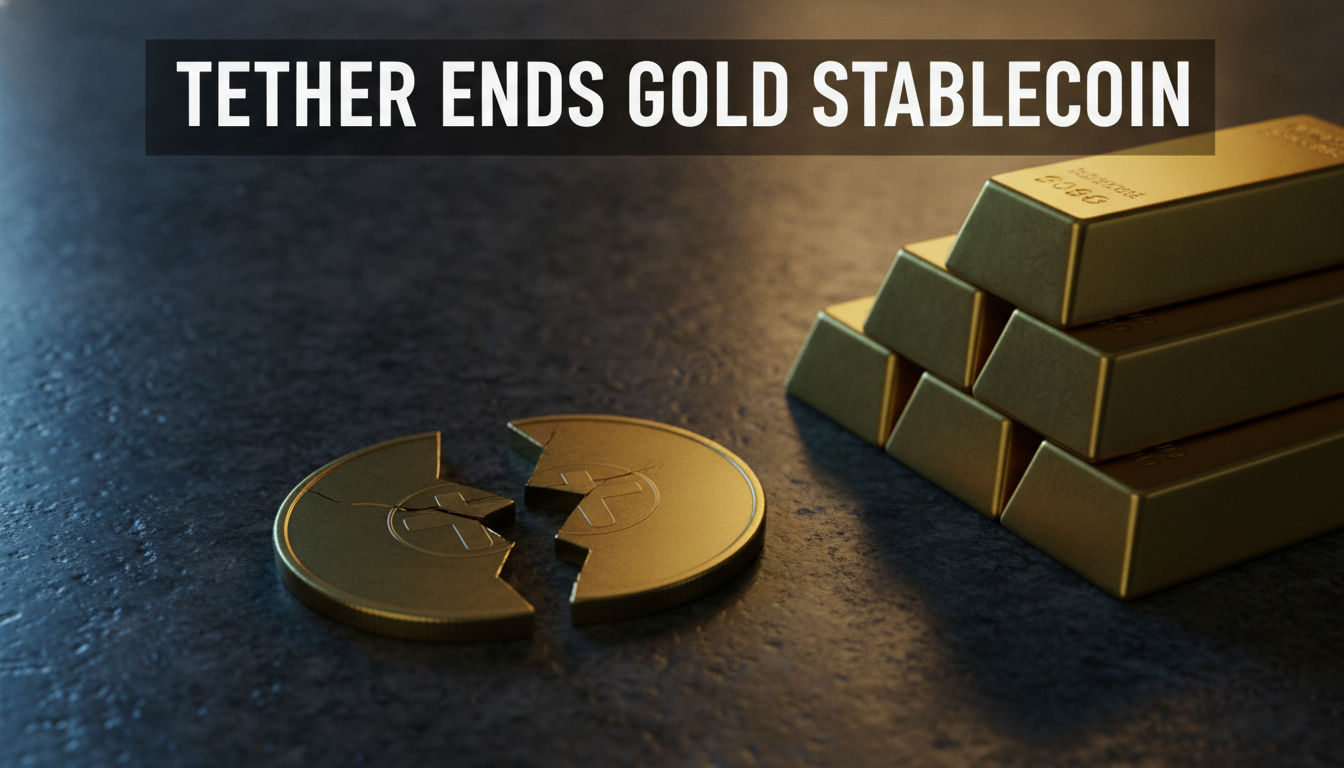
Tether just killed its gold-linked stablecoin. This sudden announcement sent shockwaves through the digital asset market. Many experts did not expect the wind-down of Alloy by Tether.
However, a closer look reveals a clear strategic signal. The company is actively shifting its focus. It wants to support deeper liquidity and more sustainable scaling.
Why Tether Just Killed Its Gold-Linked Stablecoin
The discontinued asset was known as aUSD₮. It launched in June 2024 to great fanfare. The asset functioned as a synthetic dollar.
Users deposited Tether Gold (XAU&₮) to mint it. This overcollateralized structure aimed to combine stability and commodity exposure. Developers utilized complex Tokenization Smart Contracts to run the mechanism. It seemed like a win-win on paper.
In reality, the experiment struggled to find traction. When the platform halted minting on June 17, 2026, the market cap of aUSD₮ stood at just $1.2 million. The supply was backed by only 14.73 kilograms of physical gold. For a company managing more than $113 billion in circulating USDT, this amount is tiny.
Investors realized that a synthetic dollar was unnecessarily complex. Most users who wanted dollar exposure simply held standard USDT. Meanwhile, commodity investors preferred holding physical gold on the blockchain directly. The project became a solution to a problem very few users actually faced.
To learn how similar platforms operate, some teams study How To Build A Defi Staking Platform. But for Tether, keeping this niche asset alive became a costly operational burden. The decision represents an important lesson for asset issuers.
Redemption Windows and Smart Contract Integrity
The wind-down of Alloy by Tether is structured in phases. Minting has been disabled immediately. Existing holders have until September 17, 2026, to redeem their tokens. They can claim the underlying Tether Gold collateral. This clean exit window prevents immediate losses.
Ensuring secure and structured redemptions is vital for trust. Decentralized applications rely heavily on robust security. Teams frequently seek Ways To Ensure Smart Contract Security to avoid smart contract failures. For synthetic assets, a secure redemption pipeline is essential.
Many protocols implement a dedicated What Is A Smart Contract Wallet for managing collateral vaults. These mechanisms keep investor assets safe during major migrations. Account abstraction makes such security standards easier to execute. Partnering with a specialized Erc4437 Token Development Company helps projects deploy highly compatible tokens.
A Clear Pattern of Product Consolidation
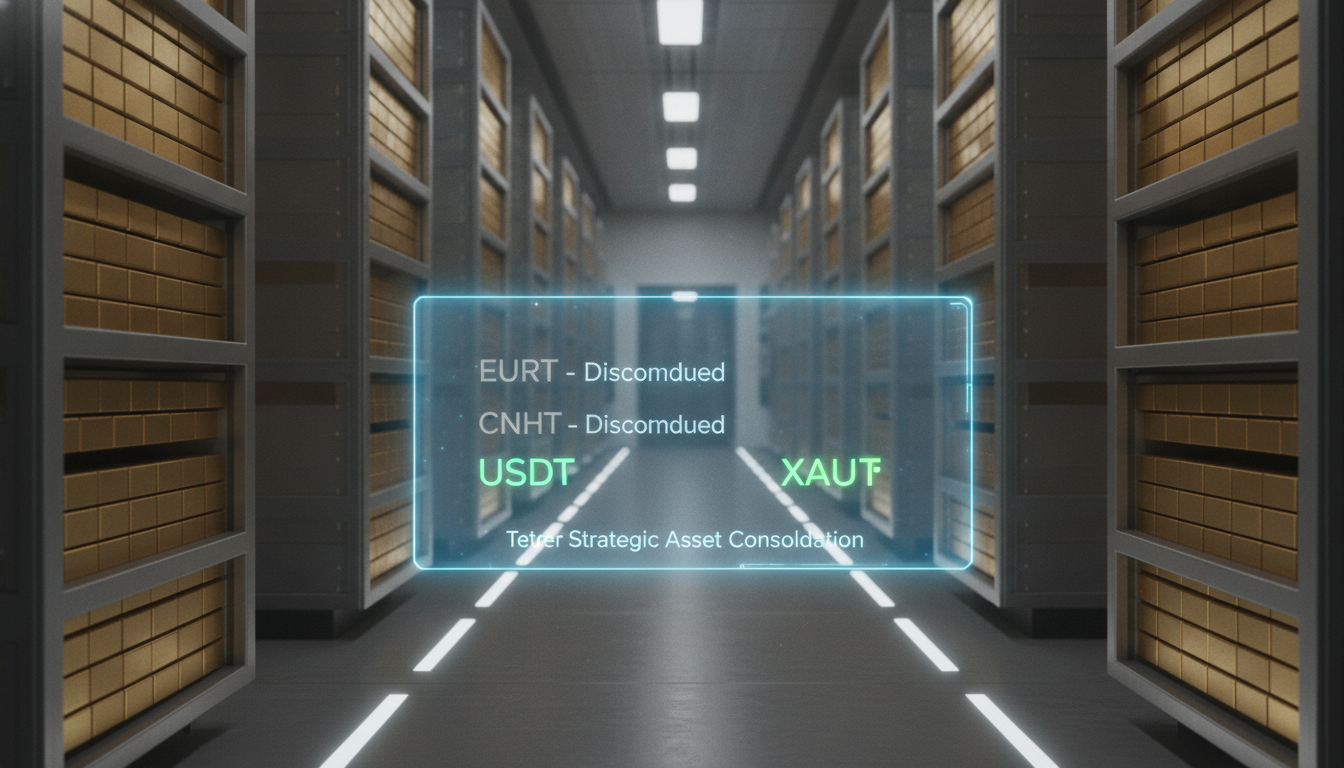
This closure is part of a broader consolidation trend. It is the third Tether product to be discontinued in the last eight months. In November 2025, Tether ended its euro stablecoin, EURT. This was due to low demand and strict MiCA regulations.
In February 2026, the company retired CNHT, an offshore Chinese yuan stablecoin. Tether is cutting underperforming experiments to refocus its massive capital. The company wants to concentrate on high-performance products. This focus will benefit USDT and the primary gold product, XAU₮.
Tether Gold (XAU₮) remains highly successful. It has a market cap of nearly $3 billion. The asset is backed by over 22,000 kilograms of physical gold. These gold bars are held securely in Swiss vaults. Tether is also expanding its real-world asset ecosystem. It recently purchased a 12% stake in Gold.com. It also launched options on XAU₮ on the Bybit exchange on June 12.
Furthermore, Tether is investing in the future of tech. The company is actively deploying funds into AI, cloud computing, and robotics. It recently invested $1 billion in NEURA, a prominent German humanoid robotics firm. This shows a transition from a simple stablecoin issuer to a massive technological conglomerate. Tether is scaling through Ai Integration And Automation across its operational arms. Investing in humanoid robotics and Adaptive Ai Smart Solutions aligns with this vision.
Market Watch: Financial Squeezes, Global Scrutiny, and Web3 Talent Gaps
Beyond Tether’s latest decision, several major events are shaping the global blockchain landscape.
1. Strategy’s STRC Preferred Shares Slide Below Par
Strategy Inc. (NASDAQ: MSTR), led by Michael Saylor, is facing pressure. Its Variable Rate Series A Perpetual Stretch Preferred Stock, known as STRC, hit a record low. On June 17, 2026, the stock closed at $89.00. This is 11% below its $100 par value.
STRC pays an 11.5% annual dividend rate in cash semi-monthly. However, bitcoin volatility has weighed heavily on the security. Because the stock is trading under par, the company has paused its at-the-market (ATM) issuance program. This program is a vital channel Strategy uses to raise capital for buying bitcoin.
The company has a massive bitcoin reserve of over 846,842 BTC. However, it recently sold 32 BTC for $2.5 million to cover dividend payments. According to public disclosures on SEC.gov, this was Strategy’s first bitcoin sale since 2022. Analysts are tracking these developments closely.
They study modern corporate finance using Ai Finance Agent Development models. While the company has substantial reserves, the current cash flow gap remains a major talking point.
2. India’s FIU Targets Crypto OTC Transactions
In South Asia, regulators are tightening control. India’s Financial Intelligence Unit (FIU-IND) has issued a strict directive. It ordered the three largest local exchanges to provide records of all over-the-counter (OTC) trades. The rule applies to transactions exceeding $10,000 dating back to January 2026.
OTC transactions are negotiated off public order books. This opacity helps large institutional players move capital without causing immediate price swings. However, it also creates significant money laundering risks. Regulators worry that these opaque channels conceal the true beneficial owners.
This step aligns with global compliance trends. Countries like the US, EU, Dubai, and Singapore have also strengthened rules. Exchanges must implement robust verification. Many rely on a White Label Crypto Payment Gateway to manage high-volume flows.
Regulators analyzing public ledgers often require custom tracking tools built via Block Explorer Development. Ensuring strict compliance requires implementing proven Ways To Secure Your Cryptocurrency Exchange. The era of shadow crypto trading is drawing to a close.
3. The Web3 Hiring Contradiction
The blockchain sector also faces a major workforce challenge. According to a new report by Bitget, there is a mismatch between talent and jobs. The Web3 Next-Gen Talent Intelligence Report was released under the Blockchain4Youth initiative.
The study revealed that 54% of job seekers are blocked by prior experience requirements. This barrier is especially common for junior positions. Furthermore, 52% of candidates stated that their university education only provided theoretical knowledge. It failed to teach practical, job-ready skills.
The report highlights a clear paradox. The talent exists, but the access doors remain shut. This challenge is prominent in emerging markets like Nigeria, Indonesia, and China. Interestingly, 61% of young professionals prefer a career combining AI and blockchain. This convergence is driving demand for advanced Ai Tools In 2025.
To bridge this gap, structured learning programs are expanding. The Blockchain4Youth program has registered over 10,000 learners. It provides a direct path from certification to employment. Educators are analyzing these trends to design practical Blockchain In Education Use Cases.
Web3 companies must adjust their hiring models. Instead of requiring years of experience, they should focus on technical capability. Many development firms, such as a premier Blockchain Development Company In Los Angeles, are building internships. They help young developers gain hands-on experience. This shift is vital for supporting the next wave of industry growth.
Embracing Simplicity and Structure
The wind-down of aUSD₮ and Alloy by Tether is not a failure. It is a sign of financial discipline. It shows that stablecoin issuers are prioritizing simplicity over complex derivatives.
The industry is maturing. Investors prefer direct commodity exposure like Tether Gold over synthetic models. This trend is visible across the entire decentralized finance space.
Some teams still build custom networks by Creating Your Own Blockchain Network. However, core protocols are focusing on what works. For users holding aUSD₮, the clock is ticking. You must redeem your tokens before September 17, 2026. After that date, the platform will go dark.