

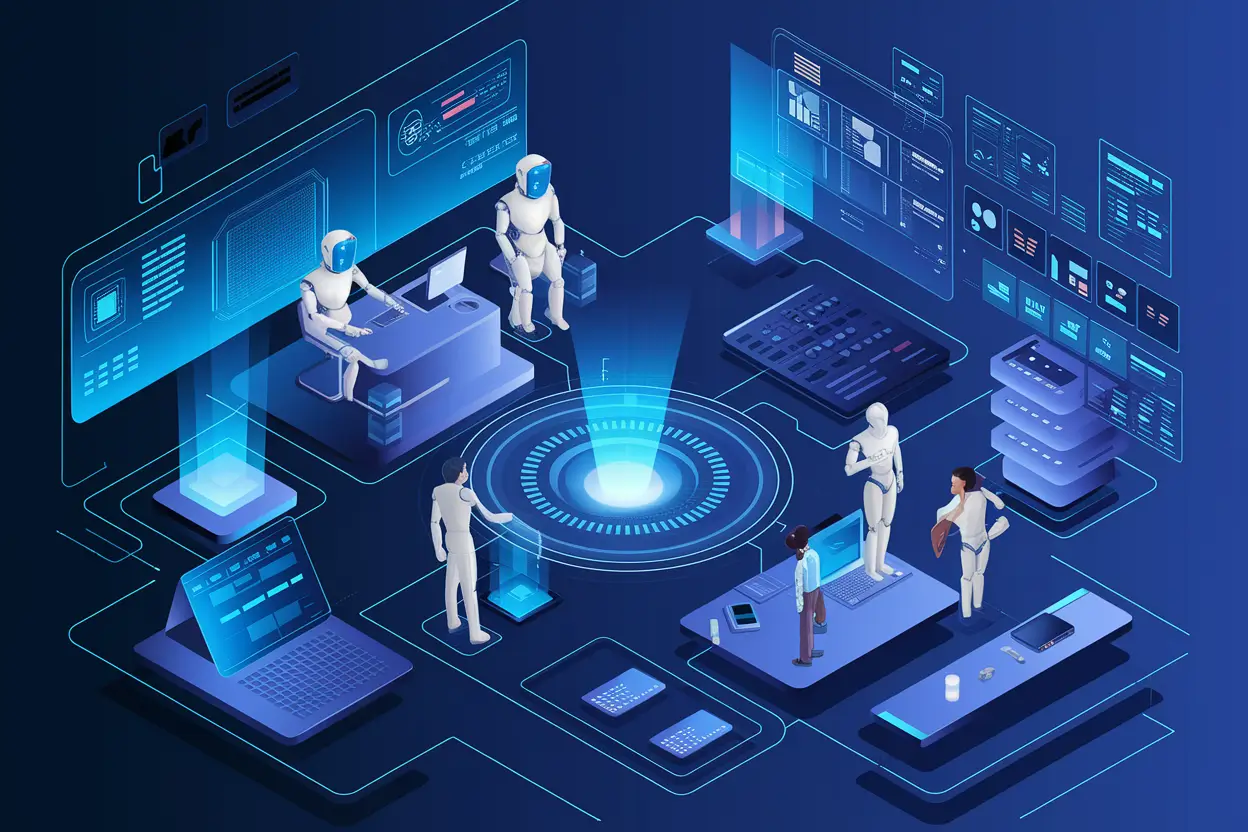
AI vs Human Jobs has become one of the most talked-about topics as industries continue to transform under the influence of artificial intelligence. By 2026, the workforce will face a monumental shift where automation and machine learning reshape how we define human value and skill relevance. This article explores what this evolution means, what skills will thrive, and how humans can complement AI rather than compete with it. The goal is to understand how both can co-exist, maximizing productivity and innovation.
Understanding AI vs Human Jobs
AI vs Human Jobs highlights the competition and collaboration between artificial intelligence systems and human capabilities in the workforce. AI refers to computer systems designed to mimic cognitive functions such as learning, problem-solving, perception, and language understanding. These technologies automate repetitive tasks, analyze large datasets, and provide insights faster than human processing. However, they lack emotional intelligence, empathy, creativity, and ethical reasoning — all deeply human traits. The comparison primarily depends on where automation efficiency meets human adaptability.
How AI Works Within the AI vs Human Jobs Landscape
AI operates through algorithms that help it learn from data, often divided into machine learning, deep learning, and natural language processing. Machine learning allows AI systems to improve from experiences without explicit programming. Deep learning uses neural networks to analyze complex patterns. Natural language processing enables interaction with human languages. In the context of jobs, these technologies speed up data processing, pattern recognition, and prediction tasks. This helps industries like healthcare, finance, and logistics achieve efficiency while reducing human workload in repetitive tasks.
Core Concepts in AI vs Human Jobs
Several fundamental concepts influence the balance between AI and human employment:
- Automation: Replacing manual labor with machines or software to increase speed and reduce cost.
- Augmentation: Enhancing human abilities with AI rather than replacing them entirely.
- Upskilling: Training the workforce to handle new technologies and manage AI-driven tools.
- Ethical AI: Ensuring AI solutions align with moral values, fairness, and privacy principles.
Pros and Cons of AI vs Human Jobs
We can identify both opportunities and risks associated with this shift.
Pros
- Increased productivity and efficiency
- Enhanced accuracy in data-driven tasks
- Reduced operational costs for businesses
- New career opportunities in AI management and data science
Cons
- Job displacement for repetitive or routine roles
- Greater inequality between high-tech and low-skill workers
- Dependence on machines leading to potential creativity decline
- Ethical and security challenges due to automation
AI vs Human Jobs: Key Use Cases in Industry
AI vs Human Jobs manifests differently across sectors:
- Healthcare: AI assists in diagnosis and treatment predictions, but human doctors ensure empathy and patient connection.
- Finance: Machines automate trading and fraud detection, while humans strategize financial planning and client relations.
- Manufacturing: Robots handle repetitive assembly tasks, whereas humans ensure quality control and innovation.
- Education: AI personalizes learning pathways, and human teachers nurture social and emotional growth.
Real-World Examples of AI vs Human Jobs
In the automobile industry, Tesla’s AI-guided manufacturing robots work 24/7, increasing precision while human engineers design innovative models. In journalism, automated content generation tools create data reports quickly, but human writers add depth, context, and storytelling. Retail giants use AI to manage logistics and demand forecasting, while humans provide customer service and marketing creativity.
Latest Trends in AI vs Human Jobs
The most significant trend in AI vs Human Jobs is the rise of Generative AI, where systems create content, design graphics, or compose code. Another trend includes ethical AI frameworks to ensure job transitions respect human welfare. Hybrid collaboration is the new norm: humans and AI share tasks for optimal outcomes. By 2026, about 43% of companies are projected to implement AI-powered workflows that still rely heavily on human input.
Technical Implications and Suggestions
To adapt successfully, both organizations and workers should embrace data literacy, cloud computing, and AI management tools. Implementing explainable AI mechanisms ensures transparency in automated decisions. For developers, integrating model interpretability frameworks like LIME or SHAP helps make predictions understandable. For business leaders, developing cross-functional teams that include both AI engineers and domain experts ensures harmonious integration.
Code Example: Basic AI Automation Setup
Below is a simplified concept of integrating automation using Python and machine learning to handle repetitive job functions such as email categorization.
Illustrative Pseudocode:
Input emails → Data preprocessing → Train classifier (e.g., Naive Bayes) → Predict categories → Route to appropriate department.
This setup demonstrates how automation complements human effort rather than fully replaces it.
AI vs Human Jobs: Comparison with Alternatives
AI vs Human Jobs differs from mechanization in previous industrial revolutions. Today’s AI can learn and make decisions, while older automation simply repeated tasks. The modern challenge isn’t just physical replacement but cognitive competition. For example, AI can create marketing content faster, but human marketers provide nuance and emotion. The alternative is balanced augmentation where both combine strengths to create efficient yet empathetic systems.
AI vs Human Jobs in the Global Economy
Developed economies are witnessing advanced AI adoption, while developing nations still rely more on human labor. The global challenge includes addressing unemployment risks through reskilling initiatives. International labor agencies suggest continuous learning and adaptability as core survival strategies for 2026. Governments must incentivize educational institutions to integrate AI literacy programs to bridge the skill gap.
Soft Skills That Will Survive AI vs Human Jobs
As automation takes over technical work, human competencies like emotional intelligence, communication, problem-solving, and adaptability become more valuable. Leadership, empathy, collaboration, and ethical reasoning remain uniquely human disciplines that AI cannot replicate. Workers with these traits will excel in overseeing intelligent systems.
Technical Skills That Will Thrive
Among technical skills that will flourish in the AI vs Human Jobs era are data analysis, machine learning, cybersecurity, robotics engineering, and cloud management. These are the skill sets that maintain control over automation infrastructure. Professionals who learn to interpret AI models, refine data, and deploy algorithms will not only survive but prosper.
Case Study: AI vs Human Jobs in Customer Support
One notable example involves customer service automation. Chatbots powered by natural language processing handle FAQs and ticket triage, while human agents resolve complex emotional inquiries. This collaboration speeds up service without sacrificing empathy. In one telecom company, AI cut response time by 45%, but humans maintained client satisfaction by handling escalations personally.
Future Outlook of AI vs Human Jobs for 2026
The future indicates coexistence rather than replacement. AI will handle high-volume low-judgement tasks, and humans will focus on strategic, value-driven roles. The emergence of AI auditors, ethical compliance officers, and prompt engineers showcases how technology refines rather than eliminates work.Clear regulatory frameworks will also emerge to ensure fair AI workforce integration.
AI vs Human Jobs: The Ethical and Emotional Divide
Automation lacks human empathy, intuition, and moral consciousness. Although AI can simulate responses, genuine understanding remains a human attribute. Companies that prioritize ethical and emotional intelligence training will lead by building trust among consumers and employees. Ethics-driven decisions will guide sustainable AI adoption.
How to Prepare for AI vs Human Jobs Future
To secure your career by 2026, consider:
- Learning foundational AI concepts and tools.
- Developing complementary soft skills like communication and leadership.
- Adopting lifelong learning and adaptability.
- Participating in cross-disciplinary projects involving AI integration.
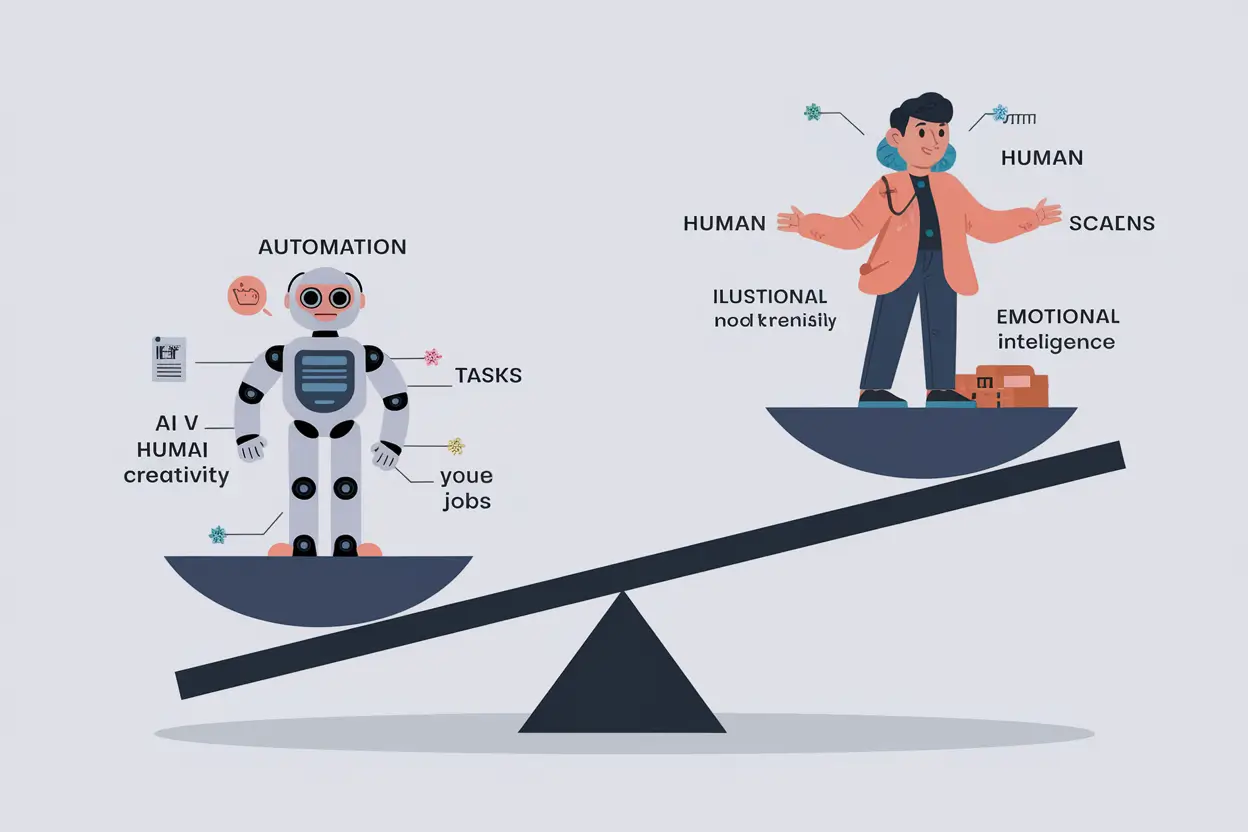
AI vs Human Jobs: Common Myths
- Myth 1: AI will completely replace humans. Reality: AI automates tasks, but humans remain essential for oversight and empathy.
- Myth 2: Only tech professionals will have work. Reality: Fields like education, healthcare, art, and leadership will still need humans for creativity and judgment.
- Myth 3: AI doesn’t make mistakes. Reality: Poor data quality or biased algorithms can produce errors as dangerous as human oversight.
AI vs Human Jobs: Common Mistakes and How to Avoid Them
- Overreliance on automation can reduce human oversight. Maintain regular auditing.
- Ignoring employee reskilling can lead to disengagement. Introduce structured learning paths.
- Lack of transparency in AI decisions can harm trust. Emphasize explainable AI systems.
Actionable Takeaways for 2026
- Blend AI tools with human creativity to achieve optimal results.
- Invest in both technical and emotional intelligence.
- Monitor emerging AI laws to adapt your business policies accordingly.
- Foster continuous education environments.
FAQs on AI vs Human Jobs
What jobs are most at risk due to AI?
Roles involving repetitive or data-intensive work, such as administrative tasks, manufacturing assembly, and data entry, face high automation risk.
Which jobs are AI-proof or future-proof?
Creative industries, healthcare practitioners, educators, researchers, and management roles requiring emotional intelligence remain highly secure.
How can employees prepare for AI integration?
By learning technical tools, understanding AI fundamentals, and focusing on soft skills development such as adaptability and empathy.
Will AI surpass human intelligence?
AI can process information faster but lacks human consciousness, ethics, and understanding. Hence, total replacement is unlikely.
Can AI create new jobs?
Yes. The rise of AI creates roles such as AI ethicists, data scientists, model trainers, and human-AI collaboration specialists.
Conclusion: The Balance of AI vs Human Jobs in 2026
In summary, AI vs Human Jobs will not result in a zero-sum game. The future lies in collaboration. As AI handles repetitive or analytical responsibilities, humans will focus on ethics, strategy, and creativity. Embracing lifelong learning and investing in hybrid intelligence ensures sustainable economic evolution where both technology and humanity thrive.