


Best AI Tools for Small Businesses in 2026 are transforming the way entrepreneurs operate and scale their ventures. As the digital economy accelerates, artificial intelligence has evolved from being a luxury reserved for large enterprises into an affordable and accessible toolset for small business owners. In 2026, these tools enable automation of repetitive tasks, enhance customer engagement, improve marketing ROI, and drive data-driven decision-making. By integrating the best AI tools, small businesses can achieve rapid growth, optimize expenses, and compete effectively with larger players while maintaining agility and personalized service.
Understanding the Best AI Tools for Small Businesses in 2026
Artificial Intelligence (AI) refers to the simulation of human intelligence by machines, enabling them to think, learn, and act autonomously. The best AI tools for small businesses in 2026 harness the power of machine learning, natural language processing, and predictive analytics to simplify complex workflows. These tools automate tasks such as lead generation, email marketing, customer support, and financial management. Cloud-based AI solutions make advanced capabilities affordable even for startups. They work by using real-time data to deliver personalized insights, forecast outcomes, and suggest the best possible actions for business growth.
How the Best AI Tools for Small Businesses in 2026 Work
The core working principle behind these AI solutions involves data input, model training, pattern recognition, and decision automation. For instance, AI-driven customer relationship management tools like HubSpot AI analyze customer interactions to improve targeting and outreach. Similarly, generative AI content assistants use transformer-based architectures to generate blog posts, emails, and ad copies with human-like fluency. By integrating APIs and cloud processing, these tools connect seamlessly with existing business management systems, allowing even non-technical users to deploy AI-driven automations in minutes.
Core Concepts Behind the Best AI Tools for Small Businesses in 2026
Underlying most AI tools are several core technologies. Machine Learning (ML) empowers programs to learn from data patterns and make predictions. Natural Language Processing (NLP) enables AI to understand and generate human-like text. Predictive Analytics uses statistical techniques to forecast trends based on historical data. Automation engines integrate with CRM, ERP, and analytics systems for workflow optimization. Together, these concepts form the backbone of AI-powered solutions that deliver measurable business outcomes.
Benefits of Using the Best AI Tools for Small Businesses in 2026
- Increased Efficiency: Automates repetitive tasks such as scheduling, invoicing, and email management.
- Enhanced Customer Experience: Chatbots and personalization engines provide faster, tailored responses.
- Cost Reduction: Cuts down the need for large manual labor forces.
- Data-Driven Decision-Making: Insights derived from analytics help in strategic planning.
- Marketing Optimization: AI improves targeting and ad performance through audience segmentation.
Potential Drawbacks of the Best AI Tools for Small Businesses in 2026
While AI brings numerous advantages, there are challenges to consider. Costs, though reduced, can still be significant depending on scale and integration needs. Data privacy and security require compliance with laws like GDPR. Inaccuracies may arise if the AI model is trained on biased or insufficient data. Additionally, small teams must invest in training to fully leverage advanced features. Nonetheless, the benefits outweigh the drawbacks when tools are chosen strategically.
Top Categories of the Best AI Tools for Small Businesses in 2026
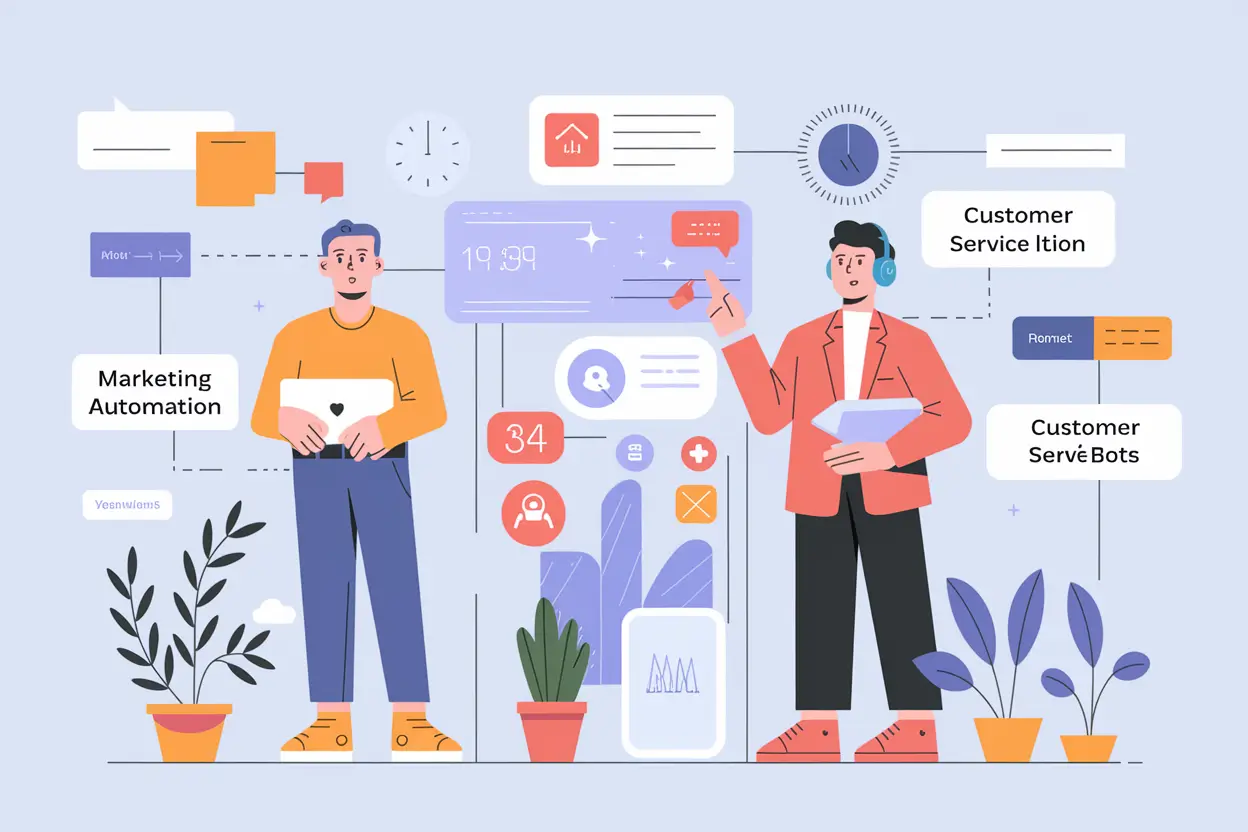
- Marketing & Sales Automation: Tools like Jasper AI and ActiveCampaign AI optimize content creation and customer targeting.
- Customer Service Automation: Chatbots such as Intercom AI or Drift assist with instant customer support.
- Financial Management: AI accounting tools like QuickBooks AI help automate bookkeeping and expense tracking.
- Human Resources: AI recruitment tools streamline candidate screening and performance analytics.
- Analytics and Forecasting: Platforms like Tableau AI or Google Cloud Vertex provide predictive business insights.
Real-World Examples of the Best AI Tools for Small Businesses in 2026
For instance, an e-commerce small business can use Shopify Magic to generate product descriptions dynamically based on attributes and SEO requirements. A restaurant owner might use ChatGPT-integrated chatbot systems to take reservations and answer FAQs in real-time. Real estate firms can deploy AI-driven CRMs for lead qualification, saving time and increasing conversion rates. A marketing agency can rely on AI social media assistants to schedule posts and analyze engagement metrics automatically.
Latest Trends Shaping the Best AI Tools for Small Businesses in 2026
Current trends reveal a massive push toward hyper-personalization and self-service AI platforms. The emergence of no-code AI automation frameworks allows users to customize tools without writing code. Edge AI and federated learning are enhancing data privacy by processing data locally. Generative AI models are now embedded in mainstream office software, allowing users to generate reports, presentations, and campaigns with ease. Integration ecosystems have become key as small businesses aim to connect AI across CRM, marketing, HR, and finance platforms seamlessly.
Technical Considerations When Adopting the Best AI Tools for Small Businesses in 2026
Before implementing AI solutions, small businesses must evaluate their infrastructure. Ensure stable cloud integration, API interoperability, and data compliance. Selecting tools with open AI APIs and strong documentation simplifies development. For example, connecting an AI chatbot to your website can be done using a webhook setup script through the following JavaScript snippet:
Code Snippet Example:
<script>const webhookUrl = ‘https://api.chatbot.com/webhook’; fetch(webhookUrl,{method:’POST’,body:JSON.stringify({message:’Customer inquiry’})}) .then(res => res.json()) .then(data => console.log(data));</script>
This basic setup demonstrates how small businesses can automate simple interactions without deep programming knowledge.
Comparing the Best AI Tools for Small Businesses in 2026
When selecting tools, it’s essential to analyze feature sets, usability, and integration flexibility. Below is a quick comparison:
| Tool | Main Use | Key Feature | Pricing Model |
|---|---|---|---|
| Jasper AI | Content Creation | Natural Language Generation | Subscription |
| HubSpot AI | CRM & Marketing | Predictive Lead Scoring | Tier-based |
| QuickBooks AI | Finance Automation | Invoice Forecasting | Pay-per-use |
| Intercom AI | Customer Support | Chat Automation | Per agent/month |
Use Cases of the Best AI Tools for Small Businesses in 2026
- E-commerce: AI-driven recommendation engines increase upselling potential.
- Healthcare Clinics: Appointment scheduling bots streamline operations.
- Marketing Agencies: Predictive analytics optimize ad spend.
- Retail Stores: Visual AI tools monitor inventory and customer behavior.
- Real Estate: Automated lead generation systems prequalify prospects efficiently.
Future Outlook of the Best AI Tools for Small Businesses in 2026
The global advancement in AI regulation and ethics will likely influence future tool development. Expect to see continued emphasis on accuracy, transparency, and responsible deployment. By 2028, smaller AI engines will run natively on IoT devices, allowing real-time analysis without cloud dependency. Integrated virtual assistants will become commonplace in every business sector. As AI prices continue to decrease, even smaller shops will harness its power for dynamic growth and competitiveness.
Pros and Cons Comparison of the Best AI Tools for Small Businesses in 2026
Entrepreneurs must evaluate both benefits and potential trade-offs to make an informed investment:
- Pros:
- Time saving and efficiency boost
- Better customer insights and engagement
- Scalability and automation of daily operations
- Improved decision-making accuracy
- Cons:
- Initial setup and training costs
- Possible data privacy challenges
- Dependence on reliable connectivity
Common Mistakes When Using the Best AI Tools for Small Businesses in 2026
Key mistakes include failing to define clear use cases before adoption, ignoring integration compatibility, and overlooking employee training. Often, small business owners assume AI automatically guarantees success, but without ongoing data updates or maintenance, models can become obsolete. Another frequent error is neglecting to measure ROI post-implementation. Tracking metrics such as conversion rate, average ticket size, or customer retention is essential to gauge success accurately.
Actionable Steps to Implement the Best AI Tools for Small Businesses in 2026
- Identify your business pain points and choose suitable AI categories.
- Start with a free or low-cost trial version before scaling.
- Integrate AI via plugins or APIs to avoid system disruptions.
- Train employees on how to interpret AI analytics outputs.
- Monitor and refine your strategies using performance dashboards.
Best Practices for Maintaining Results with the Best AI Tools for Small Businesses in 2026
Keep data clean and structured to ensure accurate results. Schedule periodic audits of AI performance. Adopt hybrid models where AI handles repetitive tasks while humans manage creative decision-making. Partner with vendors that provide ongoing updates and support. Establish clear KPIs linked to business goals such as revenue growth or customer lifetime value.
Case Study: Using the Best AI Tools for Small Businesses in 2026 to Increase Sales
ABC Boutique, a local fashion retailer, integrated AI-powered analytics and recommendation engines. Within three months, conversion rates improved by 22%, email open rates rose by 35%, and marketing costs reduced by 17%. This real-world example proves the power of strategic AI adoption for quick revenue growth. The combination of predictive CRM and automated content creation helped them maintain consistent brand engagement.
FAQs about the Best AI Tools for Small Businesses in 2026
1. What’s the most affordable AI tool for small businesses in 2026?
Many freemium AI tools like ChatGPT Business, Canva AI, or Notion AI offer substantial features under free tiers before scaling up with premium functionality.
2. Can small businesses use AI without technical knowledge?
Yes. Most of today’s tools are designed with intuitive interfaces and built-in tutorials. Drag-and-drop workflow builders allow non-technical entrepreneurs to automate processes easily.
3. How secure are the best AI tools for small businesses in 2026?
Reputable providers use end-to-end encryption, multifactor authentication, and adhere to GDPR compliance standards to safeguard data integrity.
4. What industries benefit most from these AI tools?
Retail, e-commerce, healthcare, professional services, real estate, and hospitality sectors see major gains from improved automation and personalization.
5. How can AI tools directly boost revenue?
By automating upsell recommendations, optimizing ads through predictive targeting, and improving customer service responsiveness, AI directly contributes to higher conversion rates and customer lifetime value.
6. What trends will define the future of AI for small businesses?
Expect greater focus on ethical AI practices, more embedded AI in software suites, and extensive adoption of multimodal models that can process text, image, and voice simultaneously.
Conclusion: Why You Should Start Using the Best AI Tools for Small Businesses in 2026 Now
The adoption of the best AI tools for small businesses in 2026 is no longer optional—it’s a competitive necessity. Small firms can harness automation, predictive analytics, and personalization to achieve measurable results quickly. These tools democratize technology, enabling small players to compete with larger enterprises. By strategically implementing AI today, you can future-proof your operations and achieve exponential growth in efficiency, profitability, and customer satisfaction.