

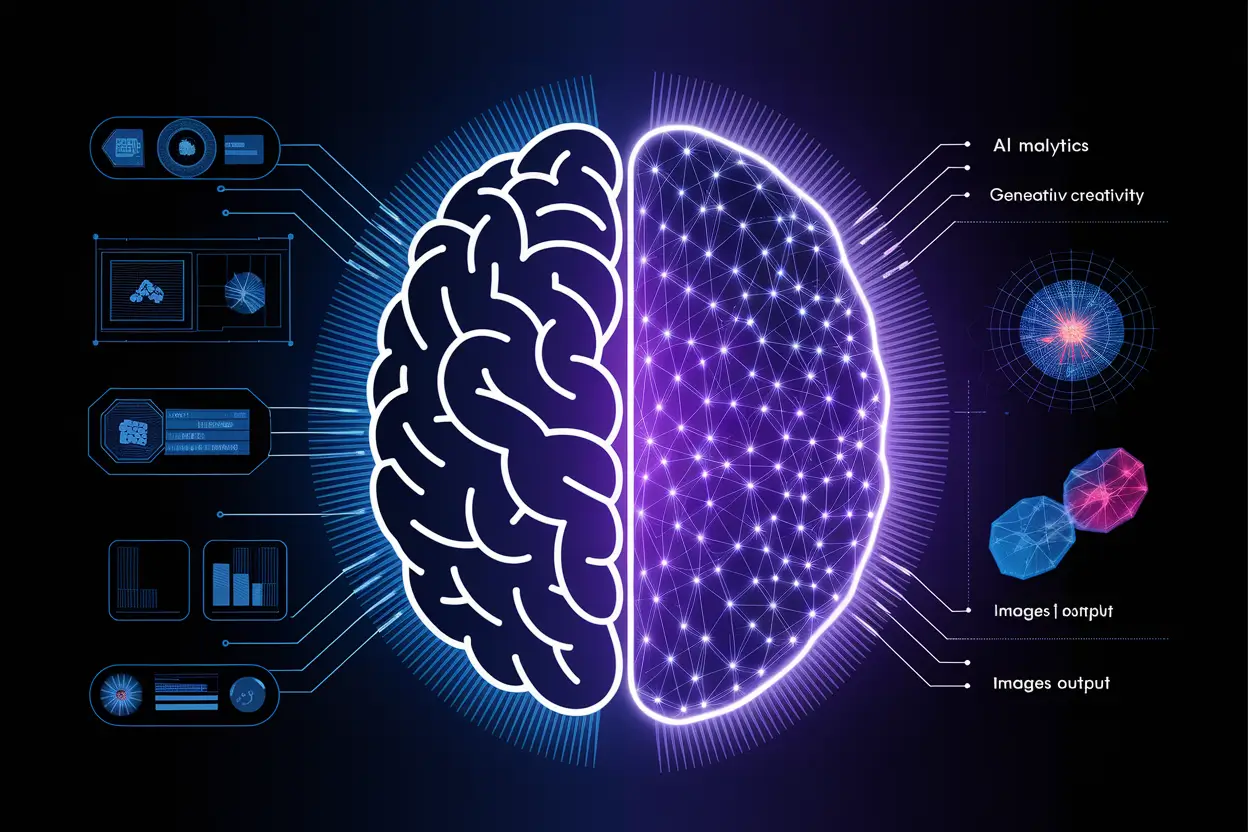
Difference Between AI and Generative AI marks a crucial distinction in the world of emerging technology. Artificial Intelligence (AI) refers to systems or machines that mimic human intelligence to perform tasks and can improve iteratively based on the data they process. Generative AI, a specialized subset of AI, focuses on creating new content such as text, images, code, and music that closely resemble what humans can produce. Understanding the difference between AI and Generative AI helps professionals, students, and businesses make informed decisions about adopting these technologies effectively.
Understanding the Difference Between AI and Generative AI
Artificial Intelligence is a broad field that encompasses all systems capable of performing cognitive tasks like reasoning, problem-solving, learning, and decision-making. Generative AI, however, emphasizes creativity by generating new and unique data outputs that didn’t exist before. The key difference lies in purpose: AI aims to analyze and assist, while Generative AI aims to create and innovate.
How the Difference Between AI and Generative AI Originated
The origin of AI can be traced to the 1950s with early research on machines that could simulate human cognition. Generative AI emerged decades later, driven by advances in deep learning, large language models, and generative adversarial networks (GANs). Tools like GPT, DALL·E, and Stable Diffusion exemplify how generative models combine neural networks with vast datasets to synthesize new data outputs.
Core Concepts Behind the Difference Between AI and Generative AI
The difference between AI and Generative AI lies primarily in their design and application. Traditional AI relies on supervised or unsupervised learning techniques where models are trained to classify, predict, or make decisions based on input data. Generative AI systems, in contrast, learn to emulate patterns within data and generate entirely new outputs. This involves probabilistic modeling, reinforcement learning, and diffusion modeling techniques that guide the creative process.
Traditional AI Core Methods
- Machine Learning algorithms like regression, decision trees, and clustering
- Reinforcement learning used for autonomous systems
- Knowledge representation and expert systems
Generative AI Core Methods
- Generative Adversarial Networks (GANs)
- Variational Autoencoders (VAEs)
- Transformers and diffusion models
How the Difference Between AI and Generative AI Works Technically
AI systems work by ingesting large datasets, detecting patterns, and performing predictive tasks. On the other hand, Generative AI learns these patterns and recreates them, generating new possibilities beyond what was initially fed to the algorithm. For example, a traditional AI may categorize photos of cats and dogs, while Generative AI can create a realistic image of a hybrid cat-dog that doesn’t exist.
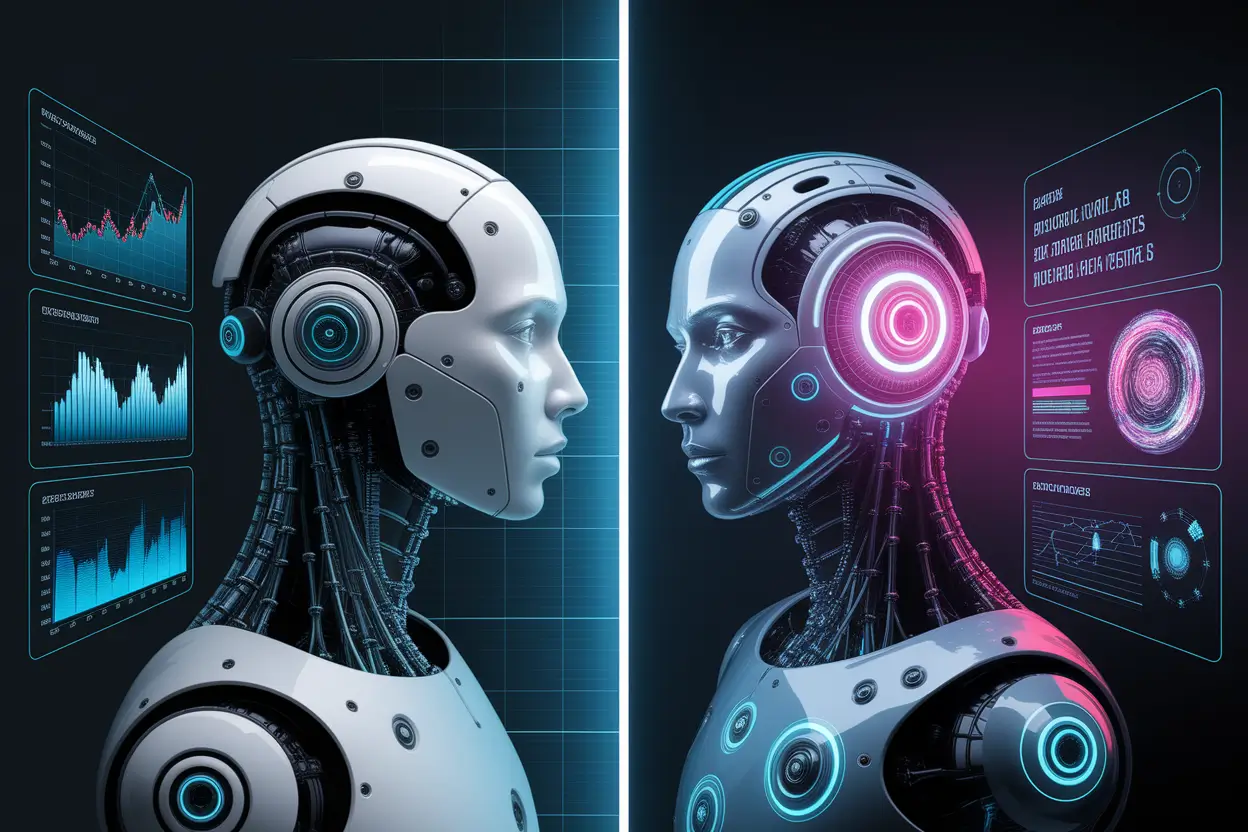
This generation happens through probabilistic sampling from learned latent spaces within the model.
Pros and Cons Showing the Difference Between AI and Generative AI
Advantages of AI
- Enhances efficiency by automating repetitive tasks
- Supports data-driven decision-making
- Reduces human error through predictive analytics
Advantages of Generative AI
- Accelerates creative processes like writing and designing
- Enables content personalization at scale
- Allows simulation of real-world scenarios for R&D
Limitations
- AI can be limited by data quality and overfitting
- Generative AI risks bias replication and misinformation
- Both require high computational resources
Use Cases Highlighting the Difference Between AI and Generative AI
AI is applied in recommendation systems, fraud detection, and predictive maintenance, while Generative AI serves roles in content creation, drug discovery, and synthetic data generation. AI supports efficiency, while Generative AI amplifies creativity. For instance, e-commerce platforms use AI for recommendations, and generative AI for automated product image generation.
Real-World Examples of the Difference Between AI and Generative AI
Common AI systems include virtual assistants like Siri and predictive text systems, where algorithms analyze patterns to provide answers. Generative AI applications include OpenAI’s GPT models for language, DALL·E for image synthesis, and Google’s Imagen for video generation. In business, Generative AI powers ad generation and automated content writing, while AI assists with analytics and trend forecasts.
Latest Trends Related to the Difference Between AI and Generative AI
As the line between AI and Generative AI continues to evolve, several trends are emerging. Integration of generative models into enterprise tools is on the rise, with companies embedding text-to-code and text-to-image features. Moreover, edge AI and federated learning are making models more private and efficient. Ethical AI practices and AI safety are also key trends ensuring responsible usage of generative tools.
Technical Suggestions for Implementing the Difference Between AI and Generative AI
Developers working with these systems should ensure robust data preprocessing and fine-tuning techniques. For AI, supervised models like logistic regression or neural networks can suffice, while Generative AI requires larger transformers or GAN architectures. Below is a simplified example in Python using a pretrained Generative AI model for text generation:
Example:
from transformers import pipeline
generator = pipeline(‘text-generation’, model=’gpt2′)
output = generator(‘Explain difference between AI and Generative AI’, max_length=50)
print(output)
This demonstrates how a generative model learns to produce human-like responses using transformer-based architectures.
Comparisons with Alternatives Emphasizing the Difference Between AI and Generative AI
When comparing AI and Generative AI to other computational systems like traditional programming or rule-based bots, their adaptiveness and learning ability stand out. Below is a simple table comparison:
| Aspect | AI | Generative AI |
|---|---|---|
| Goal | Analyze and Predict | Create and Synthesize |
| Examples | Recommendation Systems | Text-to-Image Generators |
| Data Dependence | Structured Data | Unstructured Data |
| Output Type | Deterministic | Probabilistic |
Code and Setup Demonstrating the Difference Between AI and Generative AI
To illustrate technical setup, consider an AI classification example versus a Generative AI content creation example. For traditional AI classification, scikit-learn models can be used. For content generation, transformers from the Hugging Face library can be employed. Example setup:
AI Classification Example:
from sklearn.tree import DecisionTreeClassifier
X = [[0,0],[1,1]]
y = [0,1]
model = DecisionTreeClassifier()
model.fit(X, y)
print(model.predict([[2,2]]))
Generative AI Example:
from transformers import pipeline
gen = pipeline(‘text-generation’, model=’gpt2′)
print(gen(‘AI vs Generative AI:’, max_length=40))
These snippets demonstrate that AI focuses on identifying patterns to predict labels, while Generative AI generates original data through trained distributions.
Future Outlook on the Difference Between AI and Generative AI
The future of both AI and Generative AI promises enormous disruption across industries. AI will continue to automate operations, improve decision-making, and enhance personalization. Generative AI will transform creativity by expanding how content is designed, from realistic simulations to new scientific discoveries. As computing becomes more accessible and model efficiency improves, hybrid models combining analysis with content generation will dominate.
Ethical Concerns Surrounding the Difference Between AI and Generative AI
Ethical risks differ across AI categories. While AI faces challenges related to surveillance and bias in decision models, Generative AI adds new layers of complexity, such as deepfake generation and misinformation risks. Implementation of explainability frameworks and human-in-the-loop systems is essential to balance innovation with accountability.
Impact of the Difference Between AI and Generative AI on Industries
Industries from healthcare to entertainment are leveraging both forms of AI differently. In healthcare, traditional AI assists diagnostics, while Generative AI designs synthetic medical data and molecules for new treatments. In design and marketing, Generative AI produces creative assets, while AI analyzes engagement for optimization. Both forms jointly shape the digital transformation journey across the enterprise ecosystem.
Common Mistakes When Understanding the Difference Between AI and Generative AI
- Assuming both are identical technologies
- Ignoring data quality during model training
- Neglecting privacy and ethical protocols
Understanding these missteps can help businesses and researchers approach implementation with clarity and responsibility.
Best Practices to Leverage the Difference Between AI and Generative AI
- Combine predictive and generative models for deeper insights
- Regularly validate training data for fairness and accuracy
- Use human review loops to enhance model output
- Monitor trends around explainability and governance
FAQ Section on the Difference Between AI and Generative AI
What distinguishes Generative AI from standard AI?
Generative AI is a subset of AI focused on creating new data rather than just analyzing existing information, which is the core function of standard AI.
Can Generative AI replace traditional AI systems?
No, it complements them. While AI handles analytics and predictions, Generative AI expands creative possibilities.
Is Generative AI more powerful than AI?
It depends on the use case. For predictive tasks, AI excels; for content generation, Generative AI leads.
What are the business applications of Generative AI?
Generative AI is used in automated content creation, synthetic data generation, drug modeling, and creative design automation.
What is the future of the Difference Between AI and Generative AI?
The future will likely see a convergence where hybrid models integrate both analytical and creative capacities, forming a new wave of intelligent automation systems.
Conclusion: Understanding the Difference Between AI and Generative AI
In conclusion, the difference between AI and Generative AI lies in purpose and outcome. Traditional AI systems optimize and predict, whereas Generative AI systems invent and create. As both technologies evolve, their convergence will redefine industries, improving both analytical power and innovative capability. For professionals, understanding this difference ensures strategic adoption and enduring competitive advantage in the AI-driven future.